In 1991, at the end of the Cold War, Washington and Moscow negotiated the Strategic Arms Reduction Treaty (START) to reduce and limit the number of nuclear weapons both states held. It entered force in 1994 and has been renewed in various forms ever since. Yet, as Al Majalla went to press, its pending expiration on 5 February 2026 seems have left the administration of US President Donald Trump unfazed.
It is the New START Treaty that is due to expire. This entered into force on 5 February 2011. Under the treaty, the US and Russia had seven years to meet the treaty’s central limits on strategic offensive arms (by 5 February 2018) and were then obligated to maintain those limits for as long as the treaty was in force. The US government says it “enhances US national security by placing verifiable limits on all Russian deployed intercontinental-range nuclear weapons”.
The expiration of New START would remove all limitations on US and Russian nuclear forces for the first time since 1972, meaning no verification mechanisms or transparency. While Trump may be sanguine, analysts warn that negotiating a new treaty can take years. Moreover, both states appear to have very different ideas about what a future arms-control framework should cover and what it can realistically achieve.
Washington has rejected Russian proposals for a one-year extension, which was intended to give time for negotiations on a successor treaty. If START expires with no replacement, it will be the first time in decades that there have been no legally binding restrictions on the world’s two largest stockpiles of nuclear weapons. Today, the US-Russia rivalry has a new look, with China also expanding its own strategic capabilities. Recent months have offered troubling indications of the trajectory these nuclear powers may take in the absence of restraint.
Sabre-rattling
On 26 October 2025, President Vladimir Putin said Russia had successfully tested the nuclear-powered Burevestnik cruise missile capable of carrying nuclear warheads and evading any existing missile-defence shield. Days later, he unveiled the Poseidon autonomous underwater vehicle, powered by a miniature nuclear reactor and designed to deliver nuclear payloads. Putin said Poseidon’s destructive capacity exceeds that of the Sarmat intercontinental ballistic missile, long considered one of Russia’s most formidable strategic assets.
The expiration of New START would remove all limitations on US and Russian nuclear forces for the first time since 1972
According to military analysts, Poseidon represents a new category of strategic nuclear weapons. It is capable of carrying a warhead of up to two megatons, more than 100 times the yield of the bomb dropped on Hiroshima. In January 2026, Russia conducted a second test of the Oreshnik medium-range missile, capable of delivering nuclear warheads while eluding air-defence systems. It has already been deployed in Ukraine.
Alongside these developments, Moscow has announced the expansion of its nuclear umbrella to include Belarus and revised its military doctrine by removing a key clause that previously limited the use of nuclear weapons to retaliatory scenarios. All of this is seen in Washington. In late October, President Trump ordered preparations for the resumption of US nuclear testing, saying, "others are doing it." On 5 November, the US conducted a launch of the Minuteman missile, part of its nuclear arsenal.
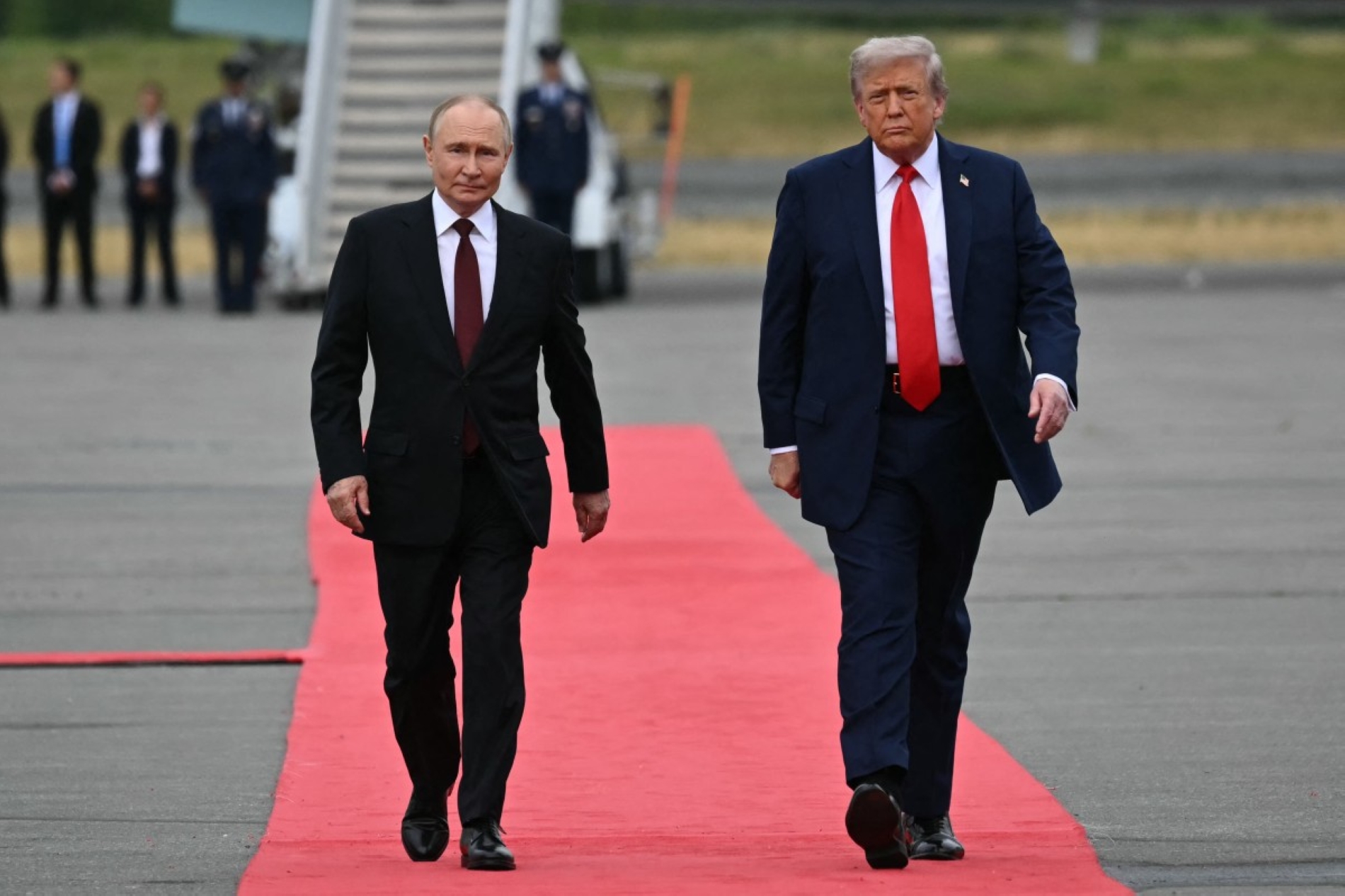
US President Donald Trump and Russian President Vladimir Putin on the tarmac of Joint Base Elmendorf-Richardson in Anchorage, Alaska, on 15 August 2025.
On 22 September 2025, President Putin offered to extend New START's warhead and launcher limits for one year, conditional on reciprocal US restraint, calling for a shared commitment to preserve strategic balance. Trump initially said it "seems like a good idea," but no formal endorsement followed. Russian Foreign Minister Sergei Lavrov restated the extension offer on 11 November, saying it could ease tensions and allow for a reassessment beyond a "purely Ukrainian lens".
Lavrov stressed that the proposal rested on strict adherence to the treaty's numerical ceilings by both sides, but Washington continued to reject the idea, instead reinforcing its own strategic capabilities while expressing interest in "a better agreement". Speaking to The New York Times on 8 January 2026, Trump said of New START: "If it ends, it ends… we will simply work on a better deal."
On 2 February, Senior Russian security official Dmitry Medvedev sounded the alarm. "I don't want to say that this (letting the treaty expire) immediately means a catastrophe and a nuclear war will begin, but it should still alarm everyone," Medvedev told Reuters, TASS and Russian war blogger WarGonzo in an interview.
"The clocks are ticking, and they obviously have to speed up," he said, referring to the symbolic "Doomsday Clock" gauging the likelihood of a man-made catastrophe destroying the world.
Era of transparency
The New START treaty caps each state's deployed strategic nuclear warheads at 1,550. The idea of limiting the number and types of nuclear weapons deployed on strategic delivery systems is far from new. In 1972, the US and the Soviet Union concluded their first accord, and over the decades that followed both made major reductions in their stockpiles which, in the 1970s, exceeded 70,000 warheads.
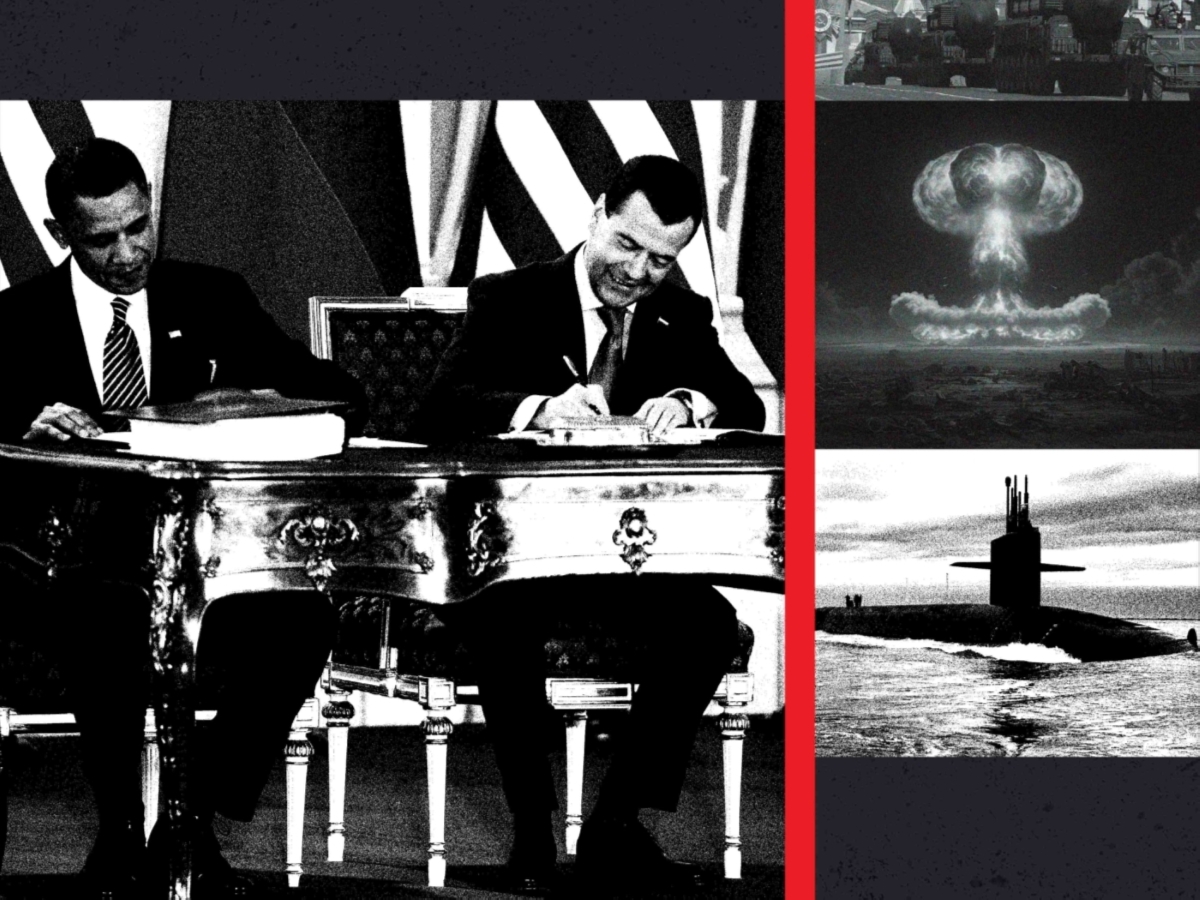
New START is the eighth such agreement. Dmitry Medvedev—who was Russia's president at the time— and US President Barack Obama signed the Treaty on Measures for the Further Reduction and Limitation of Strategic Offensive Arms in April 2010, and it entered into force on 5 February 2011 for a ten-year term, with the option of a single five-year extension.
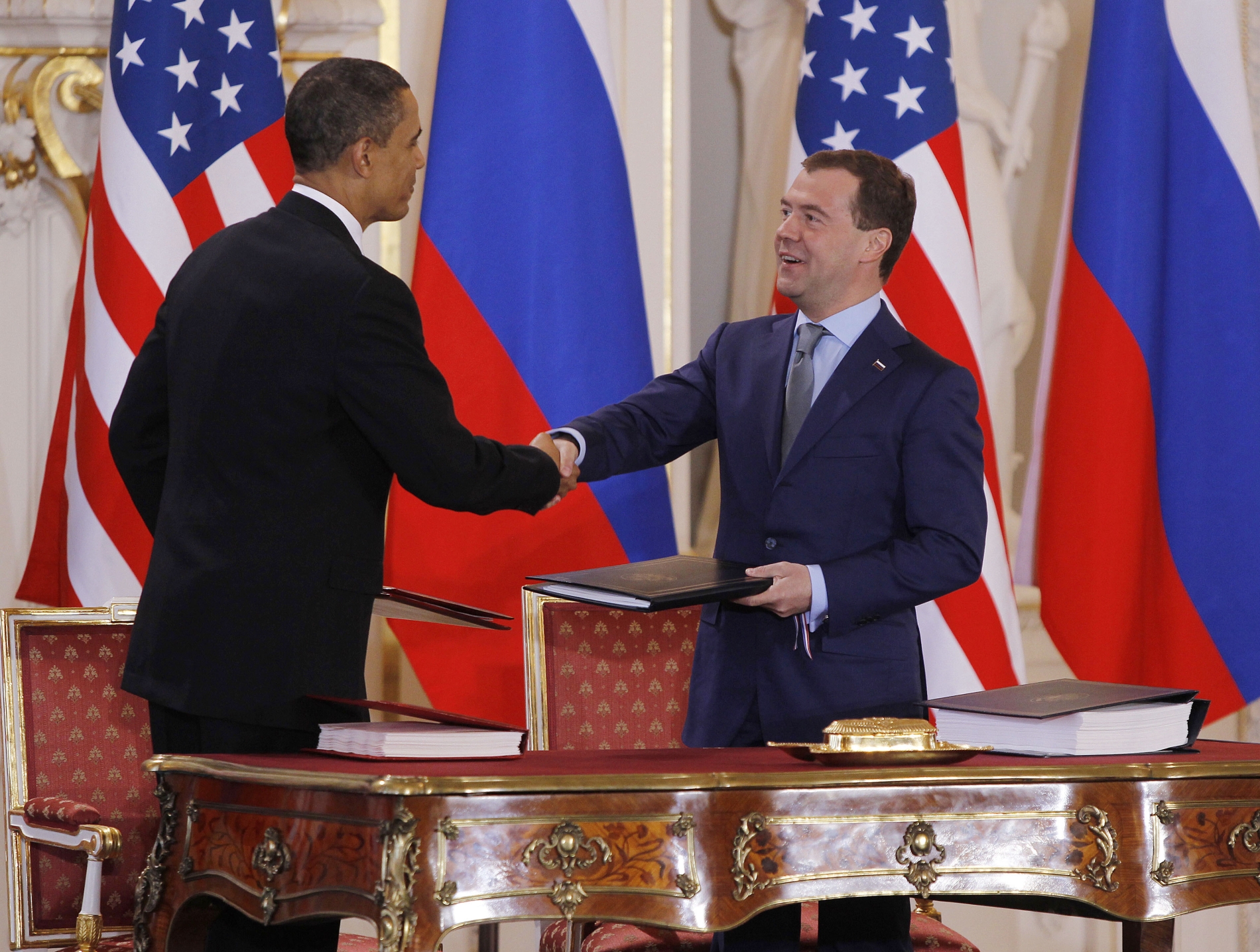
US President Barack Obama and Russian President Dmitry Medvedev shake hands after signing the new Strategic Arms Reduction Treaty (START II) at Prague Castle, Prague, on 8 April 2010.
Under it, both sides committed to limiting their strategic offensive forces to no more than 700 deployed intercontinental ballistic missiles, submarine-launched ballistic missiles and heavy bombers; 1,550 warheads deployed on those systems; and 800 launchers for those delivery systems, whether deployed or not. New START also introduced key definitions, including 'non-deployed' launchers and launchers not in combat readiness—typically used for training or testing and carrying no warheads.
Each party retained the right to determine the composition and structure of its strategic offensive forces, provided they remained within the treaty's limits, but the agreement prohibited the deployment of nuclear arms outside national territory, forbid the conversion of ballistic-missile launchers into missile-defence interceptors, and established robust verification and transparency mechanisms, including on-site inspections, regular data exchanges, notifications on the number and status of covered systems, and a Bilateral Consultative Commission to oversee implementation.
In February 2023, Putin suspended Russia's participation, citing US military support for Ukraine and other issues. Moscow has not breached the treaty's core limits, according to the US State Department, but its past three compliance reports note that Russia's refusal to allow inspections means it has not been able to verify warhead numbers since 2023.
Involving China
The collapse of New START and the continued expansion of arsenals in both countries is expected to increase pressure on China and other nuclear-armed states to follow suit, to preserve credible retaliatory capabilities. Together, the US and Russia account for more than 87% of the global nuclear stockpile. Current estimates suggest that the US has more than 3,700 active warheads, including 3,500 strategic and 200 non-strategic, while Russia holds over 4,300.
Trump told The New York Times that any follow-up to New START should include China. "I feel strongly that if we are going to do this, China should be part of the agreement," he said, adding that he had raised the issue with President Xi and believed China would be willing to participate. Yet bringing China into a formal arms-control framework has become a point of contention.
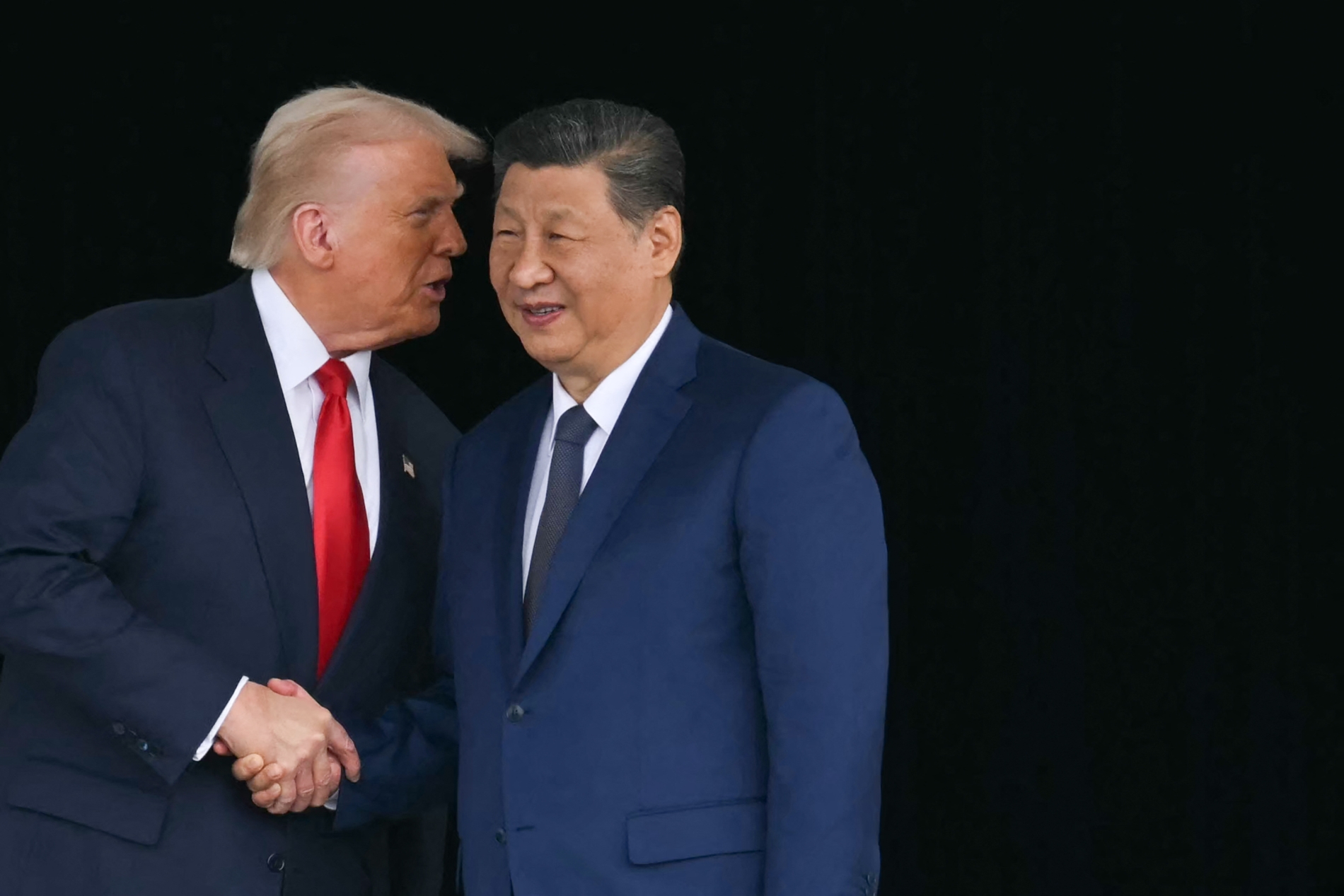
US President Donald Trump (L) and China's President Xi Jinping shake hands as they leave after their talks at the Gimhae Air Base, located next to the Gimhae International Airport in Busan on 30 October 2025.
All three appear to want different things. While Washington supports a trilateral arrangement that includes China, Beijing thinks any future talks should also address new strategic systems and non-strategic weapons, while Moscow has shown limited interest in involving China and continues to prioritise broader issues such as missile defences and long-range conventional strike capabilities.
China's arsenal is expanding rapidly but remains modest compared with those of the US and Russia. According to Pentagon assessments, China's stockpile of warheads surpassed 600 by mid-2024 and could reach 1,000 by 2030. These warheads are stored separately from their delivery systems, unlike the American and Russian set-ups, but China continues to develop new missiles and aircraft capable of delivering nuclear payloads, so this could change in the future.
The US administration seems to have concluded that extending New START's core limits for a year would be a hindrance in the face of China's expanding nuclear arsenal and Russia's evolving strategic capabilities. In its final report for 2023, the Pentagon's Strategic Posture Commission said the country must prepare to increase the number of warheads deployed on existing strategic launch platforms, referred to as 'uploading.'
Broadening the scope
Policymakers in Washington emphasise the need to account for Russia's new nuclear weapons systems, developed after the treaty's signing. These include the Kinzhal and Oreshnik missiles, the Poseidon submarine drone, and the Burevestnik cruise missile. They argue that any extension excluding these systems effectively lets Russia expand its nuclear force outside treaty constraints.
Critics of a one-year treaty extension say this also limits the US from increasing warhead numbers on existing platforms or expanding the capabilities of emerging ballistic missile submarines and strategic bombers. These measures, in their view, are vital for addressing China's growing military reach.
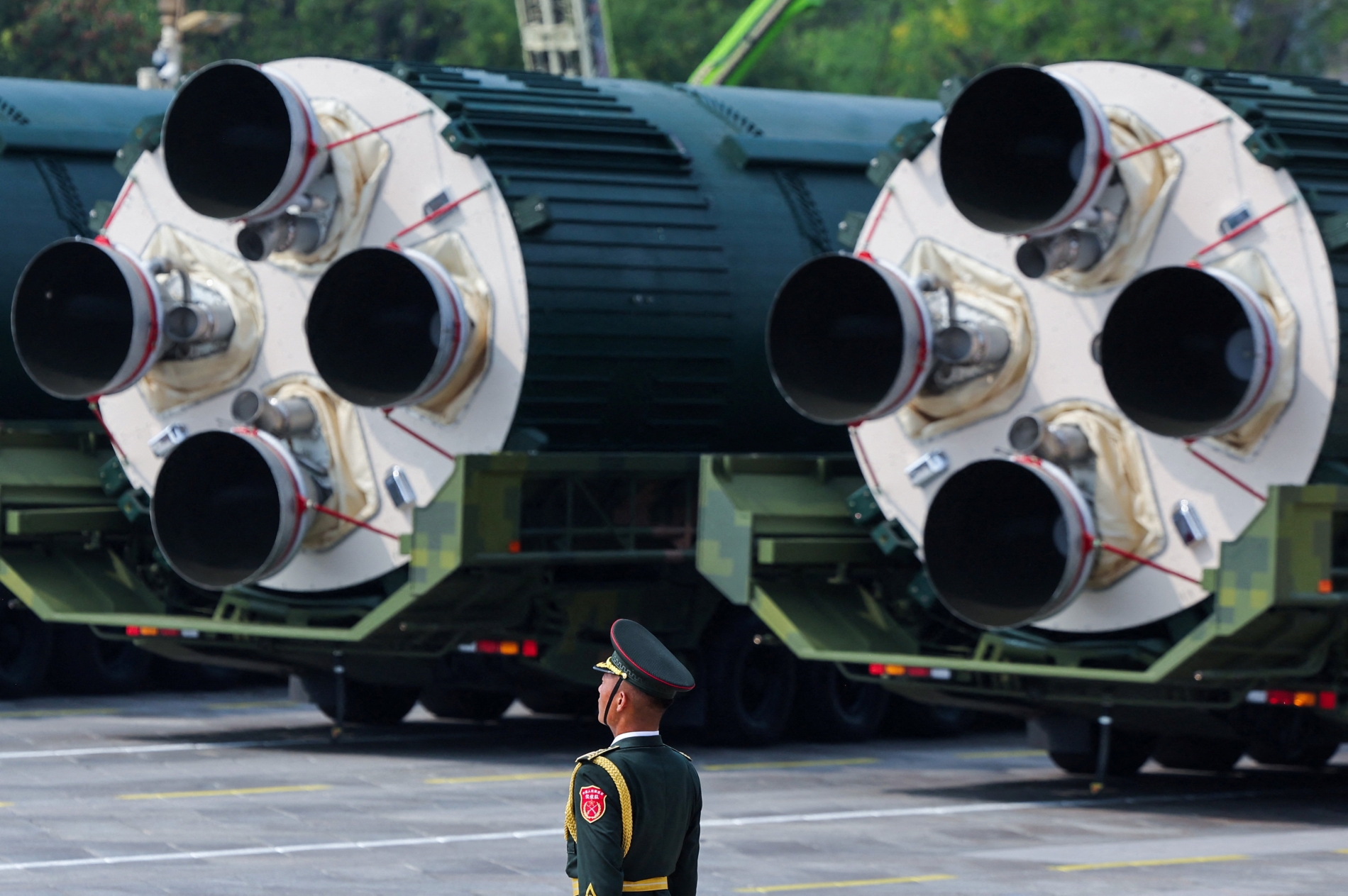
A member of the People's Liberation Army stands as the strategic strike group displays DF-5C nuclear missiles during a military parade to mark the 80th anniversary of the end of World War II, in Beijing, China, 3 September 2025.
It seems likely that the US will begin a structured expansion of its strategic nuclear posture following the treaty's expiration. Near-term steps would include reactivating launch tubes on Ohio-class submarines, reinforcing submarine-launched ballistic missile forces, readying additional warheads for operational deployment, and uploading Minuteman III intercontinental ballistic missiles.
In the medium term, it would include upgrades to America's iconic B-52 nuclear bombers while increasing production of next-generation air-launched cruise missiles. Yet, given the Pentagon's limited financial and technical capacity to modernise the nuclear arsenal in response to both Russian and Chinese developments, the US is expected to favour a framework that brings both powers into negotiations.
Despite Trump's previous remarks, a one-year extension remains possible, depending on whether it includes the full restoration of New START's verification regime from 6 February 2026, and whether Russia accepts oversight of its new systems, including their placement under the treaty's central limits, along with data declarations and access to on-site inspections.
In 1972, when Moscow and Washington first agreed to limit their nuclear arsenals, the last US combat troops left Vietnam, US President Richard Nixon went to China, and Apollo 17 landed on the Moon. A lot has happened since. After more than half a century of managing their nuclear stockpiles, is 2026 the year that the process unravels? Many will hope not.