Europe and South America seal a trade pact for the Trump era

The EU-Mercosur agreement is a big deal in the world of geoeconomics

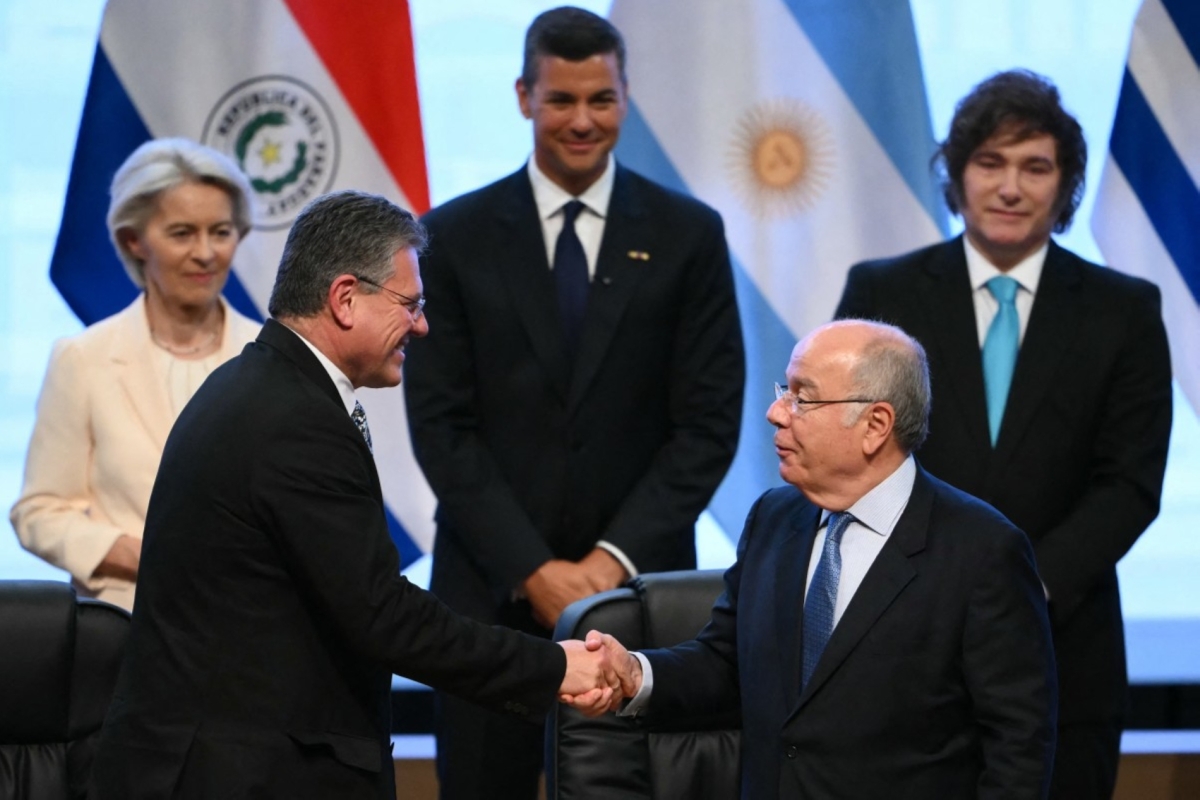
European Commissioner for Trade and Economic Security Maros Sefcovic (L) and Brazil's Foreign Minister Mauro Vieira shake hands after signing a EU-Mercosur trade agreement in Asuncion, Paraguay, on 17 January 2026.
LUIS ROBAYO / AFP
European Commissioner for Trade and Economic Security Maros Sefcovic (L) and Brazil's Foreign Minister Mauro Vieira shake hands after signing a EU-Mercosur trade agreement in Asuncion, Paraguay, on 17 January 2026.

Europe and South America seal a trade pact for the Trump era

The European Union and Mercosur, a bloc of South American countries, first started negotiating their trade deal last century. In 1999, Bill Clinton was in the White House, Boris Yeltsin was stumbling around the Kremlin, and China had yet to join the World Trade Organisation. The EU was proudly introducing its future currency, the euro. Globalisation offered tantalising prospects: a flatter world in which countries traded more and understood each other better. Onwards to the 21st century!

That the two blocs signed that deal this month, after more than 25 years of negotiations, highlights how things have changed. America is retreating from globalisation, raising tariffs, and threatening to seize Greenland from Denmark, a NATO ally, after sending troops into Venezuela to kidnap its leader. Chinese competition threatens businesses in both Latin America and Europe, and countries are increasingly obsessed with guaranteeing secure supplies of critical raw materials, of which Latin America has plenty.

Anticipating such challenges, the EU and Mercosur completed their negotiations shortly after Donald Trump won America’s presidential election in 2024, though agreeing to approve the deal took Europe another year. On 17 January, the two sides formally signed at a ceremony in Paraguay.

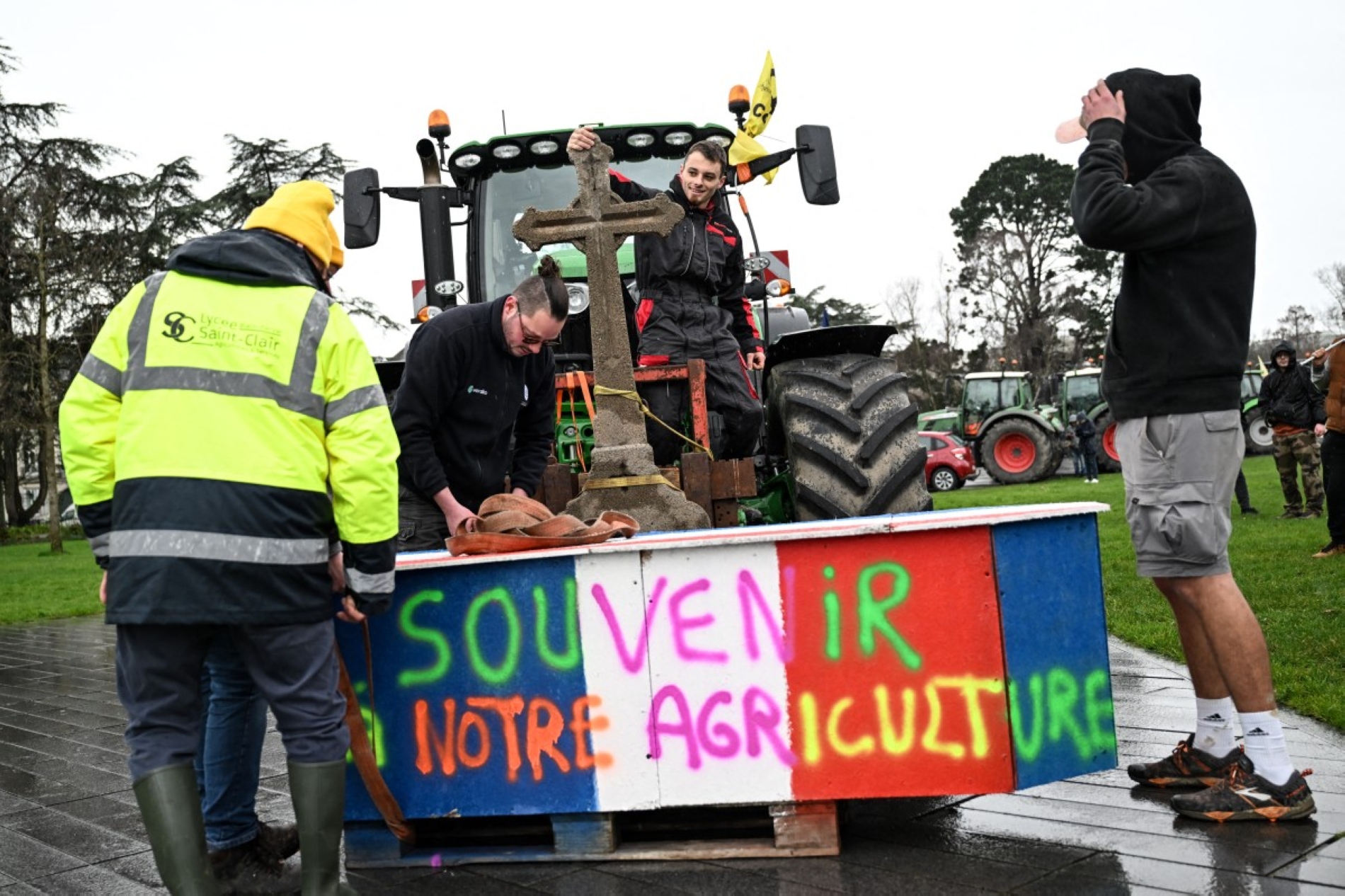
The quarter-century negotiating delay is the fault of protectionist lobbies on both sides of the Atlantic, especially European farmers, who fear a flood of cheap beef and sugar. Some dubbed the deal “cows for cars”, suggesting the winners would be Latin American farmers and European industry. Predictably, France led the griping: it stood firm to the very end on 9 January, when it was joined by Poland and a few smaller EU states in opposing the deal in an internal EU vote-count.
SEBASTIEN SALOM-GOMIS / AFP
Protestors move a fake coffin adorned with graffiti which translates as 'in the memory of our agriculture' during a protest against the free trade agreement between the EU and the Mercosur countries, in France on 21 January 2026.

Germany and other northern European export powerhouses were far keener, as was Spain, with its close ties to Latin America. The pact won the support of a “qualified” majority of EU countries, as weighted by population, after a raise in subsidies for farmers helped induce Italy to switch sides. It opens up markets in four longstanding Mercosur members: Brazil, Argentina, Paraguay and Uruguay. Venezuela has been suspended from the bloc and is thus not included. Bolivia, the newest member, could join the trade agreement in the coming years.
By 2040, removing tariffs on around 90% of goods on both sides will boost the EU's exports by €49bn and Mercosur's by €9bn

Economically, agriculture is a tiny part of the deal. The €240mn-worth ($279mn) of wine that EU producers export to the Mercosur states makes up a minuscule 0.0013% of the EU's GDP. And Europeans will continue to pay high prices for Argentinian steaks: a tariff cut from 40-45% to 7.5% will apply to only 99,000 tonnes of beef. That is only about half the amount they currently import from there and the equivalent of 1.5% of beef production in the EU, a net beef exporter itself. Similar limits apply to other goods.

In a time-honoured tradition, the agricultural lobby was bought off with €45bn in subsidies it can pull forward from the next EU budget. Safeguards were added to make sure Mercosur-sourced foodstuffs abide by standards similar to European ones, and do not move the prices of certain sensitive agricultural products too much.

Pablo PORCIUNCULA / AFP
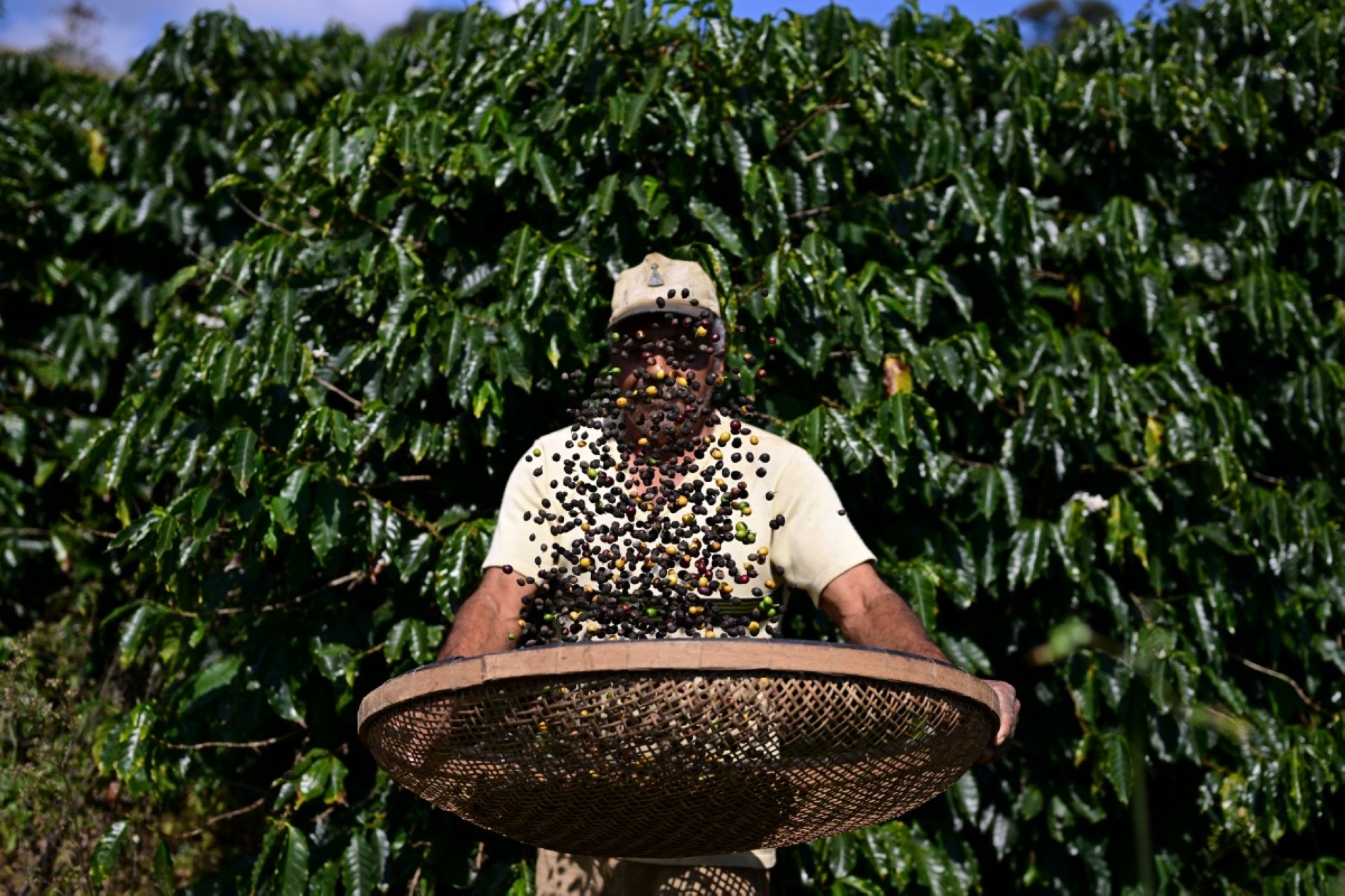
A man harvests coffee at the end of the annual crop season at Lira farm in Santa Clara, Porciúncula district, Rio de Janeiro state, Brazil, on 21 July 2025.

The real economic rationale lies in industrial and services trade. The pact creates a free-trade bloc of more than 700 million people. By 2040, removing tariffs on around 90% of goods on both sides and simplifying trade in services will boost the EU's exports by €49bn ($56bn) and Mercosur's by €9bn, the Europeans estimate. Such numbers are still low in terms of the overall economy: the EU's current annual exports to Mercosur, mostly machinery, chemicals and cars, amount to €57bn, just 0.47% of its GDP.

By contrast, EU goods exports to the Indo-Pacific region are worth about €400bn. But new opportunities matter for Europe's industries, which are struggling with American protectionism and Chinese competition. They help Europe's industries maintain scale as they lose market share elsewhere. "Brussels is prioritising tariff reductions in high-tariff areas right now, such as Mercosur and India," says Iana Dreyer of Borderlex, a specialised trade publication.

The deal is a major event in what has come to be called "geoeconomics", or the interaction between geopolitics and the economy. It is the biggest element of a wider attempt to strengthen ties with Latin America and diversify European trade and supply chains.

KENZO TRIBOUILLARD / AFP
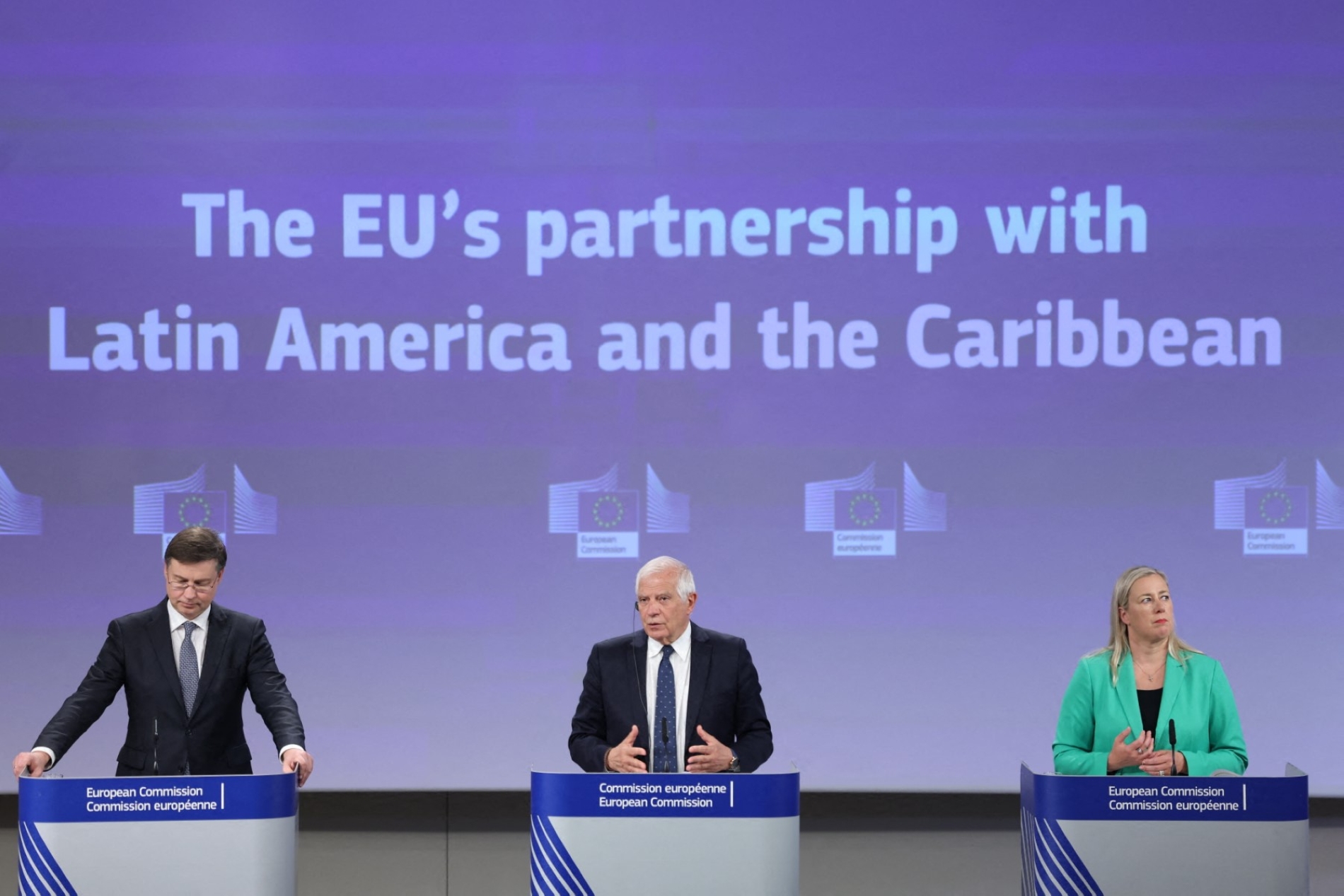
Officials give a press conference on the EU's partnership with Latin America and the Caribbean at the EU headquarters in Brussels on 7 June 2023.

As for countries that do not belong to Mercosur, the EU already has agreements with Peru, Colombia, Ecuador and Chile. It has finished negotiating an update to its deal with Mexico, which now awaits approval. Such ties help develop Latin American industries that the EU can count on if others cut it off, such as critical raw-material extraction and refinement.

Snubbing Mercosur at the behest of domestic farmers would have been an own goal for Europe. "Failing to sign the EU-Mercosur free-trade agreement risked pushing Latin American economies closer to Beijing's orbit," says Agathe Demarais of the European Council on Foreign Relations, a think-tank.

The EU and Latin America are pursuing "post-American transatlanticism", as Alexander Clarkson of King's College London calls it. The flat world of 1999 has given way to regional power politics. The EU is starting to play that game in its own way. 

font change