The history of Damascus pulses through Marjeh Square

If anywhere encapsulates the Syrian capital in recent decades, it is this enigmatic and iconic public space, which has seen more than its fair share of changes

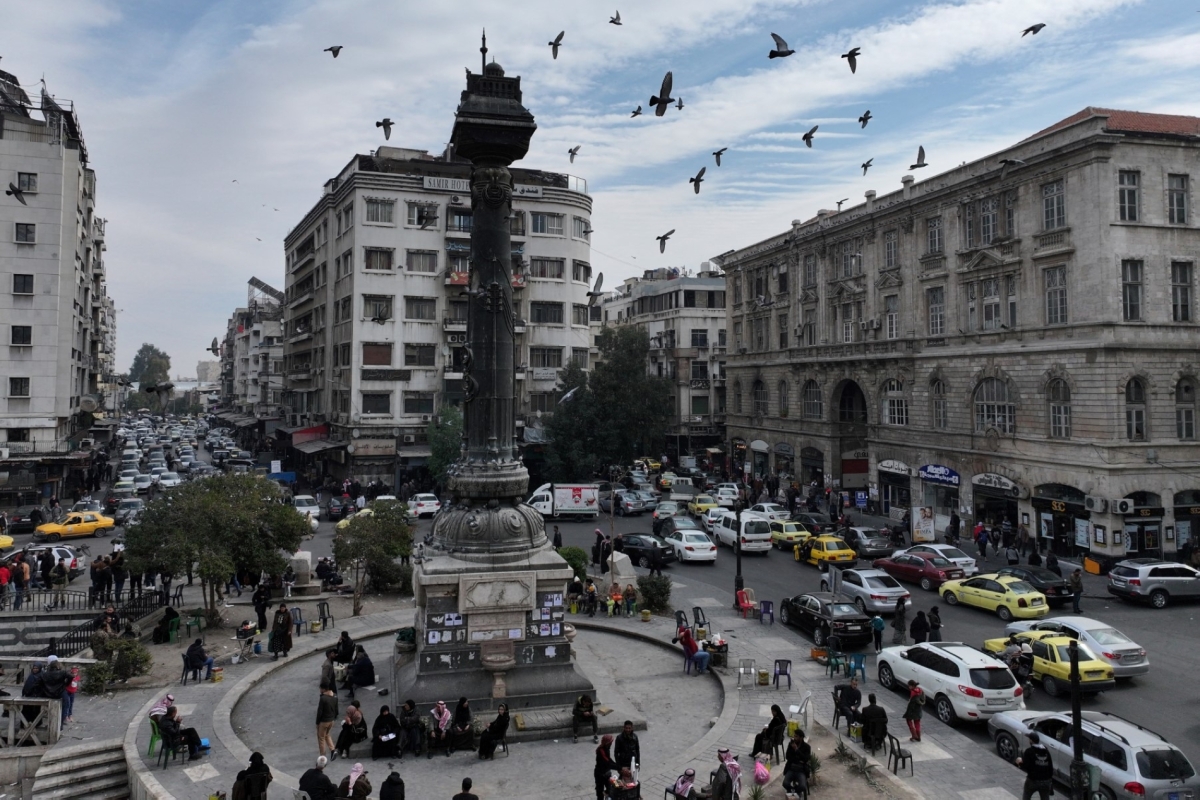
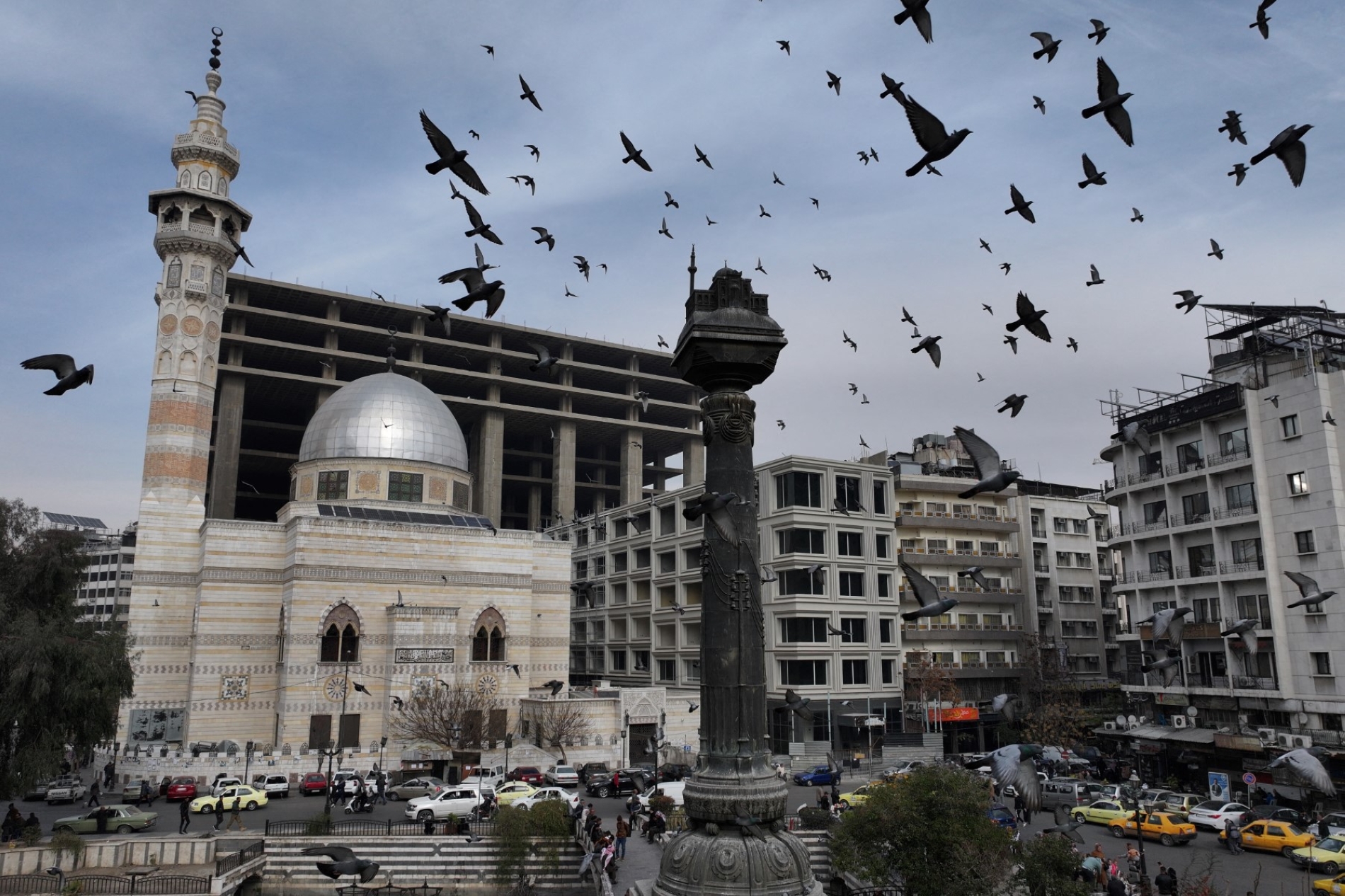
An aerial view shows pigeons flying over the Marjeh square in Syria's capital Damascus on 12 December 2024.
OMAR HAJ KADOUR / AFP
An aerial view shows pigeons flying over the Marjeh square in Syria's capital Damascus on 12 December 2024.

The history of Damascus pulses through Marjeh Square

To discover Damascus’s popular public sphere and examine its layers at close range, visit Marjeh Square. Here, no metaphors or figurative language are needed to describe the aesthetics. The organs and arteries of daily life are laid bare, letting visitors peer into the city’s anatomy.

Crowds press into the square and its offshoots, surging up and down from Al Hamidiyah Souq and Al Nasr Street to Souq al Haramiya and the civil registry building. Strangers, patients, soldiers on leave, brokers, and pimps fill the hotels, cafés, pavements, and grilling carts. In the Ottoman era, this square was the first centre of the capital outside the old city’s walls. Today, its importance lies in its historic weight. It has witnessed so many pivotal moments that it has become a living archive of the city’s shifts.

Long lines form in front of the civil registry building as people seek a personal record extract or statement to confirm the fate of thousands of the disappeared, clinging to the hope that their loved one may still be alive. Meanwhile, travel ban lists carry the names of millions for such ‘crimes’ as taking part in anti-Assad demonstrations, delivering medicine or food aid to besieged cities, resigning from a public job without official permission, to charges of terrorism, trading in dollars, and other accusations.

These arbitrary charges, as a former victim explains, were a form of extortion by officers and members of the security branches, who sought payment in dollars or gold coins. Crossing the edge of the square towards Al Thawra Street are other crowds in front of the land registry and the tabo office, seeking to correct ownership documents forged in the chaos of war, in the absence of their real owners. Today, there is a real fear of being the victim of fraud, pickpocketing, or a staged quarrel.

Cafés, clinics, and columns

In the cafés around the square are currency traders and brokers selling forged visas to the Gulf or Europe, patients huddled outside the surgeries of doctors, and sex workers and those seeking their pleasure. It can seem as if Damascus is condensed into this circle comprising clinics, law offices, official paperwork fixers, translators, and antiques shops. In the markets and stalls, visitors can buy Damascene sweets, fish, fruit and veg, wicker baskets, birds, perfumes, smuggled alcohol, music, bags, and counterfeit shoes.

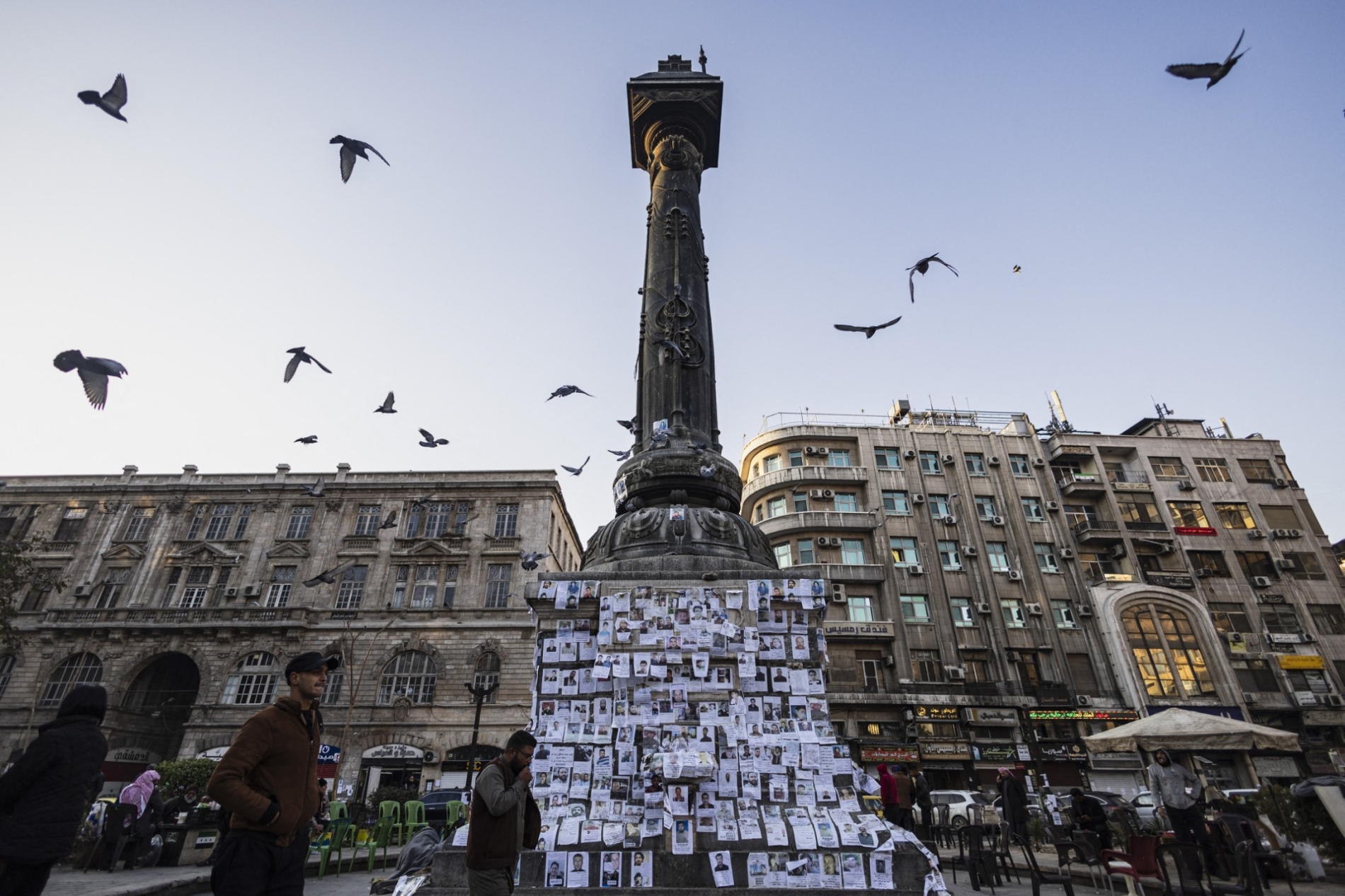
From Ali Pasha Café (open day and night), the memorial column stands at the centre of the square. Inaugurated by the Ottoman governor Husayn Nazim Pasha in 1907 to mark the start of telegraph communications between Damascus and Medina, it was designed by Italian architect Raimondo D’Aronco and consists of a basalt base and bronze column topped by a small replica of the Yildiz Mosque in Istanbul.
Sameer Al-DOUMY / AFP
Posters of missing people hang on a monument in the centre of Marjeh Square in Damascus on 26 December 2024.

Beneath it, gallows were erected to execute free nationalists on 6 May 1916 at the hands of Jamal Pasha al Saffah, aka ‘the Butcher’. The square subsequently became known as Martyrs’ Square. The French continued the trend, executing rebellious peasants and throwing their bodies into the middle of the square to spread terror. Years later, on 18 May 1965, Mossad spy Eli Cohen was hanged and displayed in the square.

This public space is associated with far more than death, however. It was from here that the first tram service set off between Damascus neighbourhoods in 1907 as the city’s first modern means of transport, before it was abolished in the early 1960s. Before the tram, Damascenes travelled in horse-drawn carriages or by hiring donkeys. Bicycles later spread. In 1913, it was here that Syrians saw their first car, which belonged to the Ottoman army inspector.

Life of the square

In time, transport offices proliferated in the square, carrying passengers between Damascus and the desert, Beirut, Amman, and Haifa. An advertisement published in a Damascene newspaper from that period reads: ‘Al Awn Billah Car Company. Huge cars of the latest model, with the fastest and largest travel saloons in the world, operating between Haifa, Beirut, Damascus, Baghdad.’
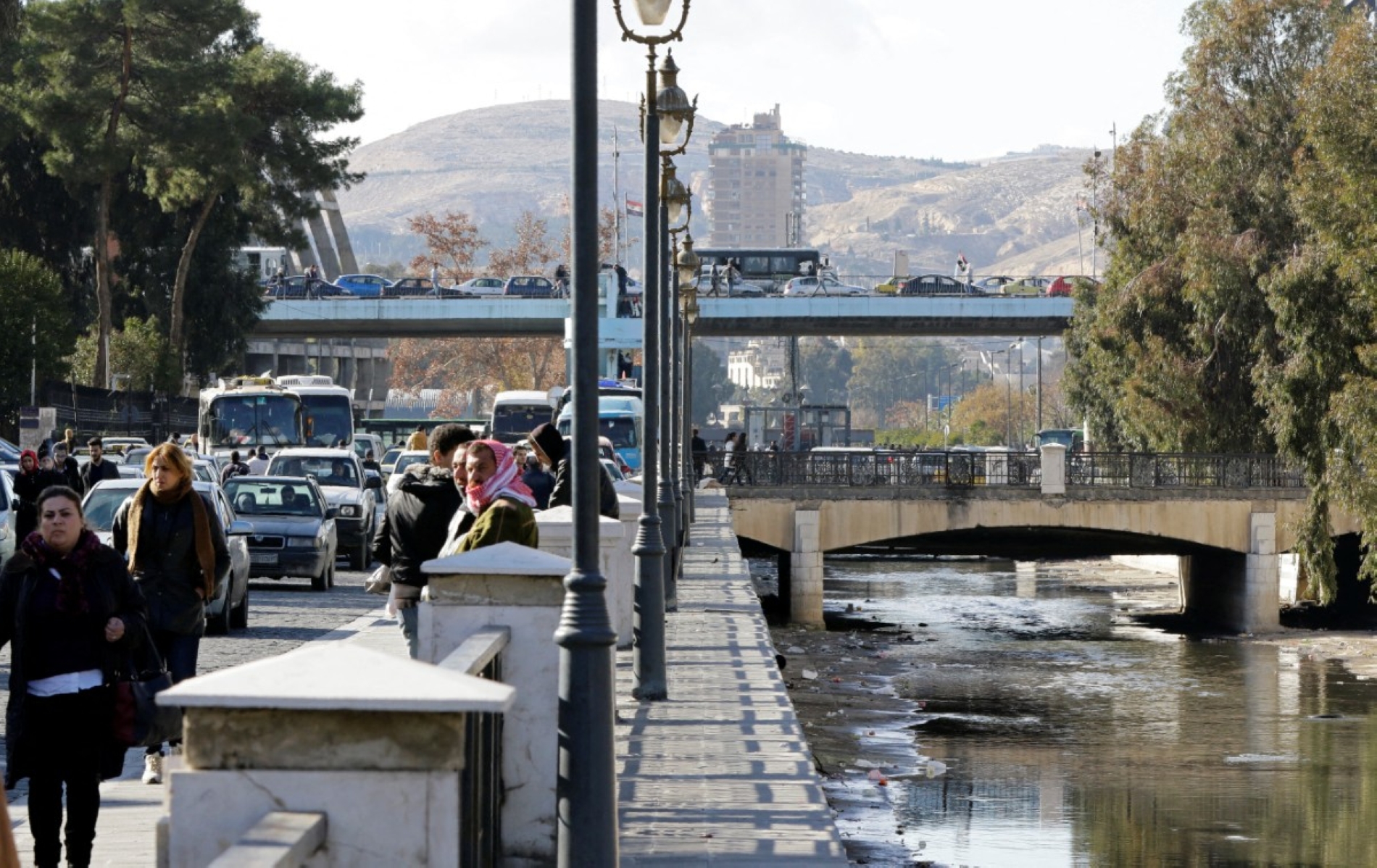
Photo by LOUAI BESHARA / AFP

The Barada River passes through Marjeh Square. Its water was once so abundant that it overflowed. Today, it has dried up. All that remains is a memory. In Ahmad Shawqi’s famous line: “A greeting from the breeze of Barada, more delicate, and tears that will not be wiped away, O Damascus.”

At the end of the 19th century, the Zahret Dimashq Café and Theatre was established at the square’s northern corner, owned by Habib al Shammas. In 1912, it hosted the first silent film screening, before becoming the Zahret Dimashq Cinema, where The White Rose by Mohammed Abdel Wahab was screened—an exceptional event in the city’s cultural life. The hall suffered a fire in the late 1920s, however, and the building was demolished. In its place, a hotel was built. It was the end of the era of the khans.
The Marjeh clock stopped long ago and no longer shows the correct time. It is as if time left this square for somewhere else more modern and alluring

The city's first hotel overlooked Marjeh Square, near the bank of the Barada River in the Jouzah al Hadba neighbourhood. Dimitri Hotel, named after its Greek owner, Dimitri Karah, is believed to have been built in 1850. An inn made up of two connected courtyards, it was furnished in an eastern style, with a central fountain basin and lemon trees. A night's lodging cost 50 piastres.

The best-known hotel of that period was the Damascus Palace Hotel, where Jamal Pasha stayed. Its promotional material described it as "the hotel of aristocratic families and respectable personalities" and "the oldest and the newest lodgings in the Levantine capital, furnished in a modern style with luxurious furniture".

At the far end of the square, towards Victoria Bridge, is the Omar Khayyam Hotel, designed by Lebanese engineer Farid Trad in 1927. Once called the Umayyah Hotel, it was described as "the finest modern hotel in this flourishing spot, on the banks of the eternal Barada River (with) beautiful views, electric lift, comfort, luxury, and ease provided at moderate prices".

Past influences

Little remains of the old Marjeh Square today beyond a handful of historic buildings such as the Serai and the Al-Abid Building. Most old markets around the square, like the straw market and horse market, have been demolished and replaced by concrete blocks and commercial towers. Most of the cinemas that once filled the square have also closed, including Cinema al Islah Khana, Cinema al Cosmograph, Cinema Ghazi, Cinema Central, Cinema Farouk and Cinema al Nasr.

OMAR HAJ KADOUR / AFP
An aerial view shows pigeons flying over the 13th-century Mamluk-period Yalbugha Mosque in Marjeh square in Syria's capital Damascus on 12 December 2024.

The Marjeh clock stopped long ago and no longer shows the correct time. It is as if time left this square for somewhere else more modern and alluring, following in the footsteps of Fernando de Aranda, the Spanish architect behind the most prominent buildings of modern Damascus, from the Hijaz Station to the Ayn al Fijah building and the old University of Damascus, and from the Government Serai to the Al Abid Building.

This building, which occupies part of the square, was designed in a European style as an early modern hotel, before being turned into Ottoman military barracks. It then became the headquarters of the first Syrian parliament in 1919. From its balcony, Prince Faisal I waved to the crowds who came to greet him. The following year, it served as the headquarters of French General Henri Gouraud, and later became a complex of law offices, medical clinics and commercial centres.

Damascus today bears little resemblance to its old, radiant image. After successive calamities, after centuries of invasions and coups, heavy marks have been left on its architecture. Its cramped, adjoining houses now resemble barracks. It is ironic, since Apollodorus of Damascus was the greatest architect of the ancient world, the poet of eastern architecture, who left Damascus at the end of the first century AD for Rome, carrying the spirit of local architecture to the capital of the empire, where his extraordinary genius still bears witness today.

Contrasting scenes

It is a place of memory. From this square, the Damascene Hajj caravan departed for the holy lands. In the Al Jabiri Building on Sanjakdar Street, Abd al Ghani al Atari published Al Dunya magazine, an illustrated weekly. On Al Nasr Street, broadcaster Yahya al Shihabi began Syrian radio broadcasting in 1947 by saying, "This is Damascus."

Photo by OMAR HAJ KADOUR / AFP
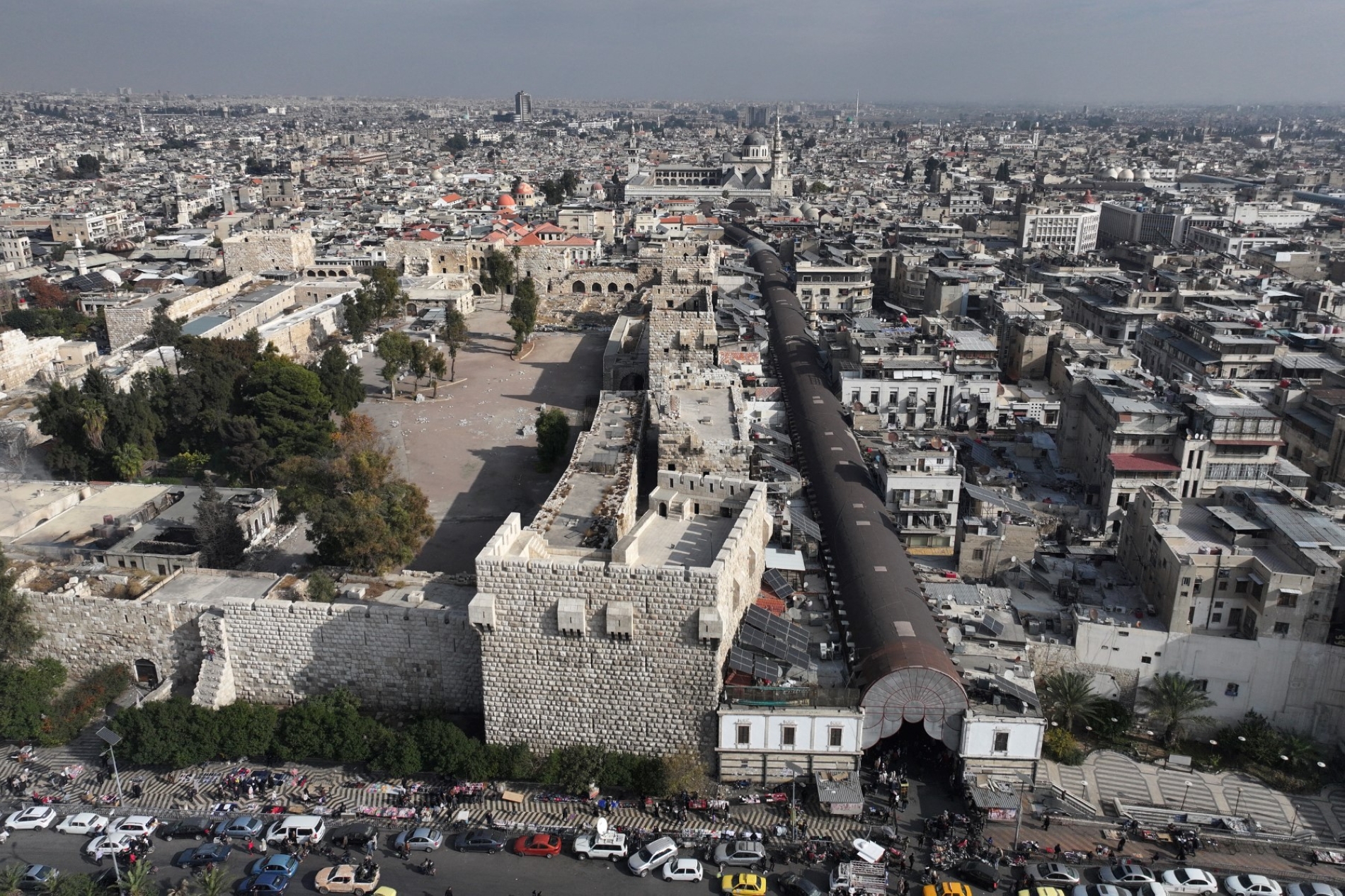
An aerial view shows the Damascus Citadel and the al-Hamidiya market in the old city of Syria's capital Damascus on 12 December 2024.

To the right of the square, the Citadel of Damascus is a model of medieval military fortifications. From the wall of this citadel, Ibn Khaldun once lowered a basket to meet Timur in his tent, which he had pitched near the dome of the Yalbougha Mosque in Marjeh Square. Ibn Khaldun negotiated with him to spare the city, but the Mongol commander did not keep his promise and violated it.

In more recent times, after the fall of the Assad regime on 8 December 2024, the square was filled with the sight of dabka dancing and bitter coffee served in celebration of victory. People from the Jazira, the Euphrates, and elsewhere who had been deprived of visiting Damascus for fear of arrest at security checkpoints streamed into the square as the place that best expressed their rural mood.

The base of the monument became a photographic archive of the missing and disappeared. On a recent visit, the author saw an elderly man in Bedouin dress sitting nearby after attaching a photo of his son, missing for years, hoping that someone would recognise him. Rolling cigarettes, he seemed to swallow the sorrows of absence. Meanwhile, in front of nearby Hijaz Square, protestors raised photos of the missing.

The photos act as an X-ray image of this famous old Damascus square, revealing new injuries on an ailing body. Yet it illustrates the deep cultural importance of this space, with all its visual ripples, including the surreal sight of dozens of lodgers on the roof of a budget hotel, avoiding the cost of a bed in one of its rooms. That image, like so many others, seems to capture this square in all its cacophonous fragility, showing above all else that it remains a space of use.

font change

Related Articles