
On 4 December 2025, the United States unveiled its National Security Strategy (NSS), a guiding framework covering foreign policy, economics, defence, national security, and international relations. Traditionally, the NSS has served as the compass of American power, with implications for the Pentagon, the Treasury, the State Department, and, increasingly, major US technology companies.
This is not the first NSS to underscore the importance of technology, but it is among the most consequential. In a sense, it redefines power, with technology joining conventional military force and diplomatic influence at the heart of the equation. In this way, the NSS reveals a growing conviction in Washington that the balance of power in the 21st century will be determined less by aircraft carriers or overseas bases than by algorithms, knowledge, and technological innovation.
The strategy presents technology as the “decisive weapon” shaping America’s position in the international order, both economically, militarily, financially, and geopolitically. It assumes that mastery of artificial intelligence (AI), semiconductors, advanced energy technologies, cyber infrastructure, and space is no longer just a matter of technical advantage but a first-order national security imperative.
According to this theory, those who dominate these domains will govern their development, regulate their use, shape the rules of the emerging world order, direct global growth, and influence the strategic choices of other states. Technology is therefore seen not as an isolated sector but as a structural force influential in economic management, geopolitical alliances, and military conflicts.
It is no longer a supporting instrument of power, but the foundation upon which strength is built, woven throughout the strategy’s core themes. This underscores the depth of America’s reliance on tech superiority, with US military deterrence now as closely tied to advances in AI, autonomous systems, and cyberspace as it is to traditional weaponry. No longer a subsidiary tool or complement to public policy, technology is now key to political decision-making itself.
There is recognition that the most serious threats confronting the state are no longer exclusively traditional or military but increasingly digital, including cyberattacks, information warfare, manipulation of public opinion through digital platforms, and assaults on critical infrastructure. These can all undermine a system’s cohesion and stability, creating a political threat.
Tech pushes sovereignty beyond borders
AI can be a productive technology, able to enhance efficiency, but it can also provide early warnings, advanced analysis, risk anticipation, and rapid crisis response, meaning that its deployment (whether defensively or offensively) is tied to sovereignty in the 21st century. Sovereignty today is no longer confined to defending territorial borders. It encompasses the protection of data and digital networks, whose control is essential to managing the public sphere and exercising authority.
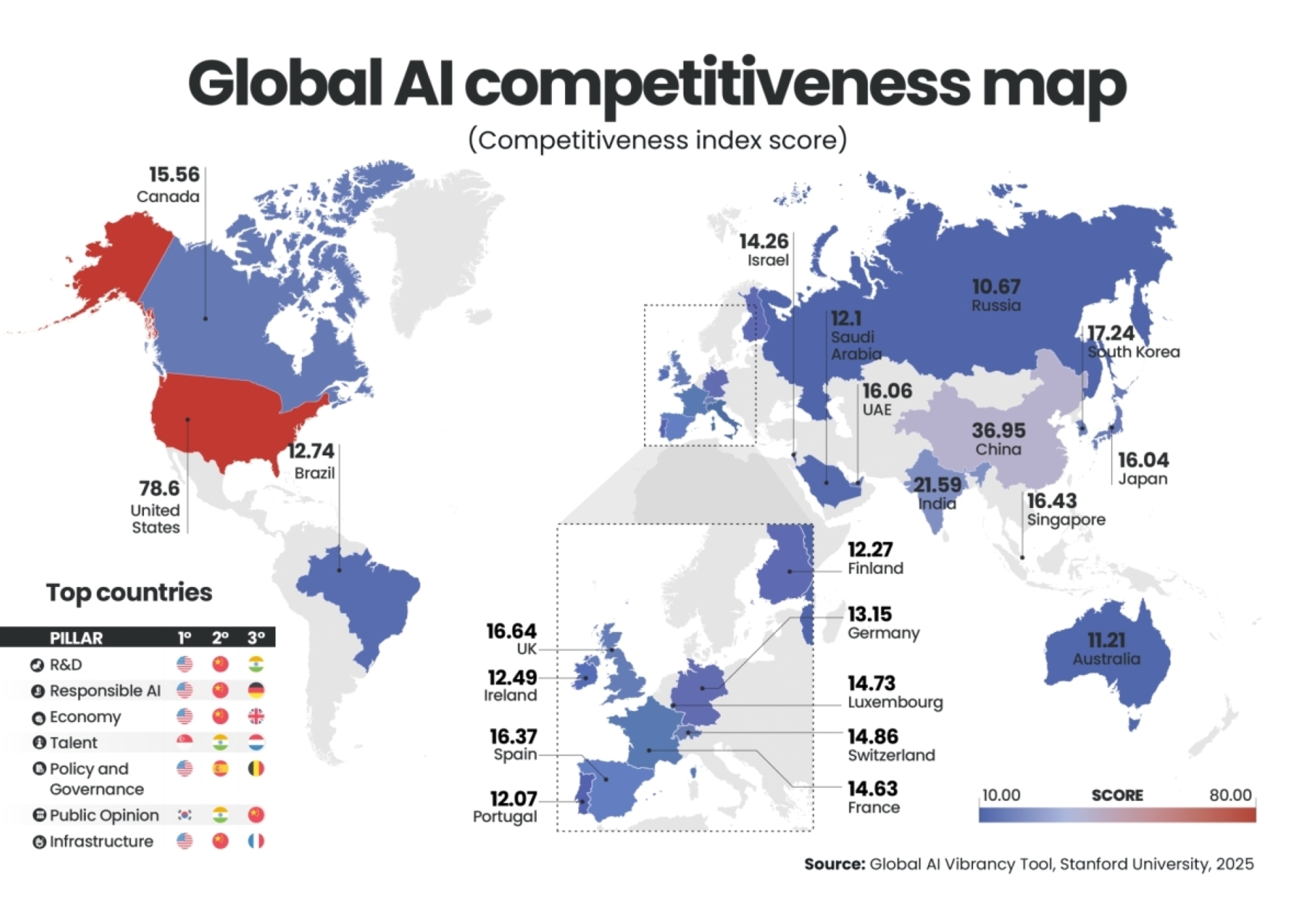
The White House aims to integrate AI across government and public institutions, with President Donald Trump recently launching the National Artificial Intelligence Plan to embed AI in both civilian and military sectors, explicitly linking it to national security and global competition.