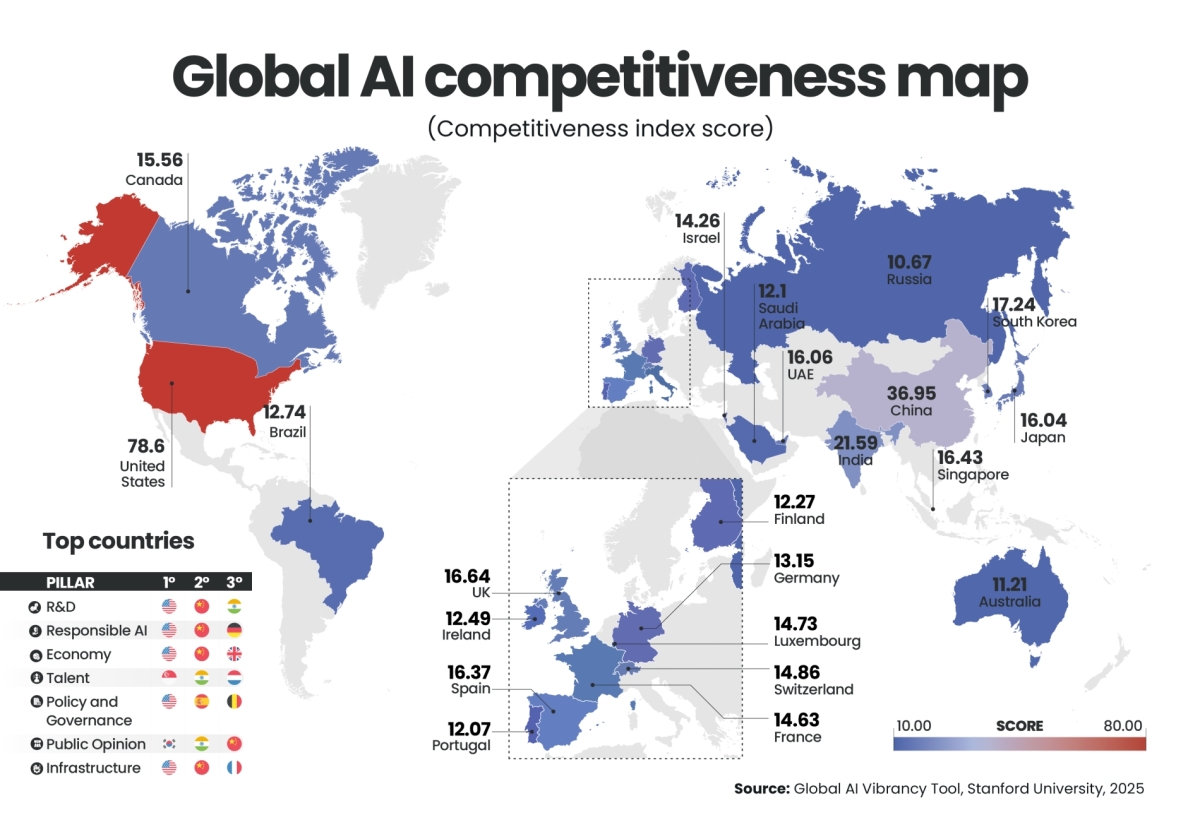

Stanford University’s Global AI Vibrancy Tool 2025 offers one of the most comprehensive assessments of artificial intelligence competitiveness worldwide. It measures the dynamism of national AI ecosystems by evaluating performance across key pillars, including research and development, talent, investment, infrastructure, governance, responsible AI, and public adoption. Rather than focusing on a single metric, it captures the full ecosystem that enables AI to move from laboratories into economies and societies.
High-income countries dominate the top ranks, reflecting deep investments in R&D, robust university systems and mature digital infrastructure. The United States retains a commanding lead followed by China and India. The latter is the only lower-middle-income country to break into the top 30, a sign of its expanding research base and large technical workforce. Brazil, China and Malaysia represent the upper-middle tier, each building out their AI capabilities with state-backed initiatives and growing private-sector activity.
High AI competitiveness goes far beyond technical excellence. It reflects a country’s ability to attract top talent, mobilize capital, shape regulatory frameworks, deploy AI at scale, and influence global norms around its use. Countries with the highest scores are not only innovating faster, but also setting the standards that others must follow.
This leadership increasingly translates into geopolitical and economic power. AI-leading countries dominate strategic sectors such as defense, energy, finance, logistics, and digital platforms, while controlling critical data flows and computing infrastructure.