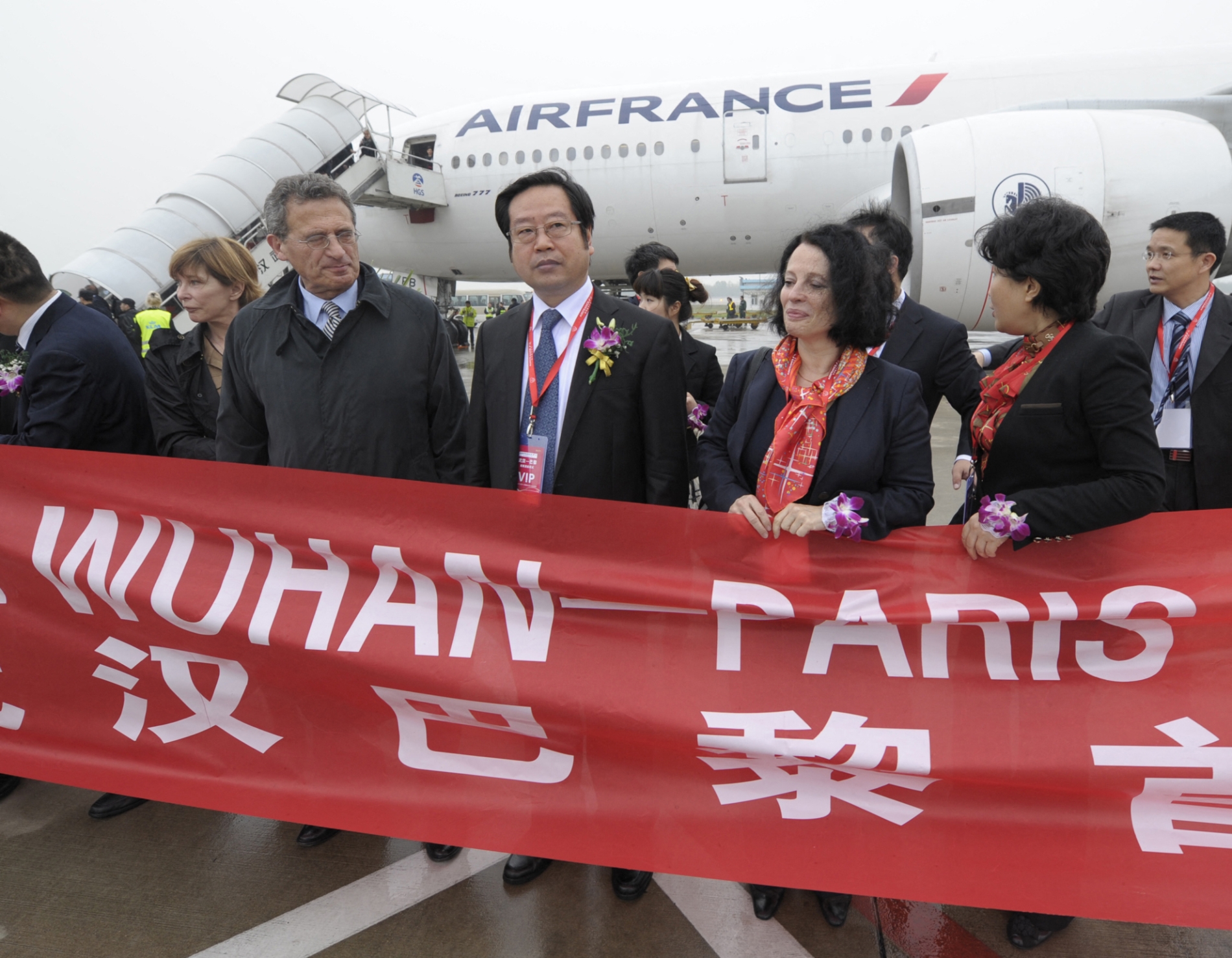

French diplomat Sylvie Bermann first encountered China as a young student at the twilight of the Cultural Revolution in 1976-77. Two decades later, she returned as her country’s ambassador to Beijing from 2011-14, before serving as the French envoy to London from 2014-17, and as ambassador to Moscow between 2017-19.
Trusted to manage France’s most important international relationships, Bermann came to know China across two starkly different eras, each marked by profound transformation. Her posting to Moscow coincided with mounting tensions between Russia and the West, alongside deepening ties between Moscow and Beijing. This placed her at the heart of the Russian-West confrontation and the evolving dynamics of the Sino-Russian relationship.
She distilled this wealth of experience in her latest book, titled The Bear and the Dragon: Russia–China, A History of Friendship Without Limits? It analyses relations between Beijing and Moscow, from pragmatic rapprochements to strategic confrontations, from 19th century border disputes to 20th century ideological schisms, culminating in today’s partnership forged in opposition to a shared adversary: the West.
Al Majalla recently met Ambassador Bermann, who now chairs the Board of the Higher Institute for National Defence Studies under France’s Ministry of Defence, to discuss the past, present, and future of Russia-China relations.
Do China and Russia consider each other allies or partners, given their historical relationship?
When I left China at the end of 2019, I met the director of Asian Affairs at the Russian Foreign Ministry—now Russia’s ambassador to Beijing—who told me that, thanks to Donald Trump, relations between the two countries had not been this good since the time of Catherine the Great in the 18th century. This remark highlights the fact that such friendship is far from self-evident.
Personally, I have seen a deeply troubled relationship between the two nations. Studying in China during the final years of the Cultural Revolution in 1976–77, I saw how tense things still were. The Chinese believed that the Russians—or rather, the Soviets—were preparing a nuclear strike against them. Relations were abysmal. Today, they are cordial because China and Russia share a common adversary: the US.
There is a diplomatic phrase: “The enemy of my enemy is my friend.” This is what has driven the rapprochement between them over the past 10-15 years. But this is not an alliance. China avoids formal alliances. It remembers the Sino-Soviet alliance, which ended in bloodshed along the Ussuri River after violent clashes. China now prefers flexible partnerships—circles of friends—rather than binding alliances.
The two countries share a common interest: the desire for a world not dominated by the United States or the West, in which rules are not imposed upon them from the outside. This explains their convergence. It did not begin with the war in Ukraine, but rather in 2014 during the Sochi Olympics, when Russia faced the threat of a boycott. Xi Jinping showed his support by attending openly and prominently.
What brings Beijing and Moscow together today?
This shared adversary and their determination not to submit to rules imposed by others, nor to tolerate interference in their internal affairs. They support the rise of what is now referred to as the ‘Global South.’ This was first seen with the creation of BRICS, which has since expanded to include new members, and the Shanghai Cooperation Organisation, which holds regular meetings. Notably, the UN Secretary-General attends these gatherings. Participants represent most of the world’s population.

China and Russia also aspire to a world in which the dominance of the dollar is diminished, since this allows the US to impose extraterritorial sanctions on many states. China has thus conducted an increasing share of its trade in yuan—not only with Russia, but also with other Global South countries, such as Brazil.
What are the potential points of discord between them?
The relationship is inherently unbalanced in favour of China yet both sides find clear benefit in it. China has replaced Western nations as the principal importer of Russian oil following the imposition of sanctions. It also supplies manufacturing equipment—fitted with microchips—that can, among other uses, support Russia’s military effort. Although China has never endorsed the annexation of Crimea or the invasion of Ukraine, I do not foresee any major disputes arising between them, as the border question was definitively resolved in 2004, with the return of the final island in 2008.
Russia feels encircled by NATO and the West, which was a factor behind the war in Ukraine, while China sees itself as hemmed in by American bases and alliances with Japan, India, and Australia, as well as the Quad and AUKUS groupings.
Between Xi Jinping and Vladimir Putin there is a genuine depth of understanding. At the popular level, however, the picture is different. The Chinese do not hold the Russians in high regard; the Russians, in turn, harbour little affection for the Chinese. Russians see themselves as European—contrary to what Putin now claims. They remain wary of Asians, including the Chinese, which is often shaped by longstanding prejudice. They also fear being exploited, given China’s far greater strength.