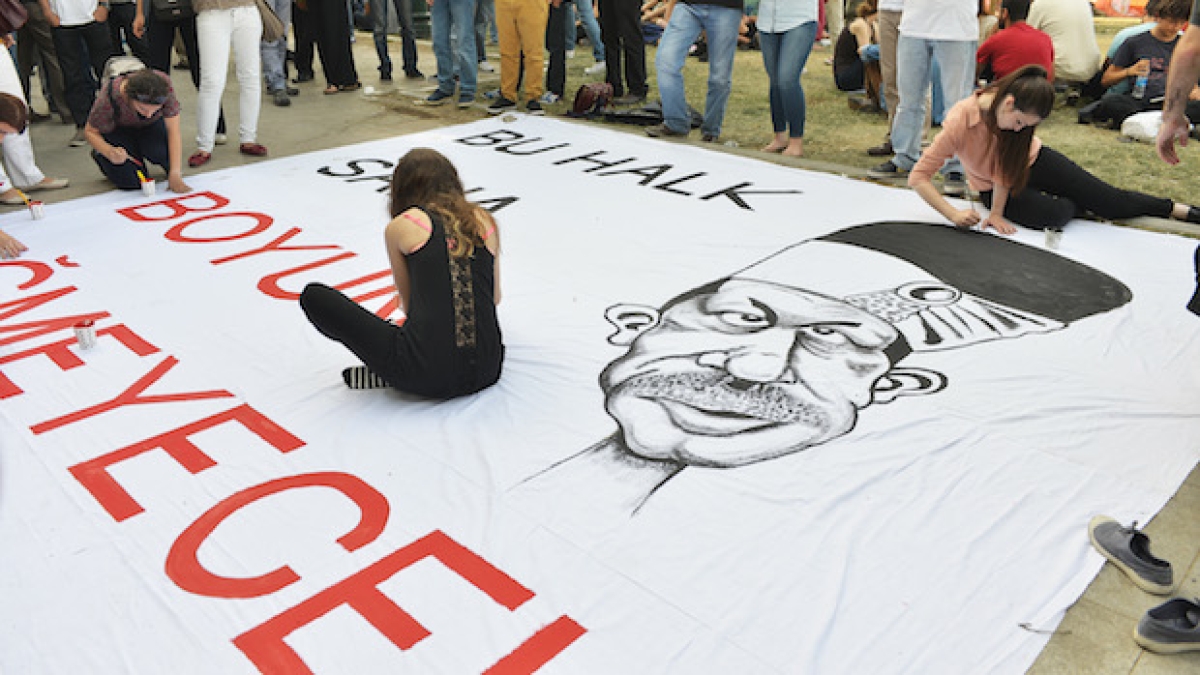

 Peaceful protesters staging a sit-in at Gezi Park on May 30, 2013, in Istanbul, Turkey. (Selin Alemdar/Getty Images)[/caption]
Prime Minister Recep Tayyip Erdoğan may still be the most popular leader in Turkey, but the bloom is off the rose when it comes to his image as the man changing Turkey. That brand helped Erdoğan come to power in 2002 and win successive elections with increasing majorities, but now it seems it is not enough to maintain his stream of success. His Justice and Development Party (AKP) did win the March 30 local elections, but his personal popularity is slipping: In the 2011 elections, the AKP received a total of 21 million votes; on March 30, 19.5 million voted for Erdoğan.
In 2002, Erdoğan rose to power because he was the agent of change. Uniting Islamists, conservatives, business groups and a small group of influential liberals under the banner of the AKP, his party swept the elections and took a majority of the parliament, with a mandate to transform Turkey. Although the party’s supporters had diverging visions for Turkey, they joined forces because they wanted to see the military—historically the kingmaker in Turkey—be divested from politics. The AKP and its allies were successful in reaching this goal. Using the Ergenekon trials, which alleged that members of the Turkish military were complicit in a coup plot, the AKP locked up much of the top brass and defanged Turkey’s powerful armed forces.
Over the following few years, though, Erdoğan’s pro-change coalition splintered. Its more liberal supporters broke away in 2013, joining the protesters in Gezi Park in criticizing Erdoğan’s social conservatism and meddling in freedoms. Many business groups threw their lot behind the demonstrators, too. More recently, the conservative Islamic movement led by prominent US-based cleric Fethullah Gülen dropped its support for the AKP. But the party remains popular even though its alliance has frayed and, although it has done well in the most recent elections, it no longer has a mandate for change—a mantle Turkey’s liberals now claim for themselves.
There are many reasons to be optimistic about the liberals’ potential for success. Economic growth has spread middle-class politics beyond Istanbul and other large cities. During the Gezi Park rallies, 2.5 million people took to the streets in all but one of Turkey’s 81 provinces to protest Erdoğan’s illiberalism. Since then, large anti-AKP protests have continued. The most notable of these recently came after the death of Berkin Elvan, a teenage boy who was hit in the head by a tear gas canister during the Gezi Park protests, when 2 million people rallied to protest Erdoğan’s policies.
Liberalism was once a marginal force in Turkish politics, but thanks in part to Erdoğan, it has become a mainstream political ideology. By implementing sound economic policies and attracting more than 50 billion US dollars in foreign capital annually, Erdoğan spurred Turkish economic growth and made the country middle class. Now Turkey is on the cusp of becoming history’s first universally literate Muslim-majority society. Ironically, these achievements created Erdoğan’s greatest and most vocal critics.
Turkey’s liberals are a growing constituency, and since the Gezi Park protests last summer they have been at the forefront of the challenge to Erdoğan and his style of governance. They are largely well educated and wealthy, and they also make up a majority of the country. While Erdoğan has transformed Turkey economically, it is this group that will change the country socially and politically.
Turkish liberals are persistent, politically diverse and fiercely committed to individual freedoms, and their opposition to Erdoğan and the AKP will endure despite the government’s efforts to silence them. For example, after Erdoğan’s recent decision to ban Twitter—an important platform for organizing protests in Turkey—more than 2.5 million tweets were posted from the country in the first three hours after the site was blocked.
But it would be premature to label the liberals in Turkey a “movement.” Indeed, they are a diverse group of people, ranging from nationalists of the Turkish and Kurdish persuasions to leftists and even pro-AKP voters. They are not united in any one party, and liberals can be found in every opposition movement.
The Republican People’s Party (CHP), traditionally the most important opposition party but also a bastion of state-centric policies, is increasingly championing sociopolitical freedoms, and many of its deputies are demonstrably liberal. One of its MPs, Şafak Pavey, for example, was awarded the 2012 International Women of Courage Award by the US Department of State for advocating on behalf of women and human rights. The Kurdish nationalist Peace and Democracy Party (BDP) also shows signs of liberalizing, and it has done more than any other party to embrace the diversity of Turkey’s population. BDP-run local governments provide public services not only in Kurdish and Turkish, but also in Armenian and Syriac, in a fitting bow to the country’s linguistic and religious minorities. Another example comes from a member of the Right-wing Nationalist Movement Party (MHP), Meral Akşener, who has used her position in the parliament as a bully pulpit to denounce Erdoğan. She is widely expected to be the first woman to seriously contest the Turkish presidency this summer against the AKP candidate. And there is even mutiny within the ranks of the AKP: having clearly terminated its support for the party, the Gülen movement and its Zaman newspaper are now leading the charge in challenging Erdoğan’s authoritarianism.
But even those who have remained loyal to Erdoğan’s party have been pushing back against his more authoritarian tendencies. Turkish president Abdullah Gül, a former AKP prime minister and a respected figure within the party, will remain as a check and balance. Although he has generally worked with Erdoğan, Gül has also often watered down legislation that would have enabled Erdoğan to consolidate power over the judiciary.
Other institutions, including the high courts, will also push back in favor of liberal democracy. Key among them is the Turkish constitutional court, which has already acted to take down Erdoğan’s Twitter ban. Turkey has a democratic constitution, and the court’s job is to protect it. What is more, as a signatory state to the European Convention on Human Rights, the Turkish courts recognize the European Court of Human Rights (ECHR), a bastion of liberal democracy, as the ultimate source of legal opinion on human rights issues and as a supra-national court of appeals. Regardless of who sits on the bench, the Turkish constitutional court, with the ECHR in the background, will likely push to safeguard liberal democracy in Turkey. As the constitutional court rises in stature so will its chief justice, Haşim Kılıç, who is also now mentioned as a potential candidate to run for presidency in August, challenging an anticipated bid by Erdoğan.
Despite their diversity, Turkey’s liberals have been united around the unwritten manifesto of the Gezi Park rallies in May and June last year. At that time, when the police moved in to crack down on a tiny group of environmentalists who were trying to save Istanbul’s downtown Gezi Park from being torn down to make way for a shopping mall, millions of Turks poured into the streets of Istanbul, and soon after all other Turkish cities, to defend the right of the Gezi Park protestors to demonstrate. The unwritten manifesto of the Turkish liberals, as coalesced during Gezi Park rallies, can therefore be seen as respect for the environment and urban space and more importantly, respect for the freedoms of expression, assembly, media and association.
Since 2002, Turkey has risen thanks to Erdoğan. But his illiberalism and preference for majoritarianism are preventing Turkey from taking the next step and becoming a high-income country. The country will continue to rise despite him, and it is Turkey’s liberals, the country’s new agents of change, who will lead the way.