
Nearly five decades after its establishment, UNIFIL is preparing to leave South Lebanon at the end of 2026, as Lebanon seeks a security arrangement for the next phase amid challenges over the international mandate, the role of the Lebanese army and the continuing confrontation with Israel
Since its establishment in 1978, the United Nations Interim Force in Lebanon (UNIFIL) has been a central part of the security landscape in South Lebanon. Created by the Security Council under Resolutions 425 and 426 following Israel's invasion, its initial mandate was to oversee the withdrawal of Israeli forces and help restore the Lebanese state's authority in the area. Its role evolved in response to developments in 1982 and Israel's withdrawal in 2000, before entering a new phase following the 2006 war.
Under Resolution 1701, adopted in August 2006 following the war between Hezbollah and Israel, the authorised strength of UNIFIL was increased from around 2,000 to 15,000 troops. Its mandate was also expanded to include monitoring the cessation of hostilities, accompanying and supporting the Lebanese army as it deployed south of the Litani River, and helping ensure that the area was free of weapons and armed personnel other than those belonging to the Lebanese state and UNIFIL.
Over the past two decades, the force has helped monitor the Blue Line along the Lebanese-Israeli border, established by the United Nations in 2000 to verify Israel's withdrawal from Lebanon. Its work has included documenting violations, facilitating communication between the two sides and helping reduce the risk of escalation. Yet it has fallen short of achieving the full security objectives of Resolution 1701.
Hezbollah continued to build up its military capabilities and develop its infrastructure and logistical networks in the south, including within UNIFIL's area of operations. Analysts attribute this in part to the force's limited powers and its lack of a mandate to enforce disarmament by force, as well as restrictions on its freedom of movement and access to suspected sites, and the need to coordinate with the Lebanese army. Both Israel and Hezbollah also continued to violate the resolution, according to UN reports.
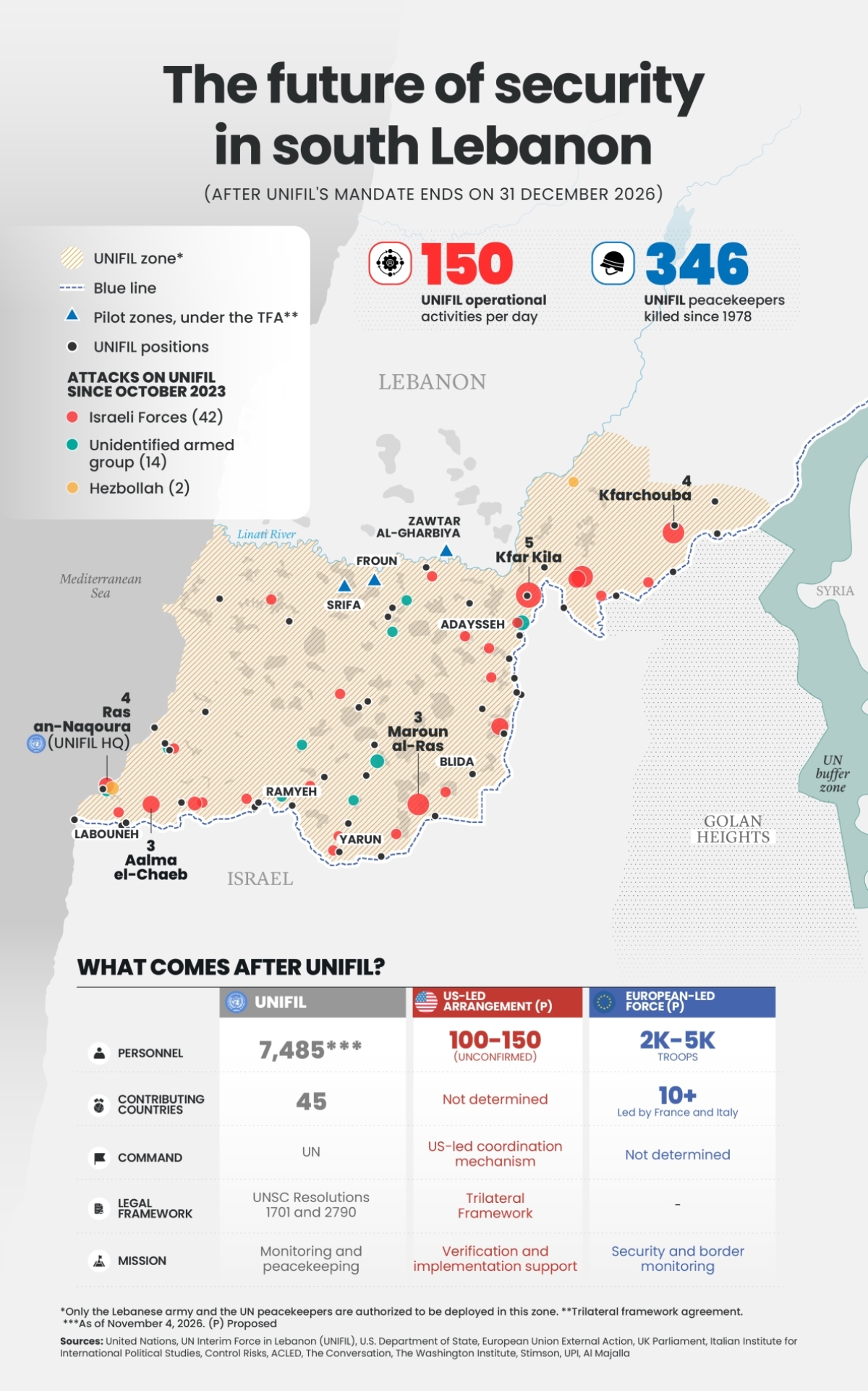
UNIFIL itself has not been spared attacks. In October 2024, Israeli tank fire struck its headquarters in Naqoura, injuring peacekeepers and damaging positions and surveillance cameras. During the escalation in 2026, seven UNIFIL personnel were killed and 32 wounded in incidents that the United Nations attributed in part to the Israeli military and in part to non-state armed groups, believed to be Hezbollah.
Financially, the mission's cumulative cost since its establishment has exceeded an estimated $13bn, according to UN figures. Its approved budget for 2026–27 stands at approximately $446.4mn.
UNIFIL's contribution has also extended beyond security. It has provided jobs for hundreds of Lebanese and, over the past four years, implemented 110 quick-impact projects across 115 towns and villages, benefiting around 1.5 million people. The projects covered water, healthcare, education, agriculture and essential services, according to UNIFIL data.
In August 2025, the Security Council adopted Resolution 2790, deciding to end UNIFIL's mandate on 31 December 2026. A gradual withdrawal of its personnel is to begin in 2027, with its positions handed over to the Lebanese army in coordination with the government.
With military operations and Israeli violations continuing in South Lebanon, efforts to place all weapons under state control have stalled, and progress on implementing the trilateral framework agreement between Lebanon, the United States and Israel remains limited; concerns are growing over a potential security vacuum once UNIFIL's mission ends. Several proposals are now being discussed for the next phase, chief among them:
A US-led arrangement: This would centre on a verification and coordination mechanism linked to the trilateral agreement between Lebanon, Israel, and the United States, signed on 26 June 2026, under US supervision and with international participation. Proposals include a small verification mission of around 100 personnel or an arrangement modelled more closely on the Multinational Force and Observers (MFO) in Sinai. Its role would be to verify compliance with commitments, monitor withdrawals and deployments, document violations and coordinate responses. Dismantling military infrastructure and confiscating weapons, however, would remain the responsibility of the Lebanese army, not the monitoring force. Such an arrangement would require intelligence, surveillance capabilities and a credible inspection mechanism, rather than a small contingent of observers alone.
A European multinational force: France and Italy are leading consultations on the formation of a force of between 2,000 and 5,000 troops, likely to deploy in areas currently covered by UNIFIL's operations. Its proposed tasks would include supporting the Lebanese army, monitoring the border and helping maintain security. Several European countries have expressed interest in participating. Ireland and Italy have confirmed their readiness to contribute, while the EU's foreign policy chief has said that 10 member states are prepared to provide troops or other resources. The force's mandate and final composition, however, have yet to be agreed upon, and would require an international legal framework.
Neither option, however, would by itself guarantee an end to attacks or the disarmament of Hezbollah. No matter how sophisticated its technology, monitoring cannot replace the state's authority on the ground. Nor can a force with limited numbers oversee thousands of locations and activities without cooperation from the Lebanese army and compliance from both sides.