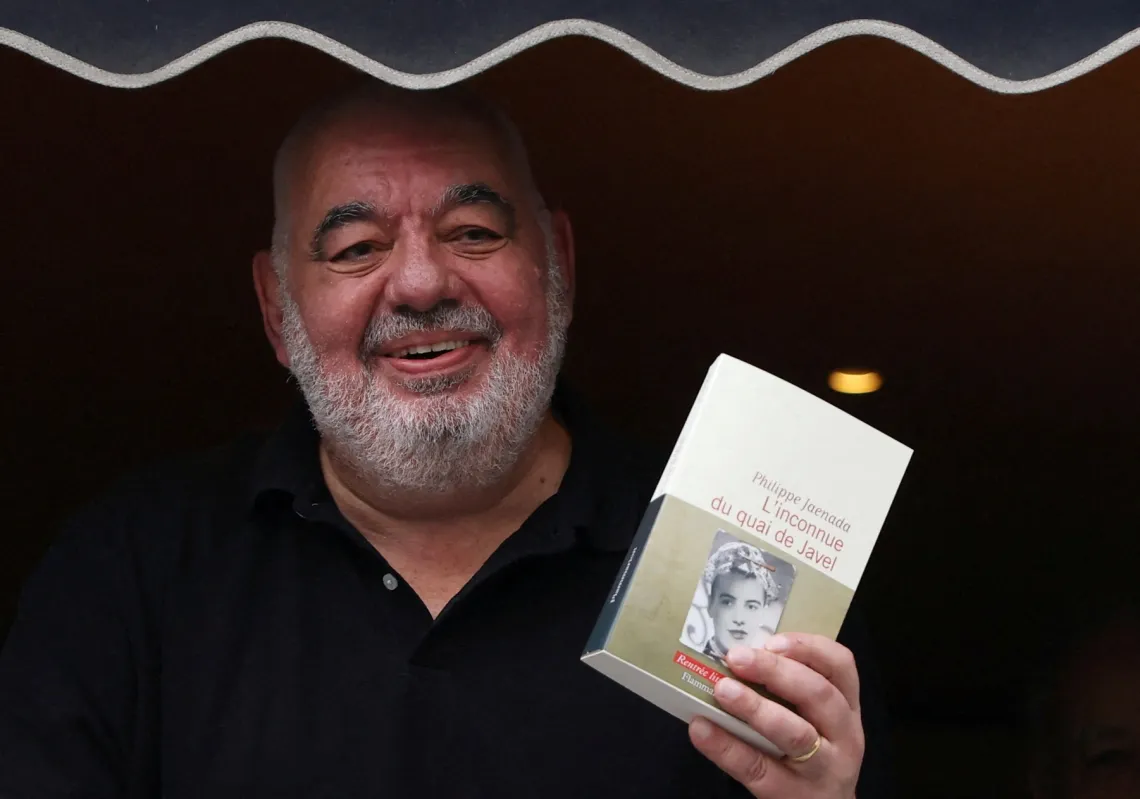

French novelist Philippe Jaenada’s recent victory in the 2026 Prix Goncourt crowned an exceptional literary season in which aesthetic considerations became entangled with difficult questions about the future of writing and the limits of human authorship in the age of artificial intelligence (AI). On this thorny issue, the venerable French publishing house Gallimard found itself at the centre of an unprecedented controversy after removing a novel from its list amid allegations of plagiarism and AI use.
The final shortlist for the prize raised further questions about the concentration of power in French publishing, with all four nominated works coming from imprints belonging to the same publishing group. Against this backdrop, Jaenada’s The Unknown Woman of Quai de Javel, published by Flammarion, emerges as a choice whose significance extends beyond its crime narrative.
Revisiting an unsolved murder committed in Paris in 1949, the novel explores the relationship between literature and memory, the power of writing to recover lives erased by time, and the distance between the truth preserved in documents and the truth that imagination can reconstruct. Ironically, Jaenada used AI for some of his research, placing the novel within the very debate that has defined this year’s prize.
The story opens on 6 September 1949, when the body of a young woman is discovered on the banks of the River Seine, at the Quai de Javel in Paris’s 15th arrondissement. The victim is identified as Louise Cansot, a Breton woman who left her birthplace at an early age for the capital, hoping to make a different life for herself. She entered Parisian artistic circles and became a familiar model to the painters of Montparnasse, before her life ended in murder under mysterious circumstances.
The investigation failed to establish who was responsible. Several suspects emerged, and witness accounts and evidence intersected, yet the case was closed without a conclusive finding. Cansot, once a familiar presence in the artistic and social world of Paris, faded to little more than a name in the archives of an unsolved crime. Jaenada begins with this gap in the record, seeking to recover the woman’s life before she became the subject of a criminal investigation.
He examines documents, follows the trail of testimonies, and revisits the places where she lived, travelling between Paris and Brittany and drawing on newspaper archives and historical records. His inquiry extends beyond the search for a possible killer; he wants to know who this woman was, how she lived, and why her disappearance became little more than a passing entry in the annals of crime. The novel thus moves from criminal investigation towards an exploration of memory.
The murder provides an entry into a life that remained obscure, even after its violent end. This endeavour acquires particular significance when viewed against the position of women in French society at the time. Migration from the provinces to the capital, work in artistic and entertainment circles, and precarious economic independence all reveal the vulnerability of women who sought a measure of freedom in a society whose conventions and structures afforded them little room for such aspirations.
Jaenada avoids turning Louise Cansot into an idealised victim or using her story to condemn the society in which she lived. He approaches her as a woman with desires, choices and relationships, whose life deserves to be understood on its own terms rather than through the circumstances of her death.
This distinction matters in true crime writing, where victims often become objects of curiosity while attention gravitates towards the perpetrator and the methods of the crime. Here, the direction of the inquiry is reversed: understanding the victim becomes essential to understanding the murder, and recovering her life takes precedence over the desire to close the case.
Pour son roman, «L'Inconnue du quai de Javel», Philippe Jaenada a remporté la 124e édition du prix Goncourt. Cette année a été marquée par l'éviction du favori, Thélyson Orélien, accusé d'avoir eu recours à l'intelligence artificielle pour l'écriture de son roman, «C'était ça ou... pic.twitter.com/9OWHLkxvUm
— Le Figaro (@Le_Figaro) November 3, 2026
Archives and imagination
With this novel, Jaenada continues a literary project shaped by his fascination with real criminal cases. He explored the life of the French robber Bruno Sulak in Sulak and the case of Pauline Dubuisson in La Petite Femelle, before winning the Prix Femina in 2017 for La Serpe, in which he reconstructed a triple murder committed in the Dordogne. He returned to this territory in Au Printemps des Monstres, published in 2021.
What unites these works is Jaenada’s treatment of factual material. Documents never yield the whole truth, testimony is inevitably selective, and memory seldom preserves events exactly as they occurred. The further an investigator delves into the past, the clearer it becomes that even seemingly established facts are surrounded by gaps and contradictions. The novelist’s task is to question both what the criminal record reveals and what it conceals.
In The Unknown Woman of Quai de Javel, this approach finds expression in Jaenada’s engagement with Inspector Maigret, the fictional detective created by Georges Simenon. In preparation for the novel, Jaenada reread all 75 of Maigret’s investigations, drawing inspiration from the detective’s attention to small details and his understanding of the people and social environments surrounding a crime.
One of Maigret’s guiding insights encapsulates this approach: to know the murderer, one must first know the victim. Yet this choice raises critical questions. How far can a novelist reconstruct the life of a real person from incomplete documents? Where does the researcher’s responsibility end and the writer’s freedom to imagine begin? Jaenada makes this tension part of the narrative.
He takes readers through the stages of his research, sharing his doubts and discoveries, while allowing his own voice to emerge through digressions, sardonic observations, and personal reflections. The result is a novel shaped by an open inquiry, driven by the desire to understand, and conscious of the limits of knowledge. This method lends the work a distinctive vitality, although it carries risks.
The author’s frequent interventions can occasionally overshadow the woman who ought to occupy the centre of the story, while lengthy digressions may slow the investigation and weaken its momentum. Nevertheless, the interplay between the researcher’s voice and the victim’s story is central to Jaenada’s literary identity. It reminds readers that a novel does more than reproduce the past; it establishes a new relationship with it.
Philippe Jaenada, Goncourt 2026 : « Ce sont de sacrés déconneurs les jurés »
https://t.co/ApTuJ1oLbO pic.twitter.com/DXcIQdsCcx
— Le Parisien (@le_Parisien) November 3, 2026
Literary recognition
The controversy over AI was hardly the only distinguishing feature of this year’s prize. Alongside Jaenada, the final shortlist included Yannick Haenel for The Solitude of Masters Is Infinite, Sylvain Prudhomme for On the Other Side of the Lake, and Clémentine Mélois for Things I Thought I Had Lost. Remarkably, all four novels were published by imprints belonging to Madrigall, the publishing group that encompasses Gallimard, Flammarion, and several others.
This concentration provides no evidence of interference in the jury’s deliberations and offers no grounds for questioning the literary merit of the shortlisted works. It does, however, reveal a structural imbalance that deserves scrutiny. How can literary prizes preserve the diversity of the literary landscape and the independence of their choices when economic power, distribution networks, and media influence are concentrated in the hands of very few publishing groups?