Lula's challenger won 47% of the vote in first-round polls. Will he win the run-off, too?
AP Photo/Eraldo Peres
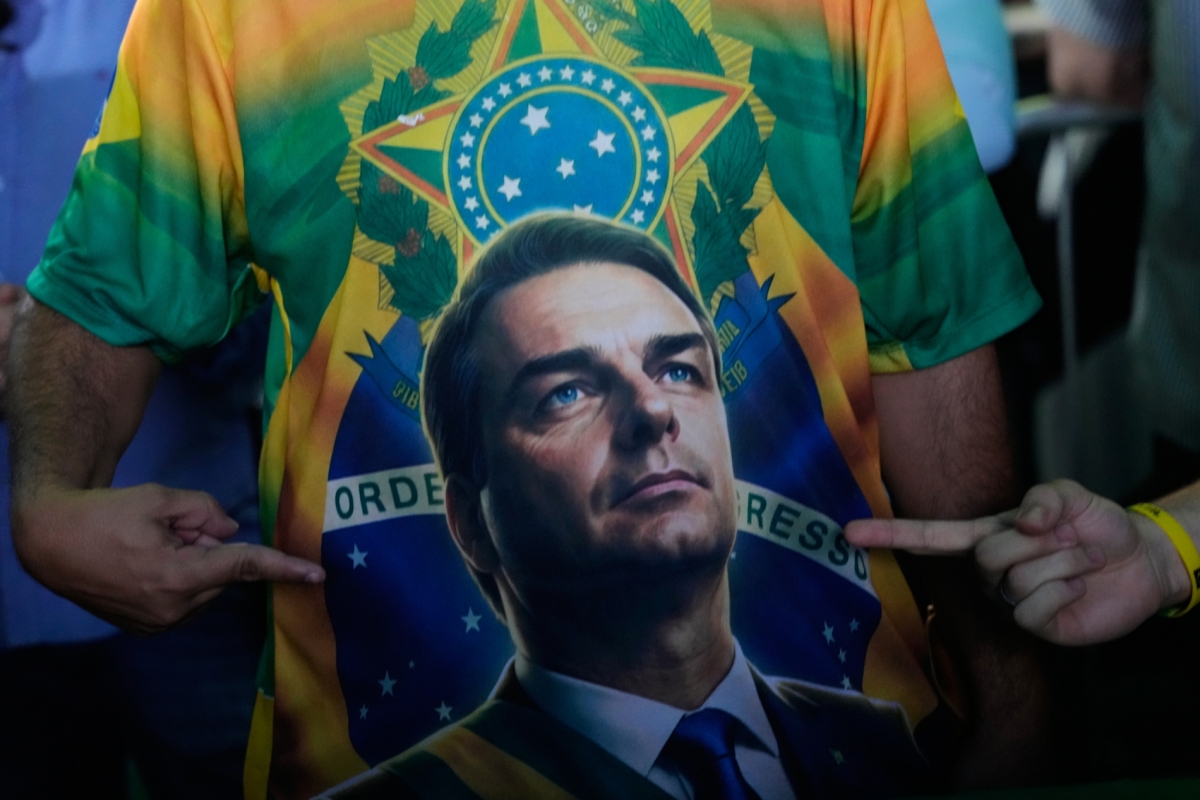
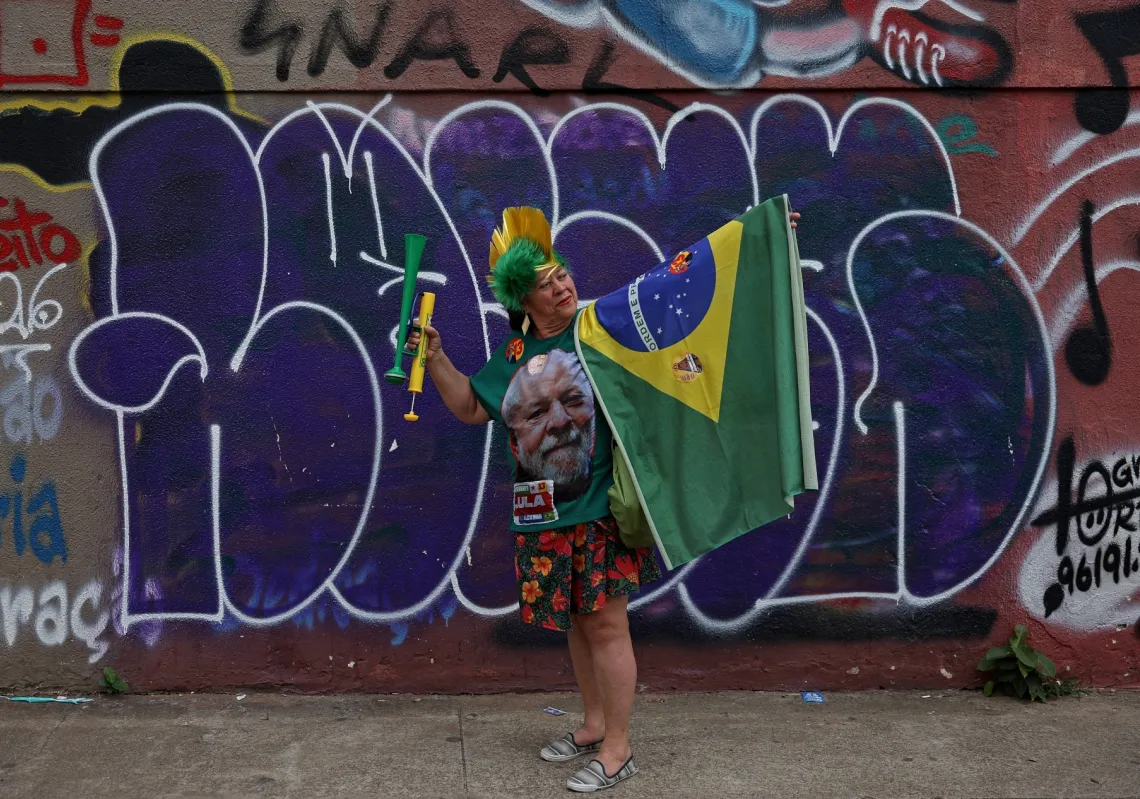
A supporter wears a T-shirt of opposition presidential candidate Sen. Flavio Bolsonaro during a rally to launch his runoff campaign in Goiania, Brazil, on 6 October 2026.
Since Jair Bolsonaro lost Brazil’s presidency four years ago, he has been barred from running again and jailed for plotting a coup, yet his eldest son now stands within reach of returning the family name to the Planalto Palace. In the first round of the presidential election on 4 October, Flávio Bolsonaro, a 45-year-old Liberal Party senator, won just over 56 million votes, or 47% of the total, according to Brazil’s electoral court. President Luiz Inácio Lula da Silva (aka ‘Lula’) secured just over 45%, more than 2.2 million votes behind.
Lula, 80, now joins Flávio in a run-off on 25 October, after neither candidate won an absolute majority. Yet the vote showed that Jair’s exclusion from electoral politics had not dismantled his movement. Financial markets responded positively to Flávio’s success. The Ibovespa, Brazil’s benchmark stock index, rose by 7.7% to a record 206,911 points, propelled by gains in banks, retailers, construction companies, and Petrobras, the state-controlled oil group.
Under a Flávio government, business groups anticipate deregulation (hence the market reaction) while Christian conservatives expect protection from cultural change. Others simply want the left-wing Lula government to go. Flávio’s success has been to assemble these assorted interests around a more cohesive party organisation that holds to Bolsonarismo’s ideological core and changes how it competes for power.
Several plausible contenders initially emerged to succeed Jair. His younger son Eduardo (a federal deputy) appeared more charismatic, while his wife, Michelle, commanded a religious evangelical following. Some business leaders have favoured São Paulo governor Tarcísio de Freitas. The field narrowed after Eduardo moved to the US, where his efforts to enlist the Trump administration against Brazil’s Supreme Court ruling embroiled him in legal proceedings at home.
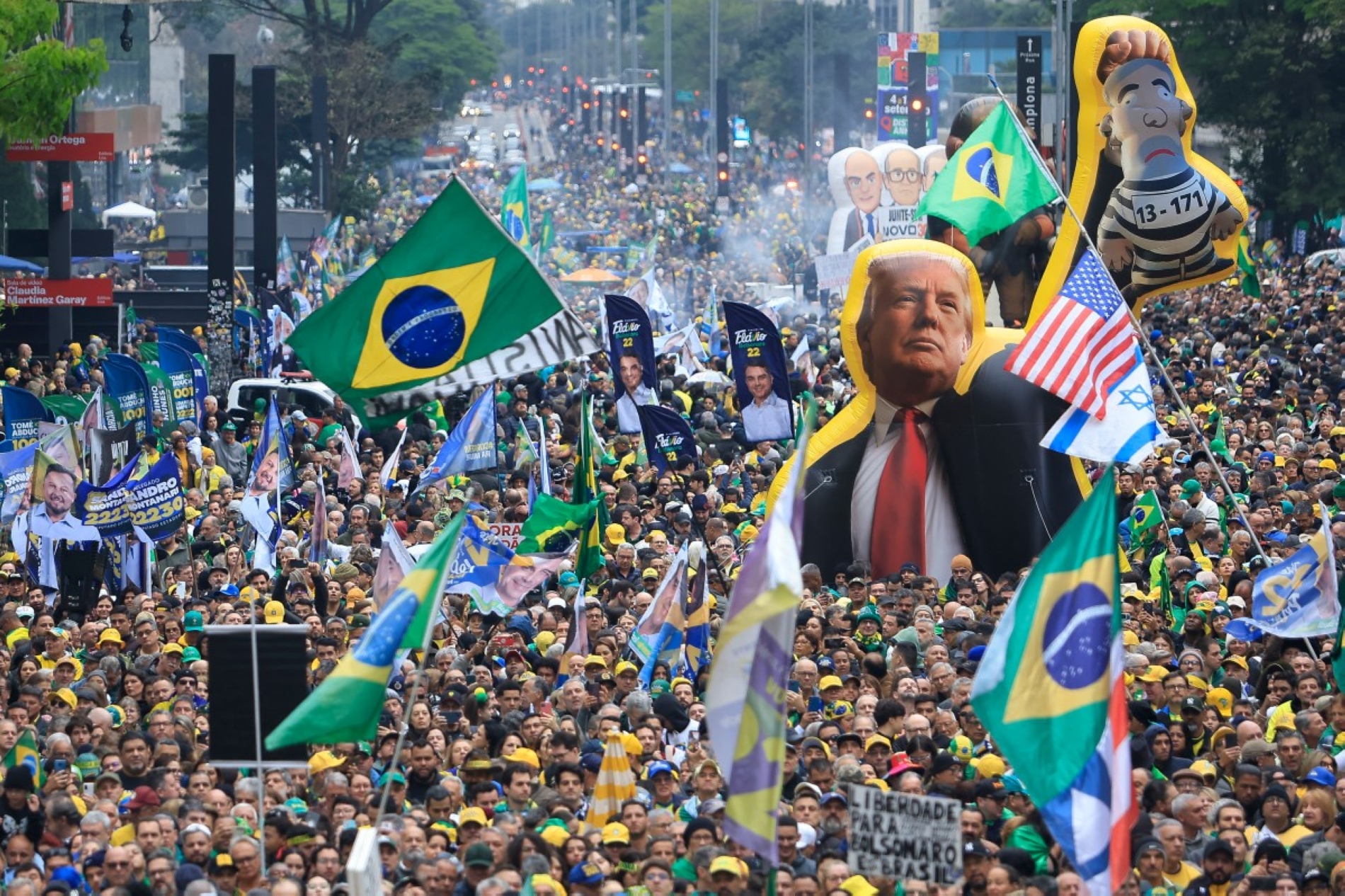
A giant balloon depicting US President Donald Trump holding Brazil's President Luiz Inacio Lula da Silva is displayed at a rally in Sao Paulo, Brazil, on 7 September 2026.
Liberal Party president Valdemar Costa Neto’s candid assessment that the candidate had to bear the Bolsonaro name has borne true. This facilitated Flávio’s entry into politics. He joined the Rio de Janeiro legislature aged 21 and completed four terms before winning a Senate seat in 2018 with 31.3% of the vote, having concentrated his early work on security and prisons.
Managing the Rio branch of his father’s former party gave Flávio an insider’s knowledge of the organisation but set him apart from the patriarch known for his habit of confrontation, weak party attachments, and erratic relations with Congress. By contrast, his son seems more comfortable with committees, negotiations, and the subtle mechanisms that convert political power into policy.
Public praise from the US president have given Flávio recognition and legitimacy within the international right
Doubts emerge
It is not all plain sailing, however. Serious allegations have accompanied Flávio throughout that career. Rio prosecutors say members of his legislative office participated in a rachadinha (an illegal political corruption scheme) under which employees reportedly returned part of their salaries to those who appointed them. The case was annulled in 2021, but only on procedural grounds.
Questions persisted. He employed relatives of Adriano da Nóbrega, an ex-Special Forces police captain suspected of involvement in the 2018 murder in Rio of prominent left-wing Brazilian politician Marielle Franco, an outspoken critic of police violence and extrajudicial killings. In 2020, while he was on the run, Nóbrega was shot and killed by police in a gunfight after they arrived to detain him.
Elsewhere, a police inquiry examined funds supplied by banker and alleged fraudster Daniel Vorcaro for Dark Horse, a fawning film about Jair. Vorcaro's bank had to be liquidated late last year, and he was arrested trying to board a flight to Malta. Flávio denied any wrongdoing and described the investigation as politically motivated. His subsequent electoral recovery demonstrated Bolsonarismo's ability to absorb legal scrutiny involving the family.
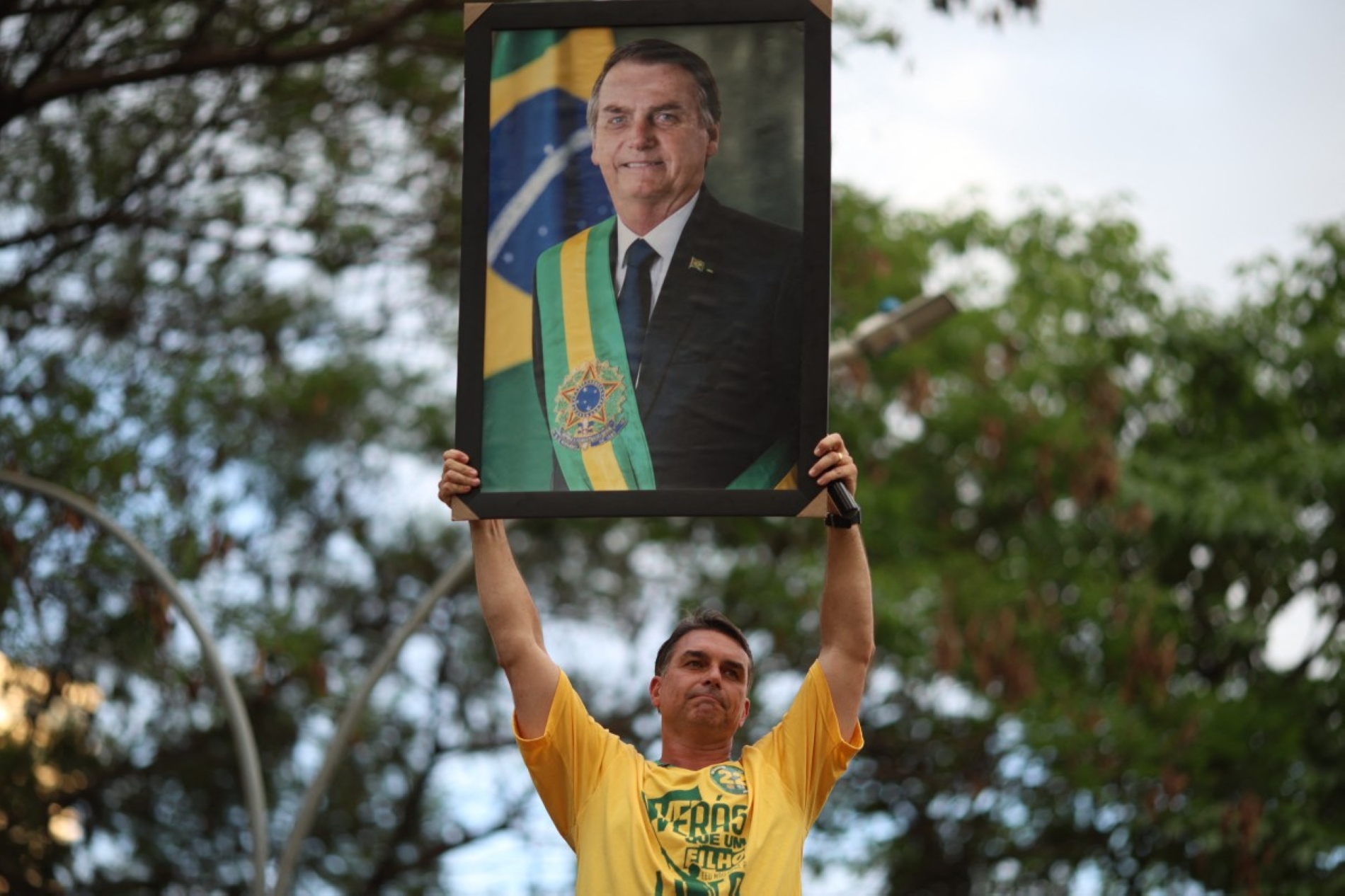
Brazilian right-wing presidential candidate Flavio Bolsonaro holds a picture of his father, convicted former President Jair Bolsonaro, during a motorcade with supporters in Goiania, Brazil, on 27 September 2026.
Moderation as method
Flávio has sought to cast himself as a more centred Bolsonaro. For instance, his father was deeply sceptical about both the Covid-19 virus and its vaccine, whereas Flávio has been vaccinated, citing this as evidence he diverged from Jair's pandemic politics. He is also quieter and less abrasive than his father, whom he has promised to free from prison. He has also promised to impeach the Supreme Court's judges and retain Jair's positions on security, economics, and environmental regulation. His moderation is therefore presentational.
Is Flávio simply his father repackaged, or an autonomous politician? The answer is that he is somewhere in between. He exercises agency through inheritance, converting an established electoral asset into a more governable project that preserves ideological continuity, reassures investors, and smoothes any resistance among conservative elites. This approach could give a Flávio presidency considerable power to reshape institutions, especially after the Liberal Party secured more than one third of the Senate.
If he wins, he can nominate four of the Supreme Federal Court's 11 justices, whose confirmation by the Senate would give his governing bloc substantial influence over the tribunal that convicted Jair and became Bolsonarismo's principal domestic adversary. Such democratic erosion would not need to resemble 8 January 2023, when Jair's supporters stormed Congress, the court, and the presidential palace after his electoral defeat; it could proceed through judicial appointments, administrative power, and selective enforcement. US President Donald Trump, who supports Bolsonaro, has questioned the legitimacy of Brazil's judiciary.
A meeting with Trump (arranged by Eduardo) and public praise from the US president have given Flávio recognition and legitimacy within the international right. The alliance also exposes him to charges that dynastic loyalties take precedence over national interests, particularly after Trump imposed sanctions and visa restrictions on Brazilian judges, then introduced steep tariffs on Brazil's exports.
Lula accused the brothers of encouraging a foreign government to punish Brazil. A nationwide survey later suggested that 51% of respondents agreed with him. Only 30% accepted Flávio's account that he had tried to prevent them. Washington said it acted on trade and regulatory grievances, including Brazilian court orders affecting US tech companies and weak enforcement against illegal deforestation.
Ideological affinity with the Trump presidency is not Brazil's answer to the economic challenges it faces, and the South American country relies heavily on trade with China. Washington's demands for stronger forest enforcement sit uneasily with Flávio's pledge to loosen environmental licensing. If he beats Lula, Flávio will hope that he does not have to choose between loyalty to Trump, economic pragmatism, and the sovereignty he claims to defend.
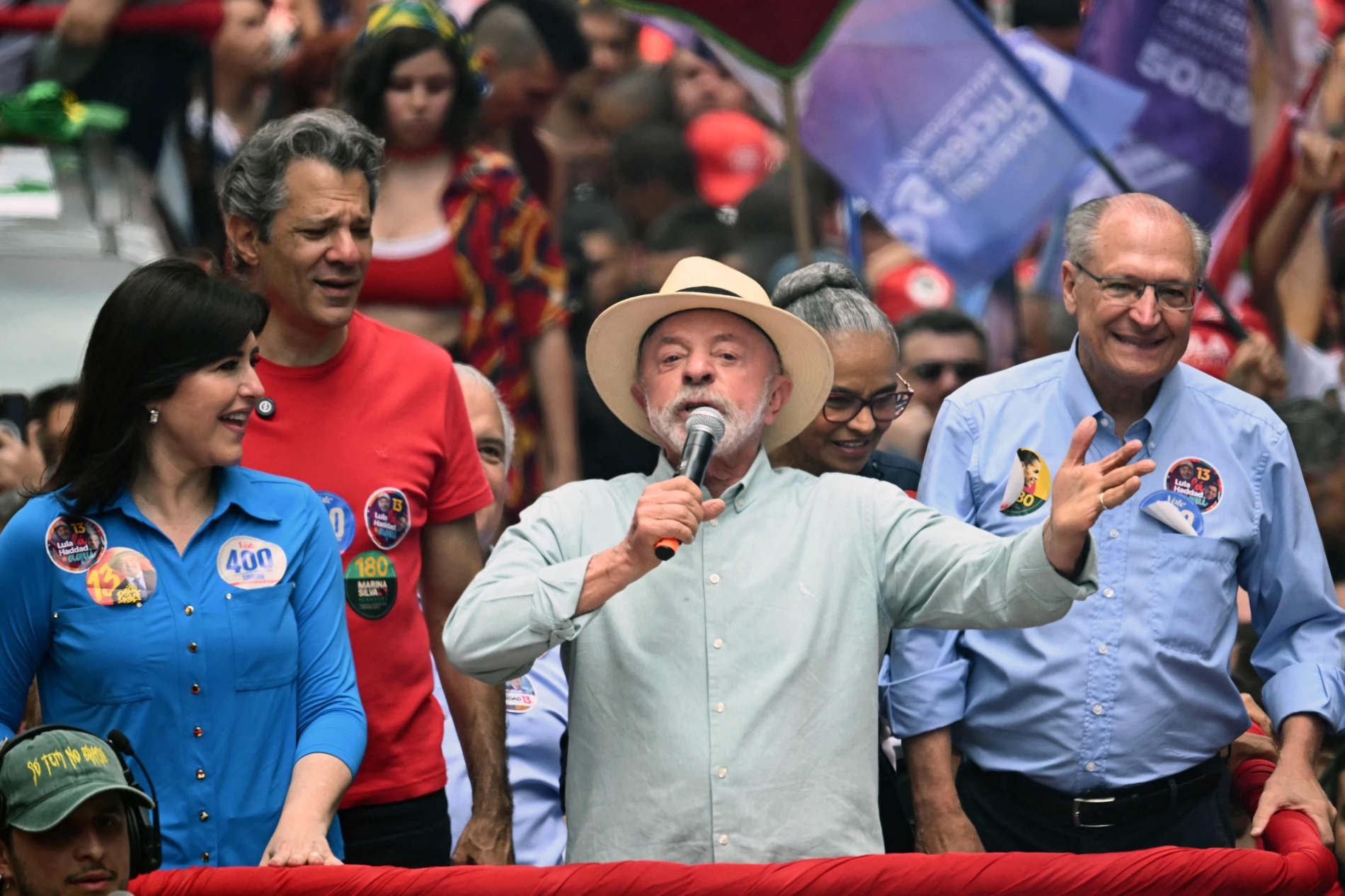
Brazil's President and presidential candidate Luiz Inácio Lula da Silva (C)addresses supporters during a campaign rally on the eve of the general election, in São Paulo, Brazil, on 3 October 2026.
Sharper instruments
Like his father, Flávio is a die-hard market liberalist who portrays the state as expensive, intrusive, and captured by the left. Privatisations, the possible restructuring of Petrobras, lower taxation, and cuts in public expenditure form the centre of his programme, even though he has not explained how tax cuts would coexist with deficit reduction, or which groups would bear the cost.
Banks and extractive industries would benefit from lighter regulation, but there would be social and ecological costs to weakening protections and oversight. Under Jair, liberalisation coincided with pressure on unions, Indigenous organisations, environmental groups, and public bodies seen to be holding back progress. Faster mining and infrastructure licenses under Flávio's banner of efficiency and growth may therefore conflict with territorial rights and conservation, and alter the balance between development, social protection, and environmental safeguards.
The contest remains open. Around nine million votes went to other candidates (who are now not in the run-off) and the abstention rate reached its highest level for 28 years. Lula's prospects depend on mobilising these non-voters and exploiting Flávio's scandals, economic threats, and ties to Trump. Yet whatever the outcome on 25 October, the first round showed that Bolsonarismo can survive without its founder through a transferable family brand, parliamentary strength, external allies, and an electorate no longer defined solely by personal loyalty to Jair.
Those expecting a replica of Jair may find that Flávio advances similar objectives but through negotiation, party discipline, and leverage over state bodies
Same same, but different
Treating Flávio solely as an extension of his father recognises that his candidacy emerged from the Bolsonaro family's drive to return to government without fully accounting for how he has adapted the movement. Those preparing for a replica of Jair may find instead that Flávio advances similar objectives but through negotiation, party discipline, and leverage over state bodies.
Greater authority within Congress and acceptance among investors does not dilute Bolsonarismo; it equips it with tools its founder never mastered. Brazil now has to decide whether Jair's failed attempt to retain power by force should be followed by his son's ostensibly more methodical effort to restore Bolsonarismo through elections and the constitutional institutions meant to constrain executive power. We will soon find out whether that pitch is enough to return the family to power.