
A surge in lithium production and the rise of lithium iron phosphate (LFP) batteries are shifting demand for battery materials, while graphite, nickel and cobalt remain essential amid concentrated global supply chains and volatile prices
Battery production has expanded rapidly since 2020, driving up demand for the minerals and refined materials used in electric vehicles and energy storage. But the growth has been uneven, as changing battery chemistries reshape which materials manufacturers need and in what quantities.
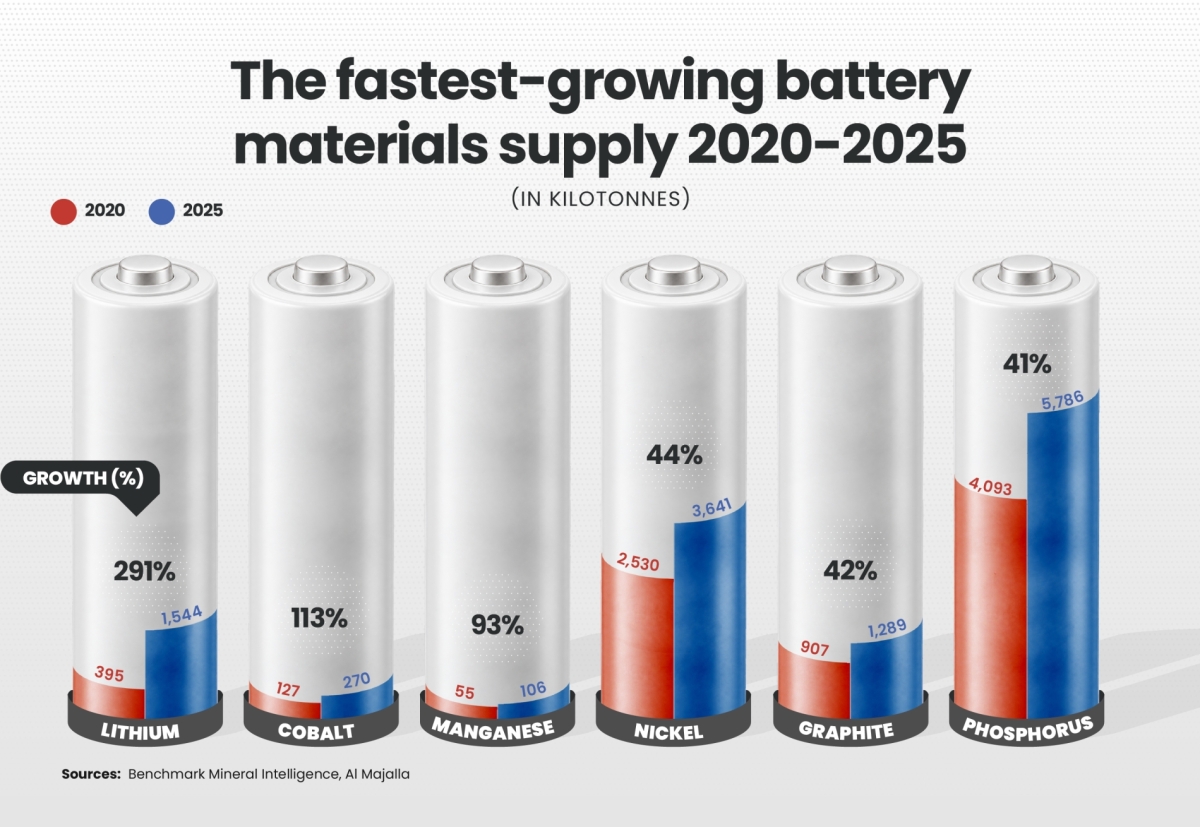
Lithium production surged from 395 kilotonnes in 2020 to 1,500 kilotonnes in 2025, nearly quadrupling in five years, according to Benchmark Intelligence. Lithium remains essential across the major lithium-ion battery chemistries. Lithium iron phosphate (LFP) batteries increased their share of the global electric-vehicle battery market from 19% in 2020 to 55% in 2025, according to the International Energy Agency (IEA). Unlike nickel-based chemistries, LFP batteries do not require nickel or cobalt, shifting demand towards other materials.
Growing demand
As LFP adoption expands, demand for phosphate-based battery materials is growing. Purified phosphoric acid production increased by 41% between 2020 and 2025, according to Benchmark Intelligence. China has played a central role in this transition: in 2024, it accounted for more than 98% of global LFP cathode-material and battery-cell production, according to the IEA's Global Critical Minerals Outlook 2025.
Although nickel-based batteries have lost market share, nickel production rose from 2,500 kilotonnes in 2020 to 3,600 kilotonnes in 2025, reflecting continued demand for chemistries that offer higher energy density and support longer driving ranges. Cobalt and high-purity manganese sulphate production also more than doubled over the period, according to Benchmark Intelligence. Their trajectories show how the expansion of battery manufacturing can sustain demand for established materials even as the industry's chemistry mix changes.
Graphite is a key component of lithium-ion battery anodes, making it essential to both LFP and nickel-based batteries. Global graphite consumption reached approximately 4.8 million tonnes in 2024, an 8% increase from the previous year, with batteries accounting for most of the growth, according to the IEA's Global Critical Minerals Outlook 2025. Supply is highly concentrated: China produced an estimated 78% of the world's natural graphite in 2024, according to the US Geological Survey. Graphite therefore remains a critical part of the battery supply chain.
Supply-chain risks
Rapid production growth has not eliminated supply-chain risks. In 2024, the three leading countries accounted for 93% of global graphite mining and 99% of graphite refining, according to the IEA. Meanwhile, expanding mineral supplies have put downward pressure on prices: lithium prices fell by more than 80% from their 2023 level through the period covered by the IEA's 2025 outlook. The challenge for the battery industry is increasingly about securing reliable, diversified supplies of the right materials as technologies and demand evolve.