
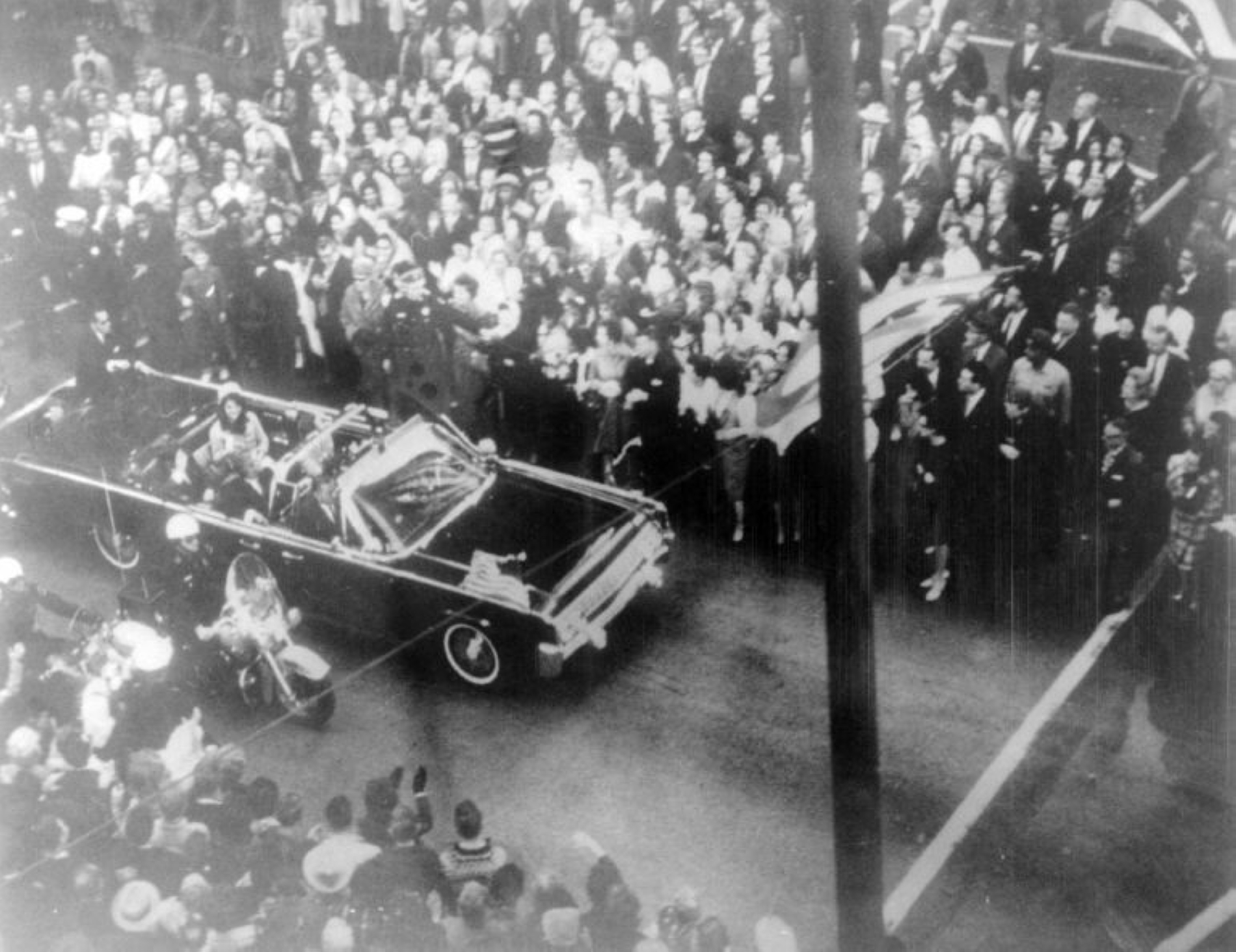
On the afternoon of 22 November 1963, US President John F. Kennedy was travelling through Dealey Plaza in Dallas in an open car when gunshots rang out, fatally wounding him. Authorities then arrested Lee Harvey Oswald and accused him of murdering the president, a charge he denied. Two days later, Oswald was shot and killed by nightclub owner Jack Ruby as he was being led away by police. It later emerged that Ruby had ties to the mafia.
A murdered president, a suspect who denied the accusation before being killed himself, Cold War tensions, mafia links, Oswald’s Soviet ties, and a resulting change in policy at the White House... the factors surrounding JFK’s killing could hardly have been more suited to conspiracy theories. As with any momentous event where answers are incomplete and information is contradictory, it helps to ask why something might have happened and who it benefited.
Uncertainty plus motive creates fertile ground for conspiracy theories, the ready belief of which has been studied in psychological research. Belief in conspiracies and cover-ups can be linked to fundamental human needs, including the desire to understand the world, feel safe and in control, and maintain a positive view of oneself and one’s group.
Looking for an answer
An extensive review was published in the Psychological Bulletin journal in 2025. Drawing on 971 statistical findings from 279 independent studies involving 137,406 participants, it represents one of the most comprehensive attempts yet to understand the motivations associated with conspiracy beliefs.
When a disaster, assassination, or epidemic occurs, humans instinctively look for a cause or an answer. Sometimes that comes quickly, but major events often result from a complex interplay of circumstances, decisions, and coincidences, an explanation that is far less satisfying than a single, coherent story. This helps explain why some conspiracy beliefs are associated with what psychologists call epistemic motivations, which is the human desire to understand what is happening around us and why.
The 2025 review did find an association between these cognitive needs and stronger conspiracy beliefs, but the relationship was weak. It also found links to motivations involving safety and control, as well as social motivations connected to how people perceive themselves and the groups to which they belong. Conspiracy theories may therefore serve different purposes for different people, with no single factor adequately explaining them.
One proposed explanation suggests that we evolved a heightened sensitivity to the presence of an intentional agent behind events. For our ancestors, hearing a noise in the trees and acting on the assumption that it was a predator was less costly than ignoring it and finding out too late.
Some evolutionary models therefore suggest that our ability to detect intentions, alliances, and threats may have helped us survive through the ages, but this same ability can lead to the misperception of deliberate agency behind events that, in fact, may not involve a hidden plot. Belief in conspiracies is not necessarily an evolutionary instinct, but our ancestry leads us to look for ‘someone behind something’ rather than accepting that events arise from chaos, mistakes, or the interplay of multiple factors.
Agency in ambiguity
In 2015, researchers Jan van der Tempel and James Alcock sought to examine the relationship between conspiratorial thinking and what is known as ‘hyperactive agency detection,’ which is the tendency to assume that someone or something is responsible for ambiguous events. Their study involved 209 university students and 37 visitors to websites devoted to conspiracy theories.
They found positive correlations between a conspiracy mentality, a tendency to perceive agency, and traits associated with schizotypy (which includes a tendency toward magical thinking, superstition, odd perceptual experiences, and unusual beliefs). Van der Tempel and Alcock suggested that uncertainty about the causes of an event may make some people more inclined to interpret it as the work of an intentional agent, but their findings could not establish that these traits cause belief in conspiracy theories.
Another related concept that helps explain the conspiracy phenomenon is the need for cognitive closure, which is the desire to reach a definitive answer and resolve uncertainty, rather than remain confronted with open possibilities. Some people can tolerate uncertainly and live comfortably with 'not knowing'. Others find ambiguity more unsettling and quickly seek an explanation that turns scattered information into a comprehensible story, hence the appeal of conspiracy theories that offer answers. Typically, this concludes that it was a single actor who had a plan.