Most listeners remember Riyad al-Sunbati as the composer behind some of Umm Kulthum’s greatest songs. But many don't know about his incredible improvisational skills. A handful of surviving recordings from private gatherings in Cairo during the 1960s show another side to the Egyptian artist: one of startling freedom, humour, and invention.
His link to Umm Kulthum has also overshadowed his phenomenal works for other singers, including Shahrazad and Saleh Abdel Hay, some of which were written in a musical idiom quite different from his compositions for Umm Kulthum. Furthermore, his purely instrumental music, apart from Longa Farahfaza and Shanghai Dance, has largely been forgotten. In fact, it is unclear whether many of his radio performances were even preserved.
Many also tend to forget that al-Sunbati was a master of the oud (a guitar-like instrument native to the Middle East). What they do know of his oud playing are his recordings in which he sings compositions he wrote for Umm Kulthum, or performs other qasidas such as Ashwaq. In fact, his name rarely enters the debate over the best oud players, despite his exquisite talent.
If it were not for a few surviving recordings of private gatherings held between 1963 and 1966, his other talents could have been forgotten altogether. In the clips, he plays at ease among friends, with an unguarded freedom that allows distinctive features of his music to emerge with unusual clarity.
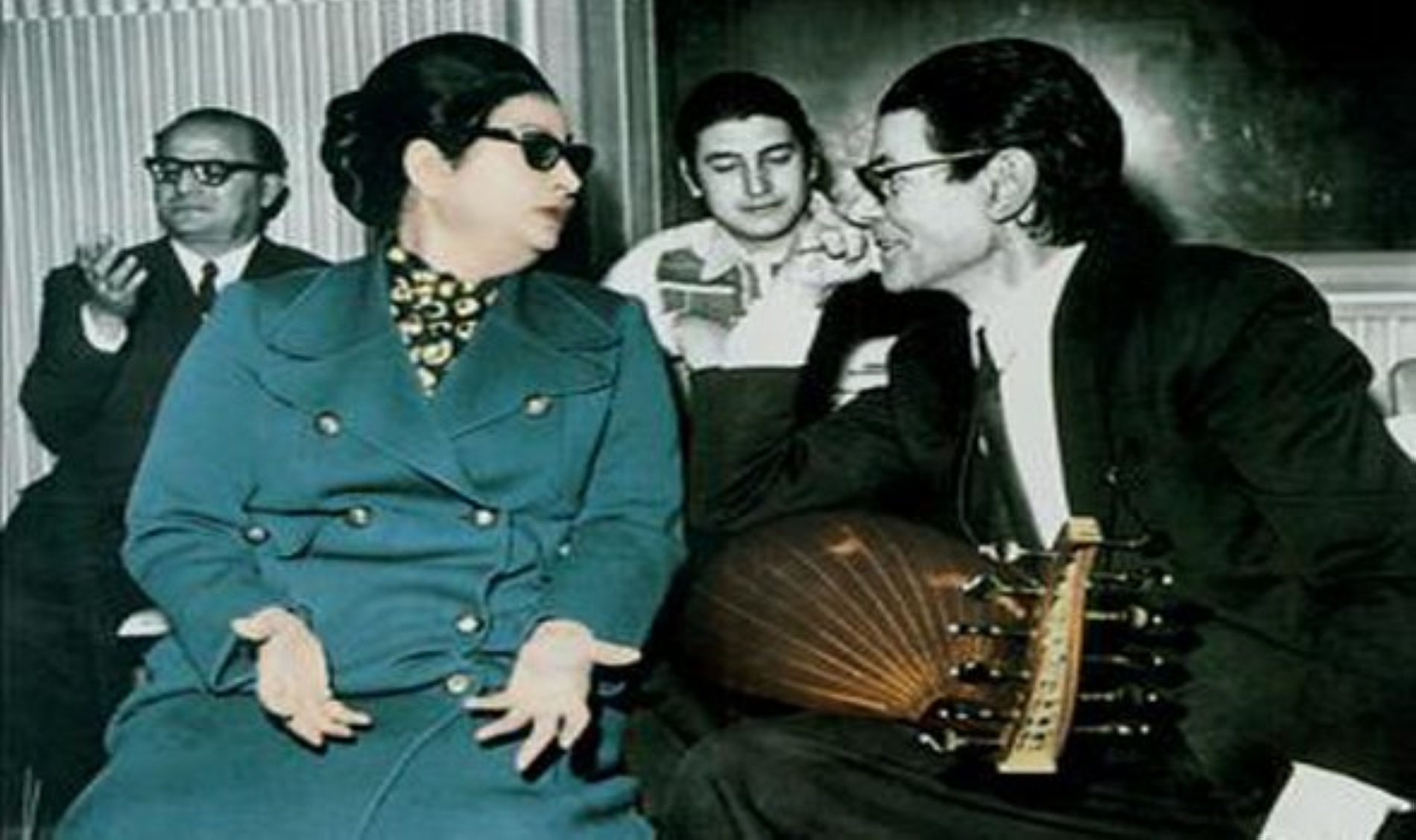
Riad al-Sunbati and Umm Kulthum
Richness in phrasing
Perhaps the first thing an attentive listener notices is the richness of al-Sunbati’s phrasing throughout these taqasim (understood in its early sense as unmeasured vocal and instrumental improvisation), especially the astonishing, almost unbroken flow of invention in the private sessions. He employs a wide range of plectrum techniques, frequent triplets, and other rhythmic figures articulated with the risha, as well as timbre changes produced through glissando, fardash, rapid repeated strokes on a single note, and other fleeting touches on neighbouring pitches.
He is acutely aware of the effect of all this on those gathered around him. At times he abruptly cuts off the melodic flow with a suspended cadence, or arrests the current of musical time altogether. He seems almost to seize the listeners’ hearts by drawing the carpet of flowing time from beneath their feet, leaving them to fall into gaps that he opens before them and drawing from them sighs of delight and admiration.
His own composition, Rubaiyat al-Khayyam with Tawfiq al-Alayli played on the cümbüş, is a masterclass in how a singer should carry him or herself on the oud, how a composed phrase can be shaded and inflected, and how its spaces can be filled with flashes of spontaneous invention.
Riyadh seems almost to seize the listeners' hearts by drawing the carpet of flowing time from beneath their feet
Some phrases in his taqasim sound as though he had prepared them in advance. The opening of a nahawand improvisation recorded around 1929, for instance, resurfaces in faint echoes in another nahawand taqsim almost half a century later. Certain tonal anchors also seem firmly established, like the foundations of a carefully conceived structure. In such choices, one can hear distant resonances of the great old muwashshahat, works rich in both beauty and instruction.
Other phrases seem to press themselves upon him, hovering somewhere between improvisation and composition. This is especially apparent in the opening improvisations that precede his performance of Abdu al-Hamuli's dawr Sharibt al-Sabr. At other moments, he seems to play with the oud in swift, fragmentary gestures, as though filling the interval before a conversation ends, before the 'serious' playing begins, or perhaps while waiting for inspiration.
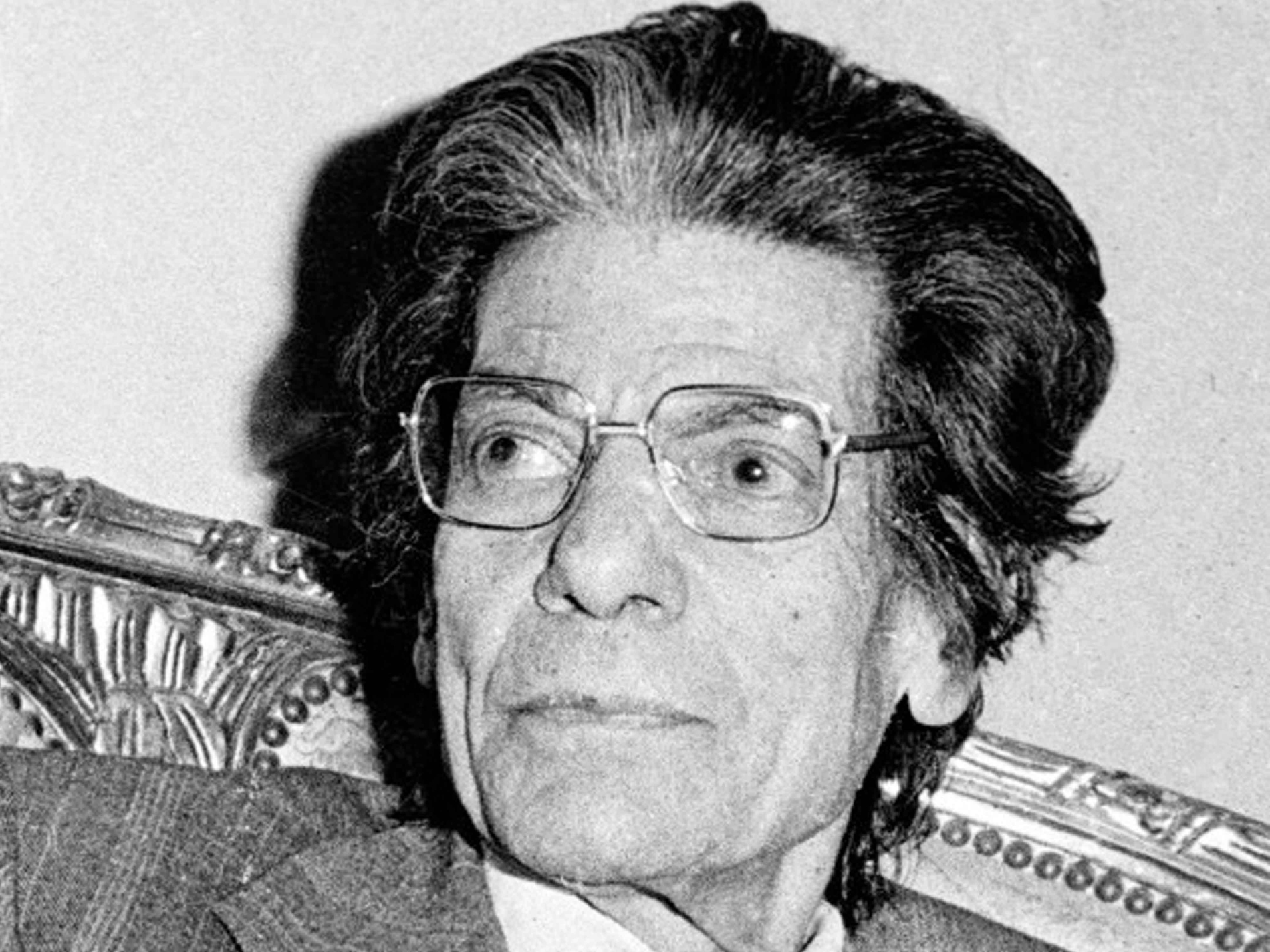
A 1970s photograph of Riyad al-Sunbati
Towards modernity
From the 1960s onwards, al-Sunbati's taqasim differ strikingly from those of Mohamed al-Qasabgi, Dawud Husni, Amin al-Mahdi, Shehadeh Saadeh, and Petro al-Awwad, all of whom preceded him and recorded taqasim in Egypt during the first third of the 20th century. One of the clearest differences lies in the construction of the phrase itself. Al-Sunbati's lines often break into small recurring motifs, with triplets sometimes serving precisely that function, while an unmistakable rhythmic, at times dance-like, impulse enters the texture.
Al-Sunbati thus seems among the first to move away from the older instrumental phrasing, with its emphasis on plectrum play, projection, and the unfolding of melody across the degrees of the maqam. In its deeper structure, that older language often recalls the dawr and the muwashshah. Al-Sunbati moves towards the phrasing of the modern 20th-century composer: motifs with a clearly shaped internal balance, silence given a structural role, individual sections coloured with distinct sonorities, and a line that approaches modern singing in the clarity of its ornamentation and the relative spaciousness of its pulse, especially when set against al-Qasabgi's greater speed. At times, he also colours his playing with very simple chords to enrich the musical texture, though he does not build melodic phrases upon them in the manner that later became common in the 21st century.
This comparison may help explain why al-Sunbati's taqasim, particularly those recorded in 1977, came to be regarded as 'classical' reference works, reinforced by their simplicity and modal clarity. These qualities have led some listeners to regard them as almost academic in method. They became touchstones for a substantial body of later taqasim, especially in Egypt.
Traces of al-Qasabgi's phrasing are scarcely audible in the improvisations of later oud players, despite his mastery and a modernism that may have exceeded what his own era could comfortably absorb. The taqasim of the other musicians mentioned above often sound older still, their sensibility reaching back toward the 19th century through a slower pace, frequent pauses, less clearly articulated phrase structures, and a comparatively shorter melodic breath.
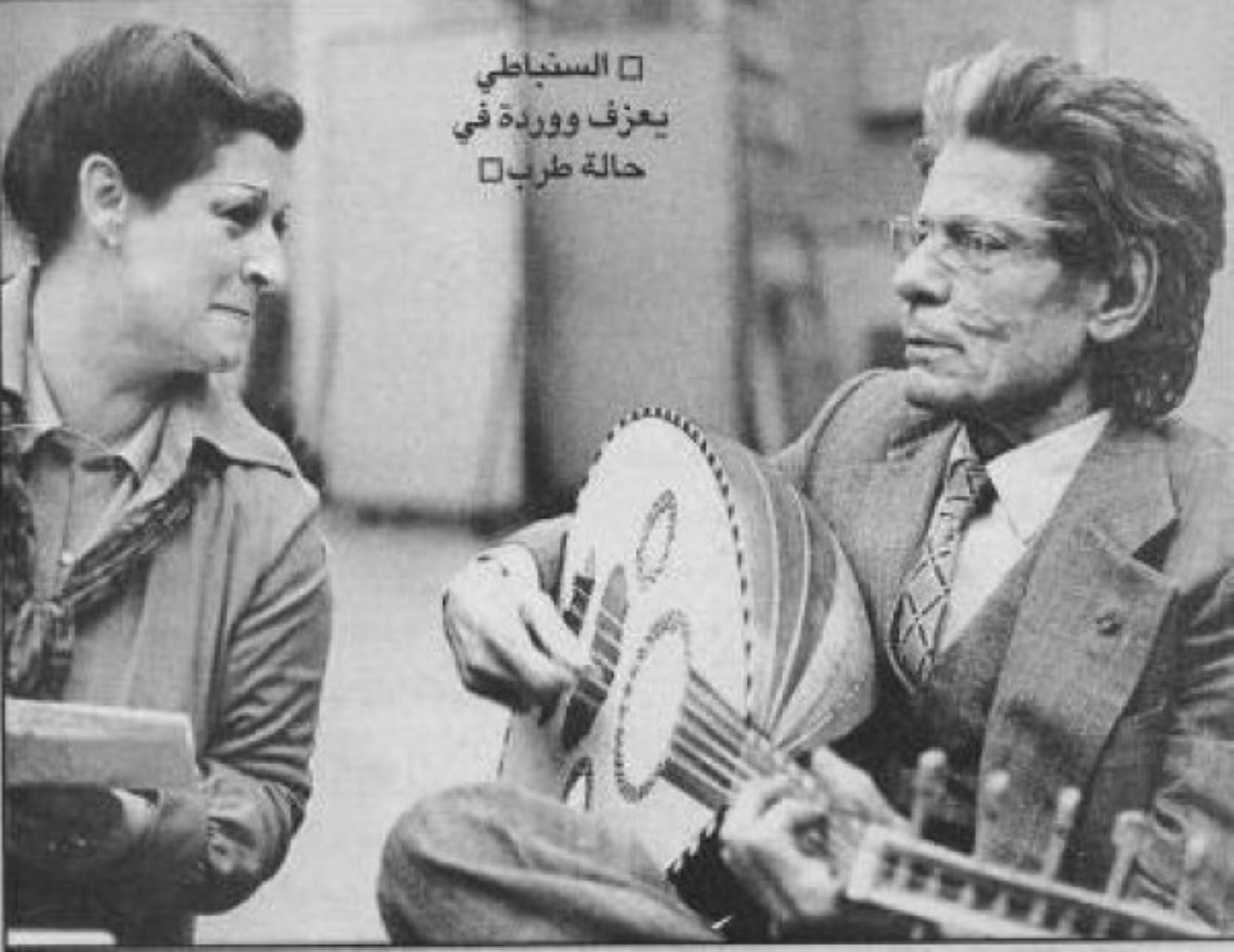
Riad Al-Sunbati and Warda Al-Jazairia.
The atmosphere of the sessions
An improvisatory spirit can also be heard in al-Sunbati's choice of repertoire during these gatherings. Alongside his own compositions, he sang a number of muwashshahat, among them Sihtu Wajdan and Qad Harrakat Aydi al-Nasim; mawawil such as Sultan Jamalak; several adwar, including Sharibt al-Sabr and Fi Majlis al-Uns al-Hani; and Sayyid Darwish's Ana Hawit wa Intahayt.
By their nature, both the mawwal and the dawr require a degree of improvisation in performance. Al-Sunbati, however, draws the mawwal away from the customary display of vocal force and toward the gentler intimacy of a private majlis among friends. His cultivated, finely controlled singing places it clearly apart from the popular mawwal of the street. A comparison between his improvisations in Sharibt al-Sabr and those of other singers who performed the same dawr reveals with equal clarity the modernist choices he made in shaping the musical phrase.
Here he distances himself from the older modes of tarab associated with the awalim and the mashayikh and moves closer, vocally, to the modern tarab of Umm Kulthum and Mohammed Abdel Wahab. Al-Sunbati was their contemporary and helped shape that transformation himself, playing alongside Abdel Wahab and composing for Umm Kulthum. His performance also takes on a more dramatic quality: rapid vocal ornamentation is reduced, melodic tension is built gradually, and particular weight is given to the leading note beneath the tonic before the cadence.
This dramatic sensibility was certainly influenced by European music, which al-Sunbati enjoyed listening to. In a radio interview, he named Ottorino Respighi among the composers he admired. Darwish had been among the first to introduce such dramatic qualities into his theatrical compositions, perhaps following Sheikh Salama Hijazi.
The adwar and muwashshahat thus appear to form part of the deep musical foundation from which al-Sunbati worked. Many later composers lacked that grounding and, with it, both that frame of reference and the awareness that the old could be carried towards a modern idiom without mere repetition, violation or embalming.
A living tradition
Musical traditions are not, as one might imagine from hearing only the fixed versions preserved on record, systems of endless repetition and near-identical reproduction. Most older works, apart from a small number of melodies (perhaps around 10%), remained in active circulation for little more than half a century. Musicians were always, in this sense, children of their own age, and before the modern era relatively few had access to music that could genuinely be called 'old'. Even within strict court traditions such as Ottoman music, the performance of preserved works continued to evolve, as comparisons between notated sources from the 16th to the 19th centuries clearly show.
Al-Sunbati's private sessions therefore open a window onto more than his own musical temperament. They suggest paths the older adwar might have taken had recording technology appeared, for instance, half a century later. They reveal forms of musical interaction that some listeners now regard as almost forbidden, largely because the tradition reached them frozen outside its original context and detached from what followed as change accelerated after the First World War: the passing of the great singers of the earlier generation, the rise of musical theatre, and the modernising work of Abdel Wahab and al-Qasabgi.
Riyadh was a master of two worlds, improvisation and composition, each feeding the other without conflict
Throughout all this, one encounters the temperament of a composer of profound talent, abundant invention and swift inspiration, qualities that continually nourish his improvisations, whether instrumental or vocal. He was a master of two worlds, improvisation and composition, each feeding the other without conflict. He also stands at the meeting point of several musical realms, seeking his own equilibrium without severing himself entirely from any of them: Eastern melody and Western drama; modernisation in composition alongside the expansive improvisatory space associated with Umm Kulthum; the suppleness of melody and the grandeur of the classical Arabic qasida.
Al-Sunbati became one of the great figures who helped spread the pleasure of encountering that elevated poetic language through song, and one of its defenders at a time when the stately register of classical Arabic was growing increasingly distant from everyday life.