
Between the risks of distraction and cyberbullying and the promise of better academic performance, school phone bans are producing mixed results while policies worldwide seek to protect learning time without shutting the door on technology.
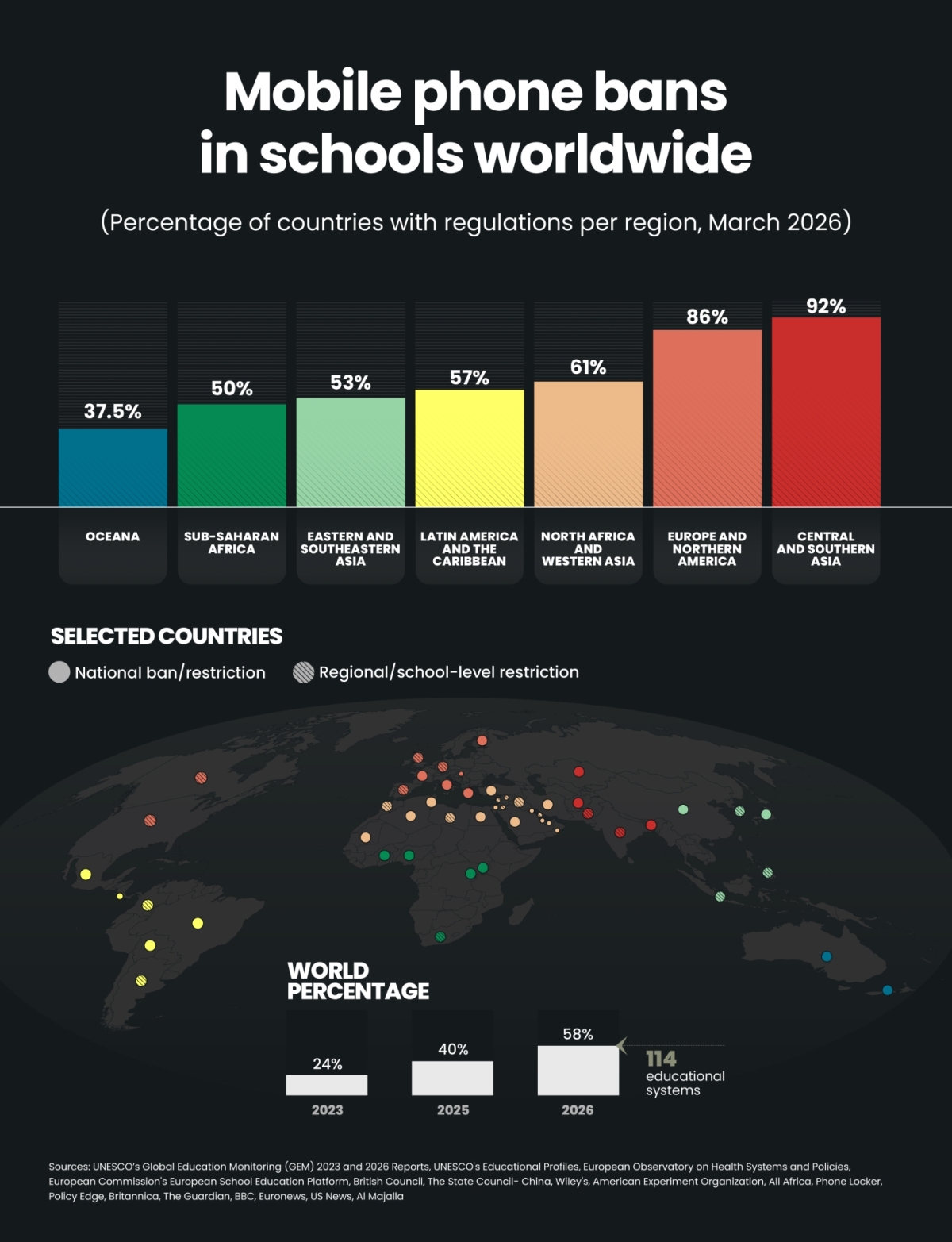
What began as a concern over distracted classrooms has rapidly evolved into a global education-policy movement. According to UNESCO’s Global Education Monitoring Report, 114 education systems—58% of countries worldwide—had national policies banning mobile phones in schools by March 2026, up from less than one in four or 24%, in 2023. The speed of the shift reflects growing concern over distraction, academic performance, cyberbullying, social media, and the wider influence of digital platforms on children.
Yet the evidence behind the bans is more nuanced than their rapid spread might suggest. UNESCO’s 2023 report found that even the presence of a mobile device can distract students, while subsequent research has linked restrictions in some settings to higher test scores, fewer disciplinary problems, less bullying and a calmer classroom environment. A study in England, for example, found that phone bans improved examination results, particularly among lower-achieving students, while a large randomised study in India reported similar academic gains.
But there is no universal formula. Other studies have found little or no measurable effect on grades, wellbeing or bullying, while researchers have warned that strict enforcement can produce unintended disciplinary consequences. The impact appears to depend heavily on how restrictions are implemented, students' age and circumstances, and the availability of alternative digital tools. UNESCO therefore cautions against treating prohibition as an end in itself: schools must still teach students how to navigate digital environments, evaluate online information and use technology responsibly.
The Arab world is becoming an important part of this policy shift. From Saudi Arabia, the UAE, Qatar, Kuwait and Oman to Egypt, Tunisia and Algeria, governments and education authorities have adopted restrictions on mobile-phone use, although the scope and enforcement of these measures vary. In some cases, the objective is primarily to protect classroom concentration and discipline; in others, restrictions reflect broader concerns about students’ exposure to social media, cyberbullying and excessive screen use.
The region therefore offers less a single model than a spectrum of approaches, from national rules to school-level restrictions. At the same time, the region highlights the difficulty of drawing a line between harmful and useful technology: in some education systems, mobile devices remain an important gateway to digital learning.
The global debate, then, is moving beyond a simple question of whether phones belong in schools. The emerging consensus is not necessarily to eliminate smartphones, but to set deliberate boundaries around them: protecting learning time while ensuring students are still equipped to live, learn, and think critically in an increasingly digital world.