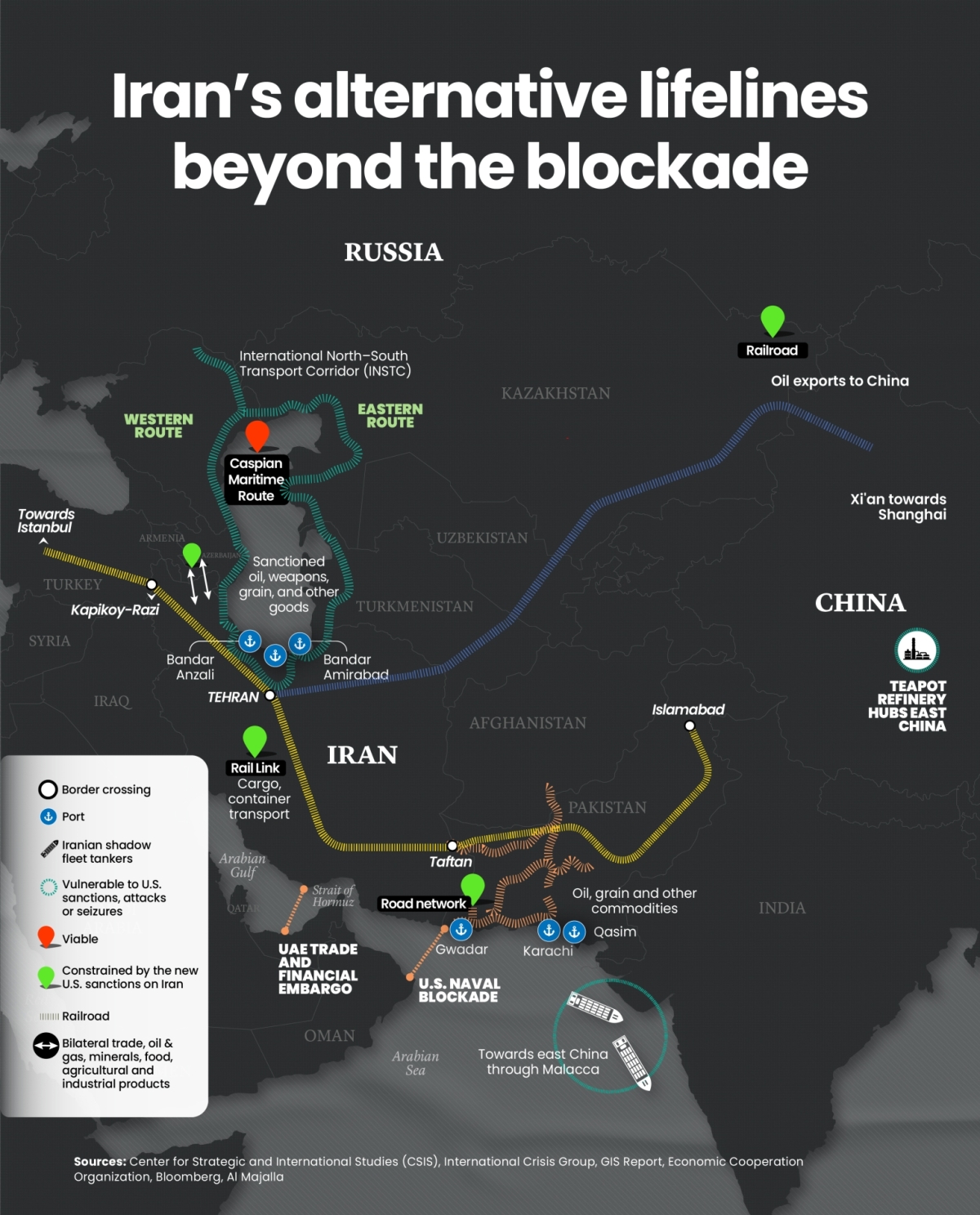

A US naval blockade has disrupted Iran’s traditional trade routes through the Strait of Hormuz, forcing Tehran to rely on land, rail and Caspian corridors. Iran shares almost 6,000 km of land borders with seven countries and has about 700 km of Caspian coastline, giving it access to alternative trade corridors through Türkiye, Pakistan, the Caucasus, Central Asia and Russia, and onward to China.
Since the blockade began in April, Pakistan opened land routes from Gwadar, Karachi and Port Qasim for cargo bound for Iran, while Türkiye offers the Kapıköy–Razi crossing. Russia has increased Caspian shipments to Iranian ports, including alleged sanctioned military cargo. The International North-South Transport Corridor (INSTC) adds road, rail and maritime options, while Iran is exploring rail routes for oil exports to China.
These corridors may keep food and consumer goods moving, but cannot substitute for the trade that comes through the Hormuz. Trucking is costlier; Caspian ports and vessels remain capacity-constrained. The INSTC also faces bottlenecks, including the unfinished 165-km Rasht–Astara railway.
Oil is the bigger vulnerability. China has absorbed more than 80% of Iran’s seaborne oil exports, making it Tehran’s crucial outlet. Yet Chinese imports fell from about 1.4 million barrels per day (bpd) in 2025 to 823,000 bpd in July and 534,000 bpd in August. Iranian crude in floating storage outside the blockade zone fell from about 105 million barrels before the July reinstatement to about 80 million by 21 August.
The UAE’s 19 August embargo removes another critical lifeline. Before the war, the UAE was one of Iran’s biggest trade partners, providing more than 30% of its imports valued at some $21bn, according to the World Trade Organisation's latest figures from 2024. The UAE is also Iran's third-largest export destination, making up nearly 13% of its exports, worth some $7bn. Dubai has served as an important financial channel for Iran, although the scale of these financial flows is not publicly quantified.
Washington is now targeting the networks behind these routes. On 24 August, the US Treasury sanctioned 60 individuals, entities and vessels across five sectors including digital assets, gold, technology, aviation and shipping, and warned that countries, companies, and entities providing economic lifelines to Iran, facilitating Iranian trade or money laundering, face the risk of secondary US sanctions, including potential exclusion from the US dollar-based financial system. The measures stop short of imposing that penalty immediately, giving countries time to wind down targeted activities.
Iran can still use yuan and local currencies, barter, alternative clearing, overland trade and shadow shipping, but their viability depends on China and other partners’ willingness to withstand US secondary-sanctions pressure.
Beijing had already banned any recognition, enforcement, or compliance with US sanctions targeting domestic companies involved in the Iranian oil trade in May. And on 25 August, the spokesperson for China's foreign ministry, Lin Jian, told reporters on Tuesday: “Cooperation between China and Iran has always been conducted within the framework of international law and should not be interfered with or disrupted."
“China has already stated many times that it firmly opposes illegal unilateral sanctions. China will take all necessary measures to firmly safeguard its own rights and interests.”
The Caspian route appears particularly viable because Russia, already under extensive Western sanctions, may be more willing to absorb additional risk. But it is not immune: in July, Ukraine struck an Iranian commercial vessel in the Caspian; Iran said one sailor was killed, while Kyiv said it targeted vessels involved in Iranian-linked military cargo shipments.