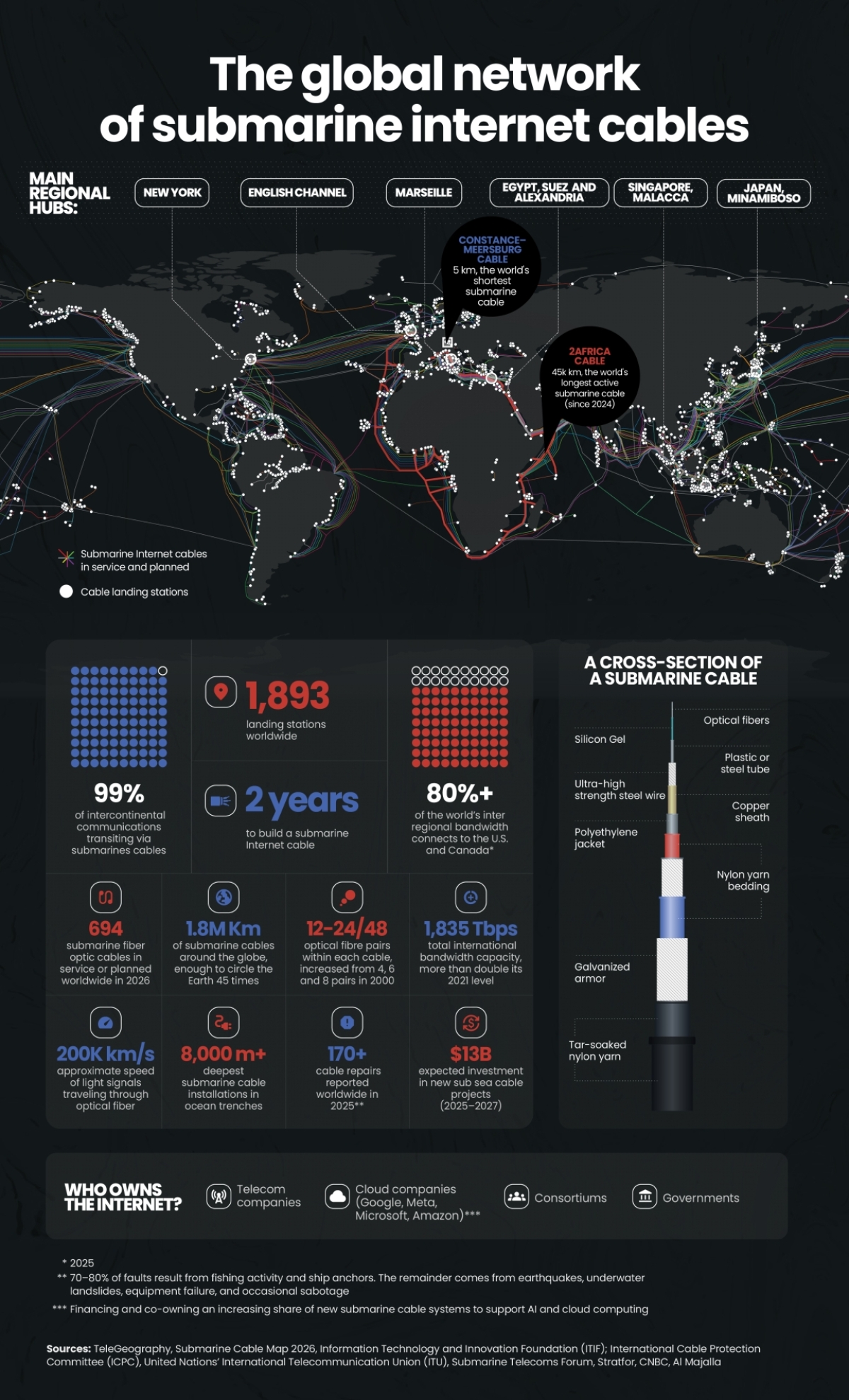

Submarine internet cables are largely invisible, lying along the ocean floor, but these fibre-optic arteries now carry around 99% of intercontinental digital communications, forming the physical backbone of the global internet, cloud computing, and the rapidly expanding AI economy.
Stretching nearly 1.8 million kilometres across almost 700 cable systems, they form the invisible infrastructure connecting global financial markets, international trade, giant data centres, governments, businesses, and billions of people, enabling trillions of dollars in economic activity and digital transactions every day.
As global demand for data accelerates, so does the strategic importance of these undersea cables. International bandwidth has more than doubled since 2021, while new systems now contain up to 48 pairs of optical fibres, allowing unprecedented transmission capacity. Building a single submarine cable can take around two years and cost hundreds of millions of dollars. More than $13bn will be invested in new projects from 2025-27 to keep pace with demand.
Narrow maritime chokepoints including the English Channel, the Strait of Malacca, the waters around Japan, the Red Sea, the Suez Canal and the Arabian Gulf have all become indispensable corridors for global digital connectivity. Egypt is one of the world’s most important cable crossroads, linking Europe, Asia, and Africa.
Risks and ownership
Yet recent regional conflicts have exposed the vulnerability of this hidden infrastructure and shown how geopolitical instability can threaten global internet resilience, even without a deliberate attack on cables. Military operations, naval deployments, restricted maritime access and the suspension of cable-laying and repair missions can impede maintenance, while increasing insurance costs.
Since multiple cable systems converge through the Red Sea and the Arabian Gulf, any prolonged disruption there could have an impact, forcing internet traffic through longer routes and affecting digital services, financial transactions, and cloud connectivity both within the Middle East and beyond.
At the same time, ownership of submarine cables is changing rapidly. Once dominated by telecoms operators and government-backed consortiums, it is now led by the big tech companies such as Google, Meta, Microsoft, and Amazon, who invest billions of dollars to finance or co-own new cable systems. This gives them greater control over the global infrastructure that powers their cloud platforms and AI services.
Meta’s multi-billion-dollar Project Waterworth, spanning more than 50,000km, and Google’s expanding portfolio of privately financed cables, illustrate a new reality: control over digital infrastructure is now just as important as control over energy pipelines or maritime trade routes.