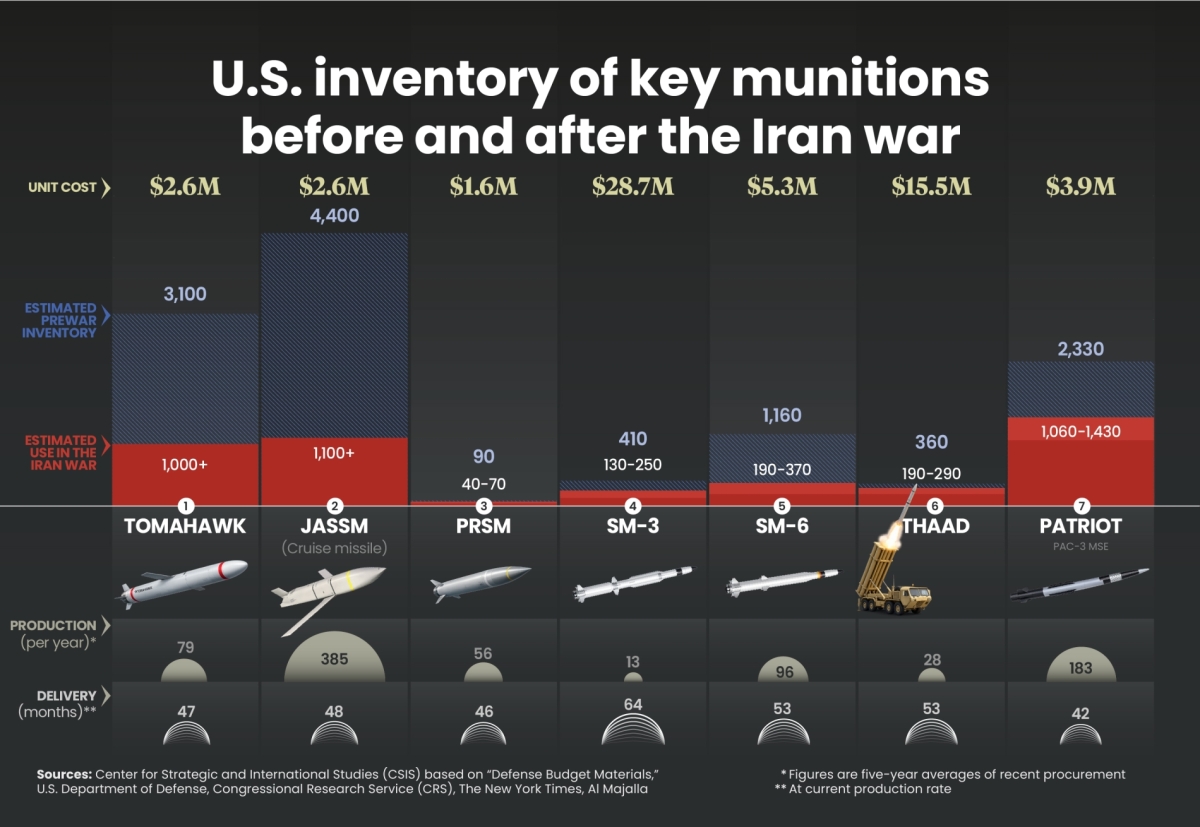

The Iran war has triggered growing concern over the state of United States munitions inventories after the Pentagon expended thousands of high-end missiles and precision-guided weapons in less than six weeks of fighting.
Over 39 days, the US struck more than 13,000 targets, relying heavily in the opening phase on costly long-range strike systems primarily designed for a potential conflict with China.
Estimates indicate that between 3,700 and 4,500 advanced munitions were used during the war. Analysts assess that, across four key munitions categories, more than half of pre-war inventories may already have been depleted.
The conflict has exposed a critical challenge for Washington: limited production capacity. Despite additional defence funding and new agreements with industry aimed at placing missile manufacturing on a “wartime footing,” replenishment timelines remain lengthy. Producing and delivering a Tomahawk missile takes around 47 months, while a JASSM cruise missile requires nearly 48 months. Rebuilding inventories of seven critical munitions could therefore take up to four years.
Diminished inventories are also expected to affect US supplies of Patriot, THAAD, and Precision Strike Missiles (PrSMs) to Ukraine and others. More broadly, the depletion of stockpiles risks weakening US readiness in other theatres, particularly the Indo-Pacific, where many of these weapons would be essential in a potential conflict involving China.
In the first two days alone, the military used $5.6bn worth of munitions, according to defence officials. Overall, studies by the Centre for Strategic and International Studies and the American Enterprise Institute estimate the total cost of the war so far at between $28bn and $35bn, or just under $1bn per day.