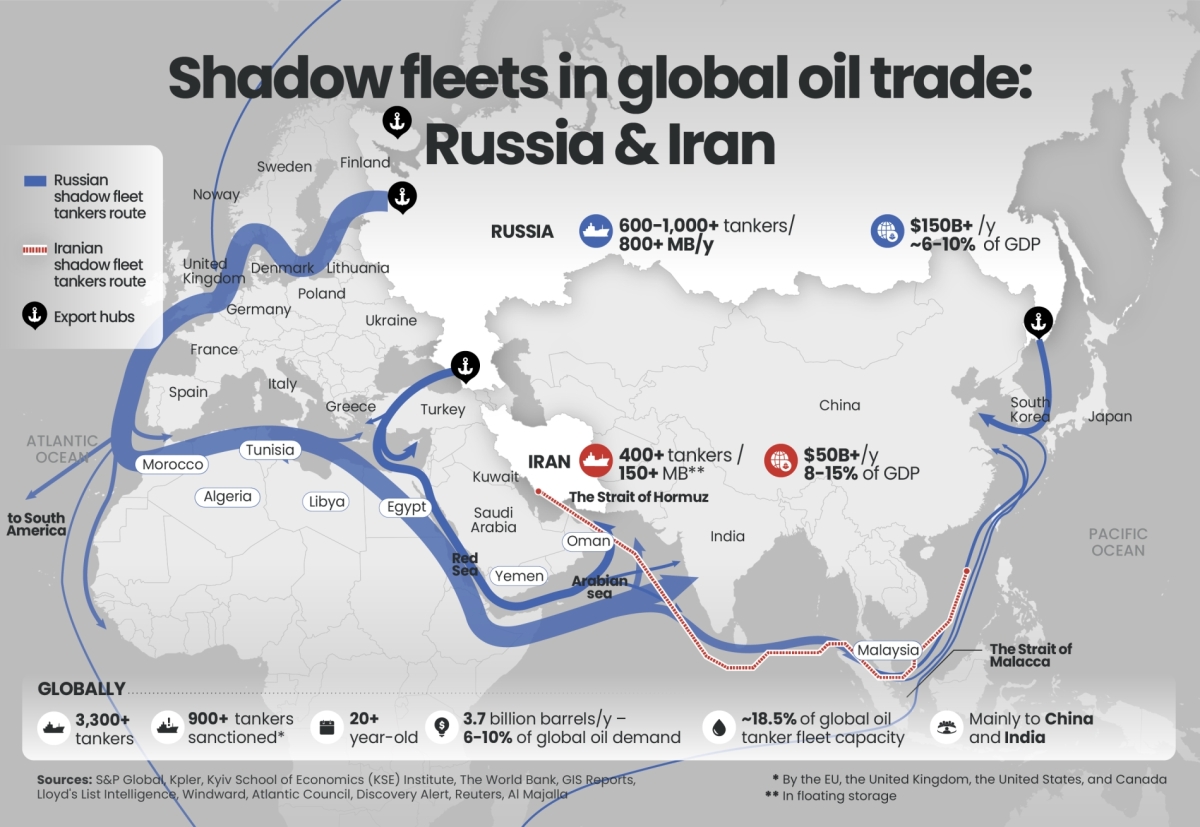

Shadow fleets have evolved from niche sanction-evasion tools into a parallel global shipping system. Today, more than 3,000 vessels operate using deceptive practices such as AIS signal manipulation, ship-to-ship transfers, and opaque ownership structures to move sanctioned oil. These tankers are often registered under flags of countries such as Panama, Liberia, the Marshall Islands, and Gabon, where oversight is limited, and enforcement gaps are easily exploited.
What makes this system significant is not just its size, but its systemic impact. Sanctioned oil flows now account for a substantial share of global tanker capacity—approaching one-fifth—underscoring how deeply embedded these networks have become in global energy trade.
At the core are Russia and Iran, whose economies increasingly depend on shadow logistics. Russia’s fleet—potentially exceeding 1,000 vessels—has allowed it to maintain export volumes despite Western price caps, with shadow tankers carrying over 60% of key export streams. This has preserved more than $150bn annually, with discounted crude primarily flowing to India and China.
For its part, Iran's shadow fleet has sustained exports for years through cargo blending, falsified documentation, and complex routing. Iranian oil continues to reach markets—primarily in China— often via intermediaries and alternative financial channels, generating over $50bn annually.
The broader implication is strategic: sanctions have not reduced supply as intended. Instead, they have reconfigured global trade routes, shifting flows toward Asia and embedding opacity into the system. Shadow fleets are no longer a workaround; they are becoming a structural feature of the global oil market.
A growing share of oil now moves through opaque, higher-risk channels, raising environmental, financial, and security concerns. Ageing, poorly insured tankers increase the likelihood of accidents, while weak enforcement exposes the structural limits of the current sanctions regime.