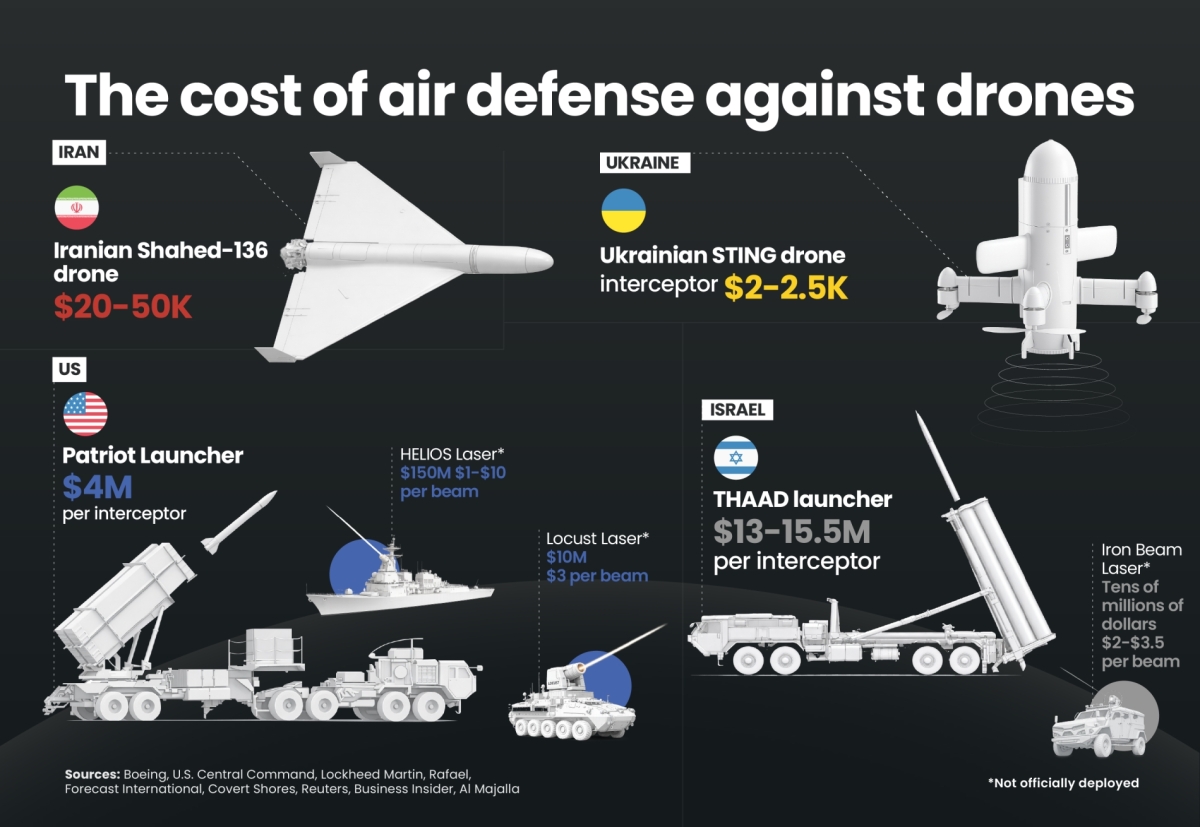

In the ongoing US–Israel war on Iran, Tehran has increasingly relied on large-scale drone deployments to overwhelm air defences and impose economic costs on its adversaries. Iranian-made Shahed drones, priced at $20,000–$50,000, have targeted strategic sites across the Gulf and advanced US and Israeli interception systems have been deployed to shoot them down.
But this comes at a high cost. Patriot interceptors cost $4mn each, and THAAD systems range from $13mn to $15.5mn, which isn't a sustainable paradigm if the war drags on for a long time. The resulting disparity is draining air defence budgets and raising concerns about the long-term efficiency of conventional counter-drone strategies.
As a result, lower-cost interception solutions are gaining traction. Ukrainian interceptor drones, including the STING system, are designed specifically to counter one-way attack drones at a fraction of the cost. With unit prices estimated between $2,000 and $2,500 and the ability to be produced at scale, these systems offer a more economically sustainable approach to air defence.
Interest in these alternatives is growing. Gulf states—along with partners in Europe and the US—are exploring the option. Compared to traditional missile-based defences, interceptor drones offer greater efficiency against swarm attacks, even though their effectiveness depends on integration within layered defence architectures that combine sensors, radar coverage, and trained operators.