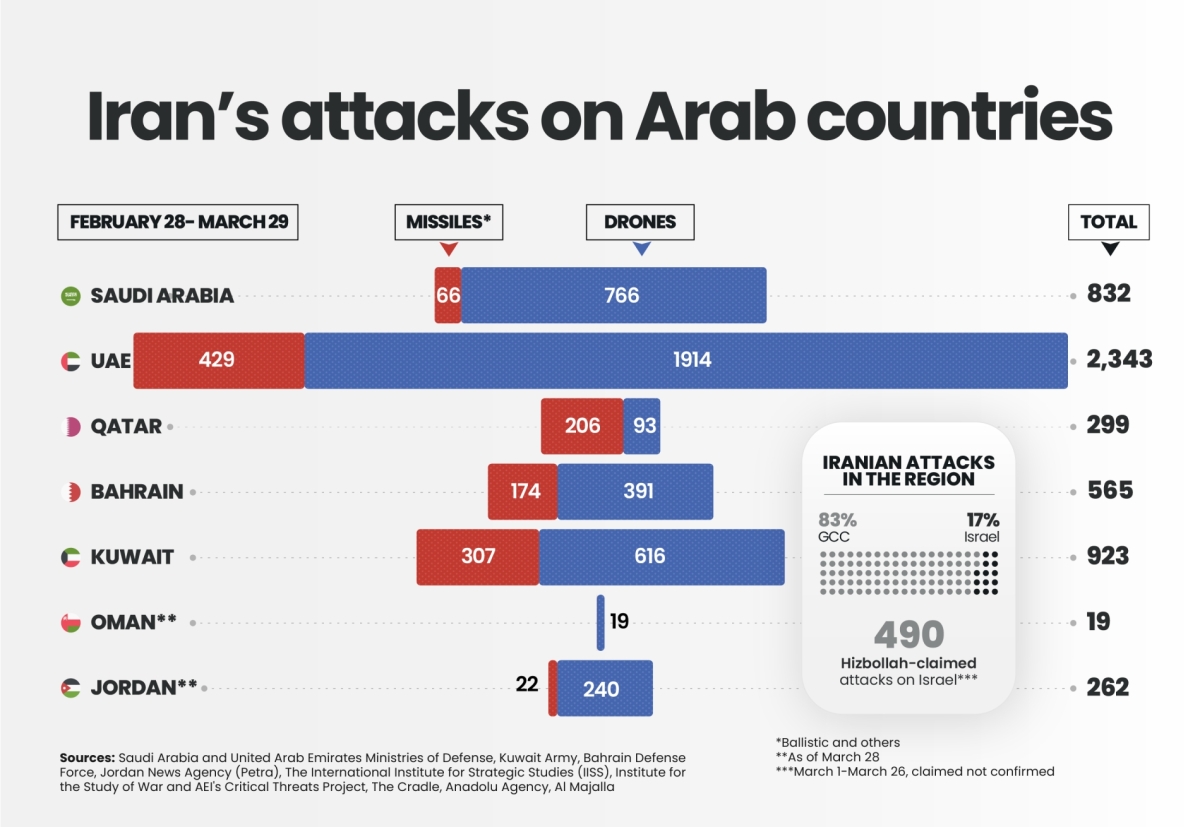

Since 28 February 2026, Iran has carried out a large-scale missile and drone campaign that has disproportionately targeted Gulf states rather than Israel. Reports by the Institute for the Study of War and the International Institute for Strategic Studies indicate that roughly 80–83% of launches were directed at GCC countries, compared to 17–20% against Israel.
In total, approximately 5,200 projectiles were launched in the first month of war, with the United Arab Emirates the most heavily targeted, followed by Kuwait, Saudi Arabia, Bahrain, and Qatar, while Oman saw limited spillover.
Targeting patterns show a dual-track strategy. While military and strategic sites, including bases hosting US forces in the Gulf countries, were struck, a large proportion, likely over half, hit civilian or mixed-use infrastructure, including airports, residential areas, and critical energy facilities. Strikes on LNG plants, refineries, and petrochemical sites, such as Qatar’s Ras Laffan, highlight a widening campaign against economic infrastructure.
More recently, Iranian strikes have expanded to what media describe as industrial and manufacturing targets, including major aluminium producers in the Gulf. Facilities such as Emirates Global Aluminium in the UAE and Aluminium Bahrain (Alba) were hit. Iran says the attacks are retaliation for US-Israeli strikes on its industrial infrastructure, including steel plants.
Notably, Azerbaijan has seen limited or no direct attacks, despite being a major oil supplier to Israel. As of early 2026, Azerbaijani oil accounts for around 46% of Israel's total crude oil imports.