
Since late February, the Strait of Hormuz—the artery for nearly 20% of global oil and gas flows—has been effectively shut, following Iranian retaliation to US and Israeli strikes and direct threats against commercial shipping.
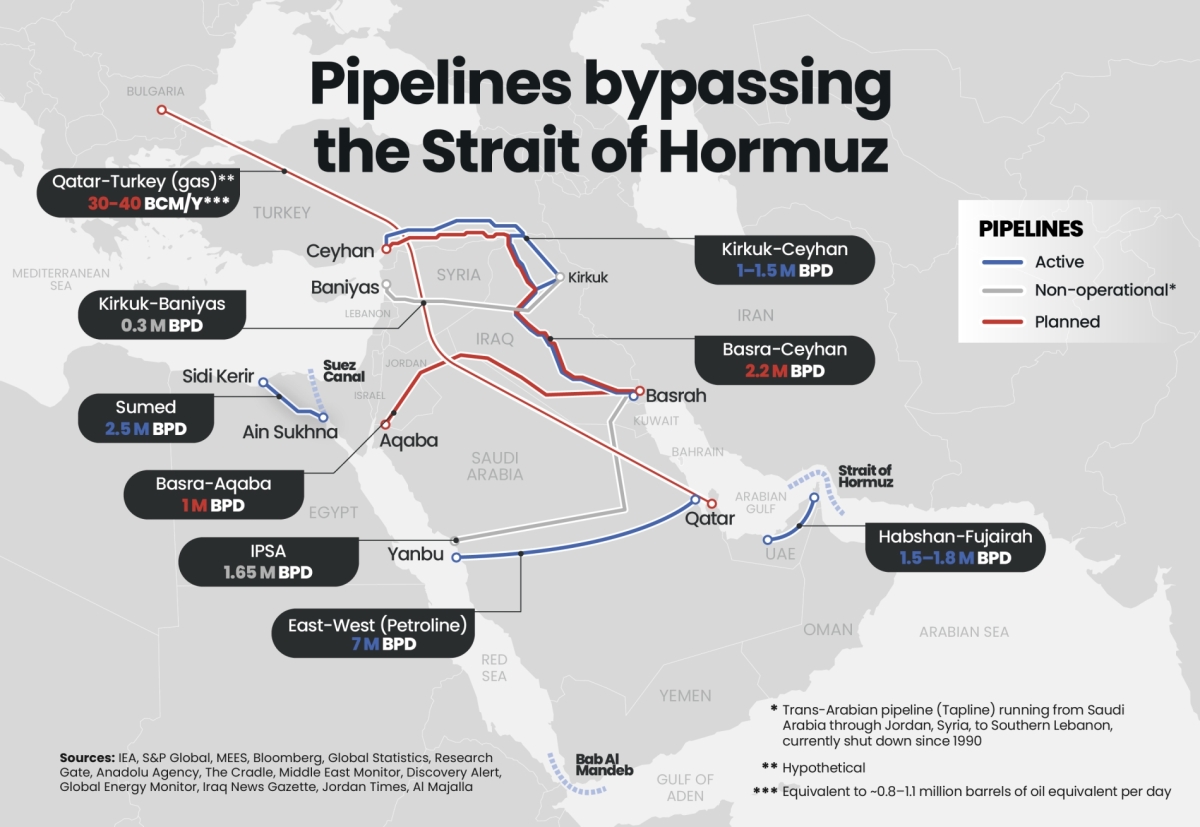
In response, proposals to bypass the Strait of Hormuz have resurfaced, with renewed focus on operating or reviving oil and gas pipelines. For his part, Israeli Prime Minister Benjamin Netanyahu called for reconsidering a project to route Gulf oil and gas exports to the port of Haifa. Yet Gulf producers remain cautious, held back by geopolitical constraints, infrastructure gaps, and market realities.
As a partial measure to relieve pressure, Saudi Arabia and the UAE have activated the East–West and Habshan–Fujairah pipelines, opening alternative routes away from the chokepoint. Still, the crisis underscores a hard limit: even if all alternative pipelines ran at full capacity, they would cover only two-thirds of the flows lost through the Strait of Hormuz.
Pipelines offer partial insulation from maritime chokepoints, granting states greater control over exports and reducing exposure to naval conflict. But they replace one set of risks with another—fixed routes vulnerable to sabotage, political instability, and limited scalability. Unlike tankers, they cannot be rerouted as crises evolve.
Economic logic further complicates diversification. While pipelines can lower long-term transport costs, most bypass routes redirect crude toward the Mediterranean or Red Sea, making them less competitive for Asian markets, where the bulk of Gulf exports is destined. Hormuz, despite its fragility, remains the shortest and most efficient eastbound corridor.