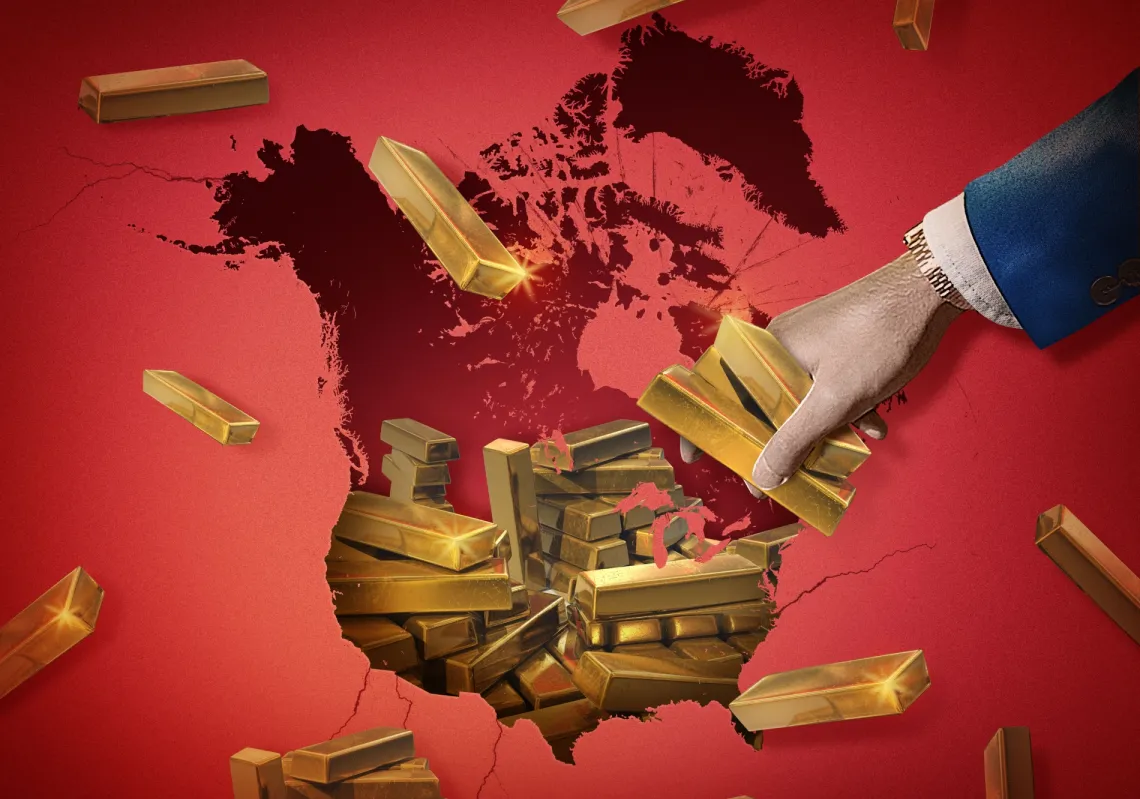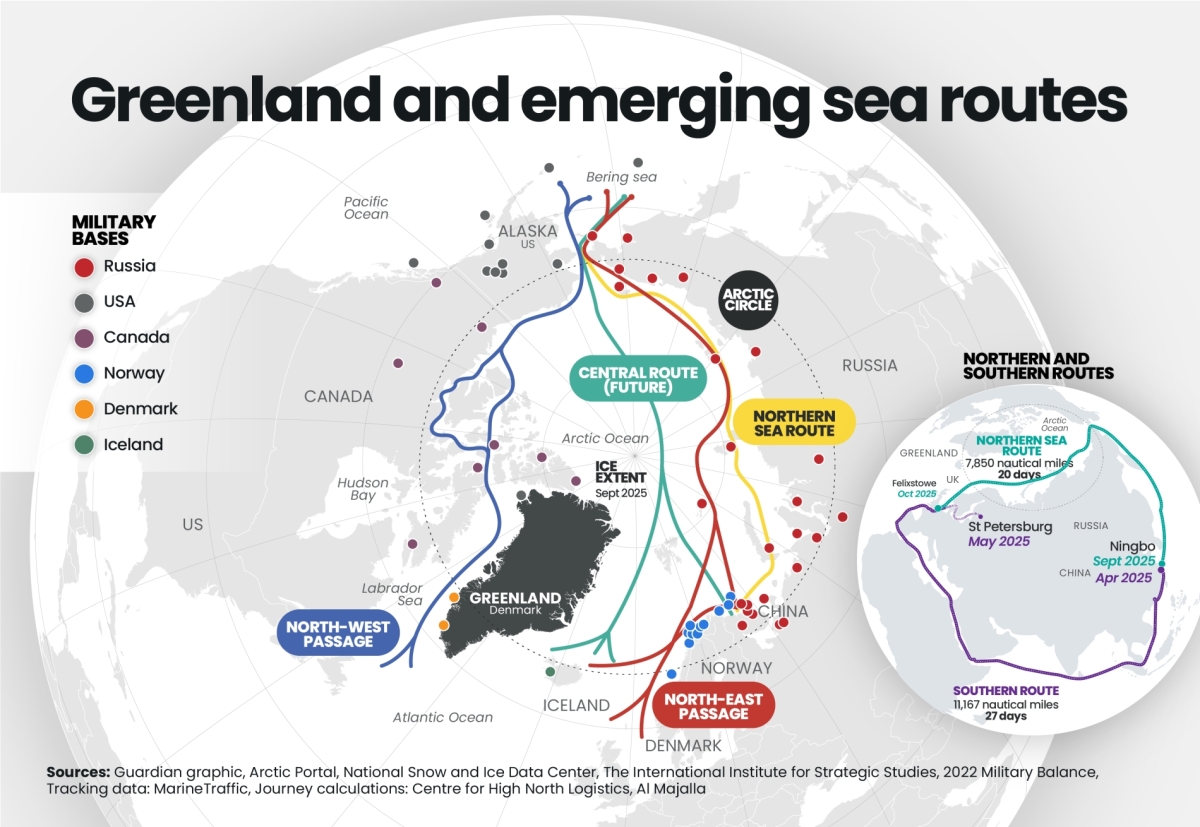

Greenland, an ice-capped country located between the United States and Russia, is rapidly emerging as a geopolitical frontline as the Arctic slowly melts amid global warming. Its growing strategic importance was highlighted when US President Donald Trump openly floated the idea of the United States acquiring the island from Denmark, a NATO ally, either through purchase or by force or as he put it, "the easy way or the hard way".
Melting ice in the Arctic exposes valuable resources that were previously inaccessible. Additionally, it opens up shipping routes that were previously only chartable via icebreakers, potentially creating new commercial corridors.
The most developed of these is the northern sea route, overlapping the north-east passage and running along Russia’s Arctic coast from Europe to Asia, a key pillar of Moscow’s strategic ambitions. Further west, the north-west passage cuts through Canada’s Arctic archipelago, while a central Arctic route across the north pole is also being considered in long-term planning.
This is reshaping global trade by offering potential alternatives to the Suez Canal and cutting travel time between Western Europe and East Asia by nearly half. In 2025, the container ship Istanbul Bridge became the first liner vessel to sail from China to Europe via the Northern Sea Route, travelling from Ningbo, China, to Felixstowe, United Kingdom, in about 20 days. However, operational risks remain, limiting full commercial viability.
Against this backdrop, the Arctic region is also seeing a growing military build-up. The US has military bases in Greenland, while Russia is restoring the Soviet-era infrastructure in the Arctic and expanding its military bases there. For its part, China asserted in 2018 that it was a “near-Arctic state” and deployed three icebreaking vessels to the region in 2024.