
The global conflict landscape in 2025 is more volatile—and more discreet—than at any point in recent decades. Much of today’s geopolitical confrontation is unfolding quietly, below the threshold of open warfare. Military signalling, economic coercion and strategic positioning are increasingly intertwined, producing a fragmented and unpredictable international environment.
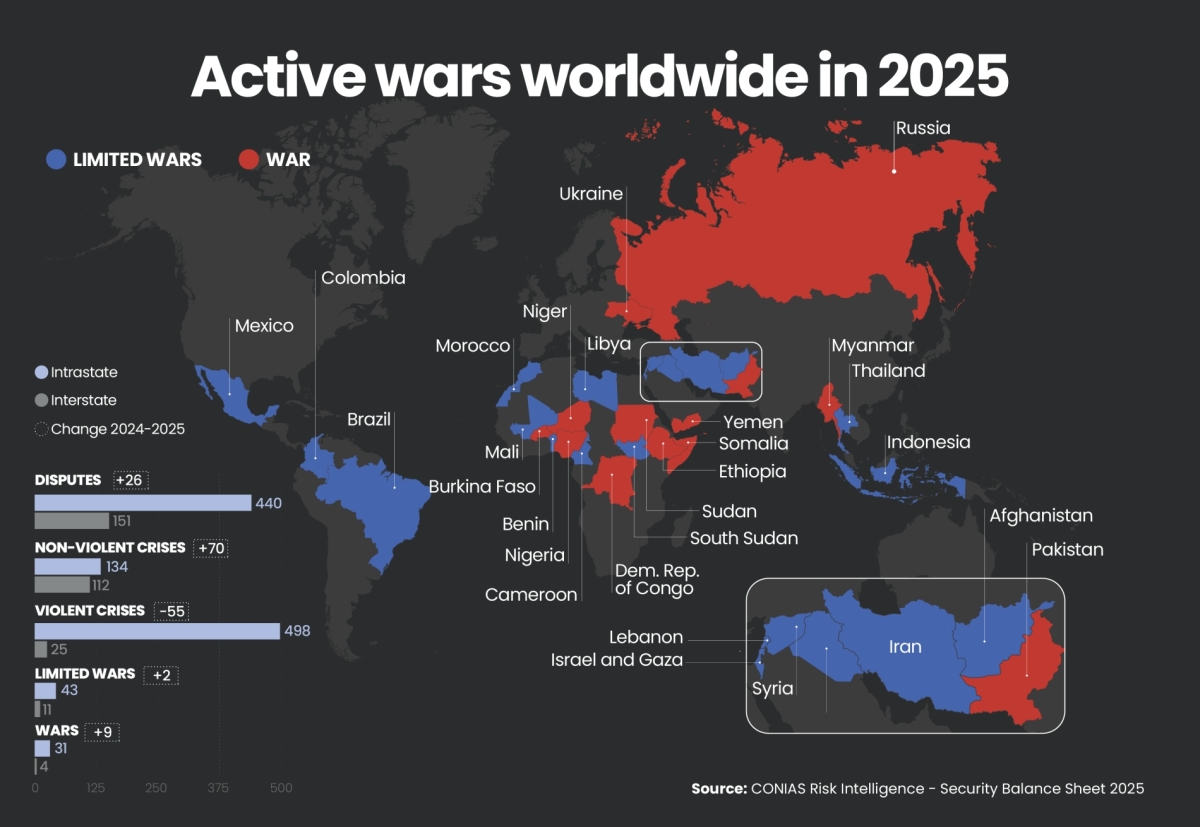
In a report by CONIAS Risk Intelligence in the last quarter of 2025, researchers documented 1,450 ongoing political conflicts worldwide, the highest number on record. Of these, 89 qualify as wars across 31 countries. Yet armed conflict represents only the most visible layer of global instability. Sanctions, tariffs, export controls, investment restrictions, and diplomatic pressure have surged, becoming preferred instruments of influence with real consequences for markets, supply chains, and security alliances.
This year’s conflicts are marked less by new wars than by the escalation of long-running ones—and by a sharp rise in non-violent crises. Seventy new political conflicts emerged in 2025, while only 18 ended, underscoring the system’s growing inertia. Trade regimes, financial flows, market access and military basing rights are now weaponised instruments of state power, while geo-economic rivalry is reshaping global security.
As the year comes to an end, global diplomacy is intensifying on multiple fronts: Ukraine has held productive talks with US and European partners to end nearly four years of war with Russia, while international mediators push to preserve the tenuous Gaza ceasefire and transition to a broader peace plan amid ongoing violations and humanitarian strain.