New drilling or net-zero? Starmer’s North Sea dilemmahttps://en.majalla.com/node/331388/business-economy/new-drilling-or-net-zero-starmer%E2%80%99s-north-sea-dilemma
New drilling or net-zero? Starmer’s North Sea dilemma
The British government must decide whether to break its manifesto promise and approve new oil and gas drilling licences or stick to its decarbonising pledge. It may need to fudge it.
DANIEL LEAL / AFP
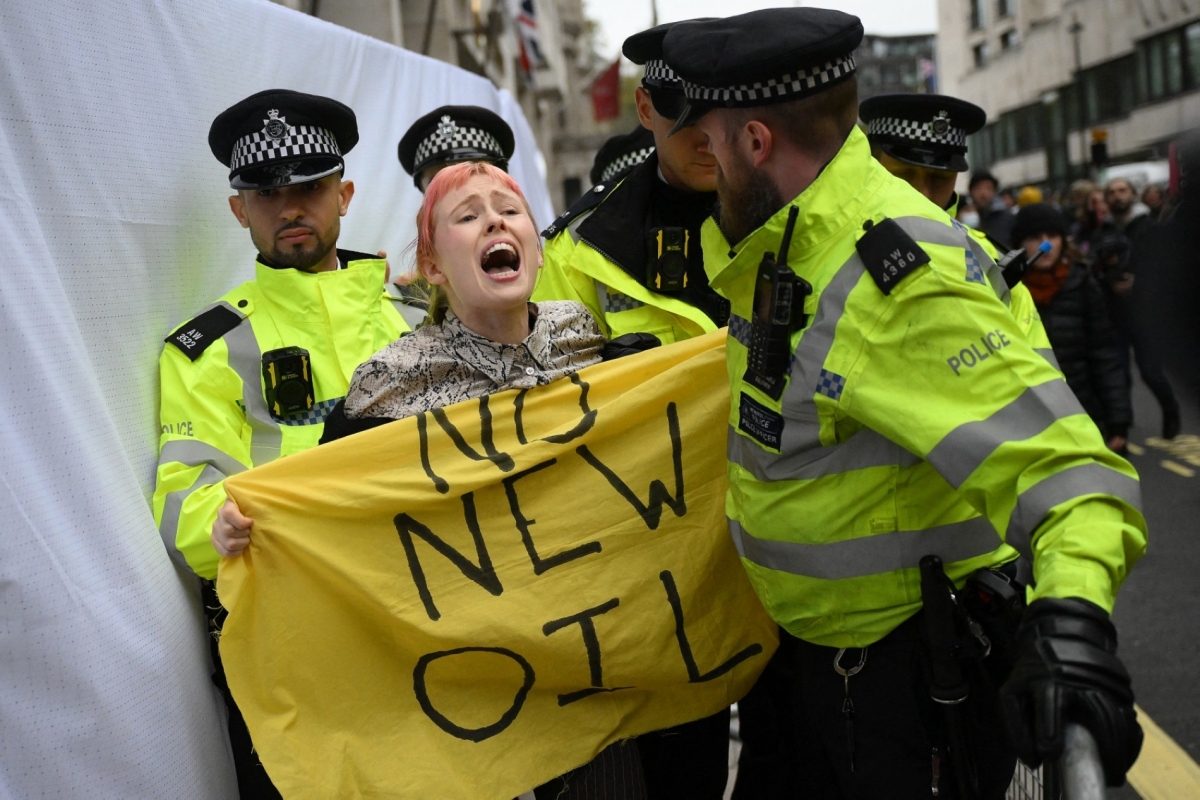
Police officers remove a climate activist protesting against the Rosebank oil field project in the North Sea off the coast of Scotland in central London on 18 October 2023.
New drilling or net-zero? Starmer’s North Sea dilemma
As pressure builds on British Prime Minister Sir Keir Starmer to reconsider restrictions on North Sea oil and gas production, the country faces a dilemma that extends beyond domestic politics. The debate is not simply about drilling licences or climate targets; it concerns energy security, economic competitiveness, political legitimacy, and Britain’s position in a more volatile international energy environment.
The issue has regained prominence following former Labour prime minister Sir Tony Blair’s intervention urging his party to reconsider elements of its net-zero approach to environmental sustainability. Blair wants Labour to place greater emphasis on affordable energy over what he described as unrealistic approaches to decarbonisation.
Blair’s comments have exposed divisions within the Parliamentary Labour Party and reopened questions many assumed had been settled. A few days later, Labour leadership hopeful Wes Streeting came down in favour of new drilling in the North Sea when commenting on the pending licence application for the giant oil and gas fields Rosebank and Jackdaw, which were given exploration licences by the former Conservative government. Streeting cited higher tax receipts as an argument.
Can Britain accelerate the energy transition while maintaining affordable energy prices, economic growth, and public support? At the centre of the debate sits a broader challenge across Europe. The energy crisis that followed Russia’s invasion of Ukraine showed that energy security cannot be separated from national security. It also exposed the vulnerability of countries dependent on imported energy.
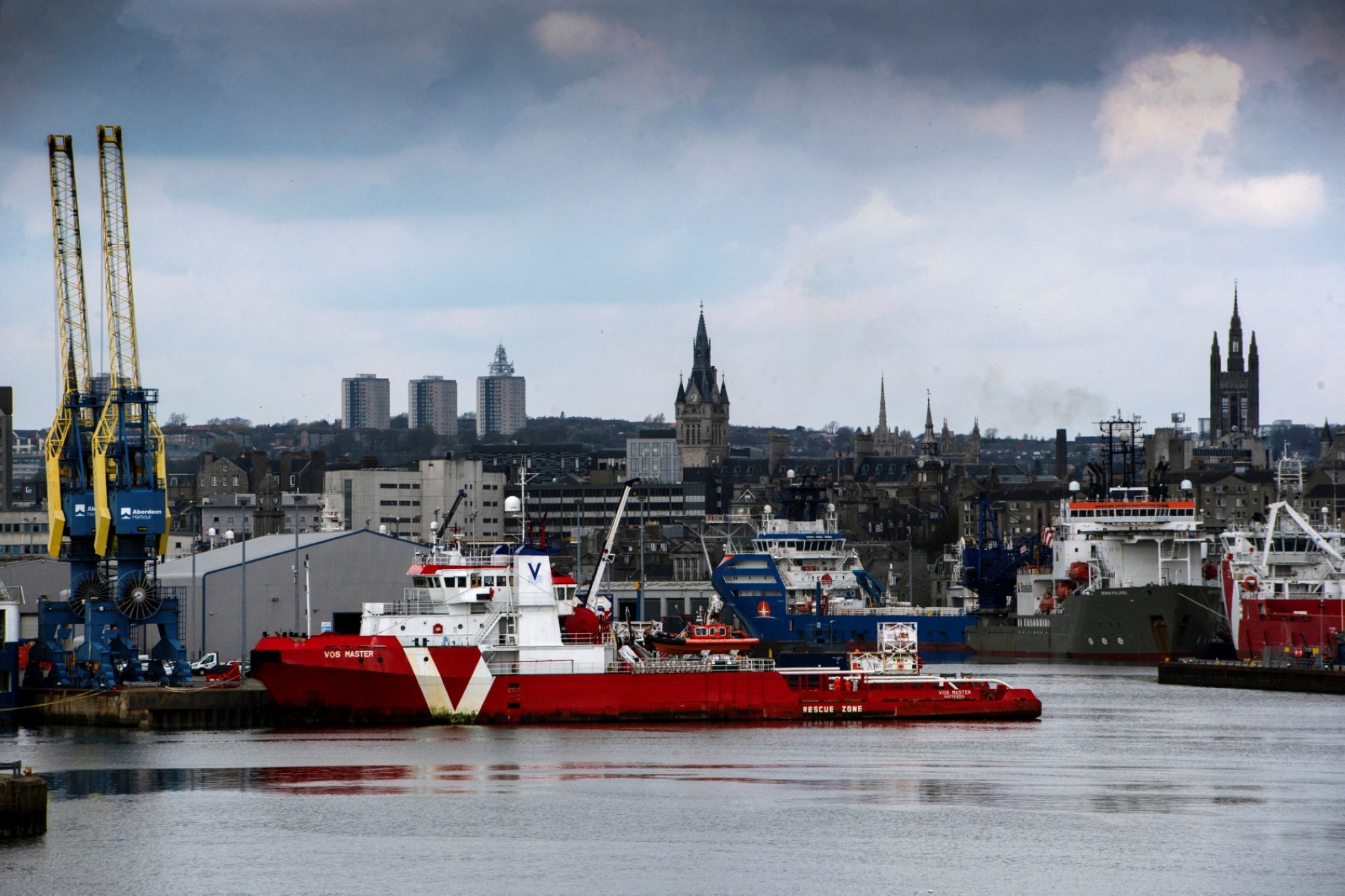
Supply vessels used in the oil, gas and renewable energy industry are docked at the Aberdeen Harbour, in the North East of Scotland, on 29 April 2022.
The case for expansion
For Britain, which once benefited from a high degree of energy self-sufficiency through North Sea production, the question is whether reducing domestic oil and gas extraction before alternative systems are fully in place creates new economic and strategic risks. Those arguing for an expansion of North Sea production think that domestic oil and gas will remain integral to Britain’s energy system for decades.
Their case rests on three pillars: energy security, economic competitiveness, and employment and industrial capacity. First, domestic production reduces reliance on imports from Norway, Qatar, the United States, and global liquefied natural gas (LNG) markets. It cannot insulate Britain from global price movements, but more domestic supply may improve resilience during periods of geopolitical tension.
The basin is now highly mature, with an estimated 90% of recoverable resources already produced or in development
Britain remains a net importer of oil and gas. Expanding domestic production could therefore improve the balance of payments, support sterling, and reduce exposure to volatile markets. A stronger pound lowers the cost of imported goods, including food, industrial inputs, and renewable energy technologies.
Employment and industrial capacity are the third argument. The North Sea sector supports hundreds of thousands of jobs across Scotland and north-east England. Industry representatives warn that a rapid decline in production could weaken skills and infrastructure that may later support carbon capture, offshore wind, and hydrogen development.
These arguments have gained traction as concern over living costs persists. YouGov polling shows that 65% of Britons prioritise preventing increases in energy bills, compared with 24% who prioritise removing all fossil fuels from electricity supply. Even among Labour voters, affordability ranks ahead of decarbonising the economy. Support for net-zero remains, but energy costs are the more immediate concern.
A climate activist with a "Wanted" poster of Shell chief executive officer Wael Sawan takes part in a protest against the Rosebank oil field project in the North Sea off the coast of Scotland in central London on 18 October 2023.
Scraping the barrel
There is a problem, however. Current UK North Sea production is already in structural decline. Output averaged just over one million barrels of oil equivalent per day (boepd) in 2024, down from a peak of roughly 4.5 million boepd per day in 1999, as mature fields have declined over time. It is projected to fall towards roughly 600,000 boepd by 2030 under existing trends.
The basin is now highly mature, with an estimated 90% of recoverable resources already produced or in development, which constrains the scope for any rapid increase in output. As such, increased production would not mean a return to historic levels but a slower rate of decline. Maintaining or modestly raising output would depend on capital-intensive activity, such as infill drilling, enhanced recovery, and tying smaller discoveries back to existing infrastructure.
Recent upstream investment has been in the range of £5-6bn annually and sustaining or modestly raising output would require continued spending at this level alongside targeted new development. Even under more supportive policy scenarios, the effect would be to slow decline and extend the basin's lifespan rather than deliver a sustained rise in daily production. Therefore, critics of expanding North Sea drilling argue that expected economic gains are overstated.
Oil and gas produced in the North Sea are sold into international markets, so higher production does not necessarily mean lower domestic prices. Britain experienced this in the 2022-23 energy crisis, when domestic output continued while household bills rose in line with global prices.
Many analysts argue that long-term energy security rests on reducing reliance on fossil fuels. Renewable energy, once installed, is not exposed to geopolitical supply shocks or commodity price volatility. From this perspective, accelerating investment in renewables, grid infrastructure, storage and nuclear power offers a more durable solution. There is also the question of investor confidence.
Labour entered government promising policy stability around the energy transition. A move towards expanded fossil fuel production could introduce uncertainty for investors committing resources to renewable and clean technology projects. The government therefore faces a delicate balance. Moving too quickly away from fossil fuels risks undermining energy security and public support. Moving too slowly risks weakening climate commitments and future investment.
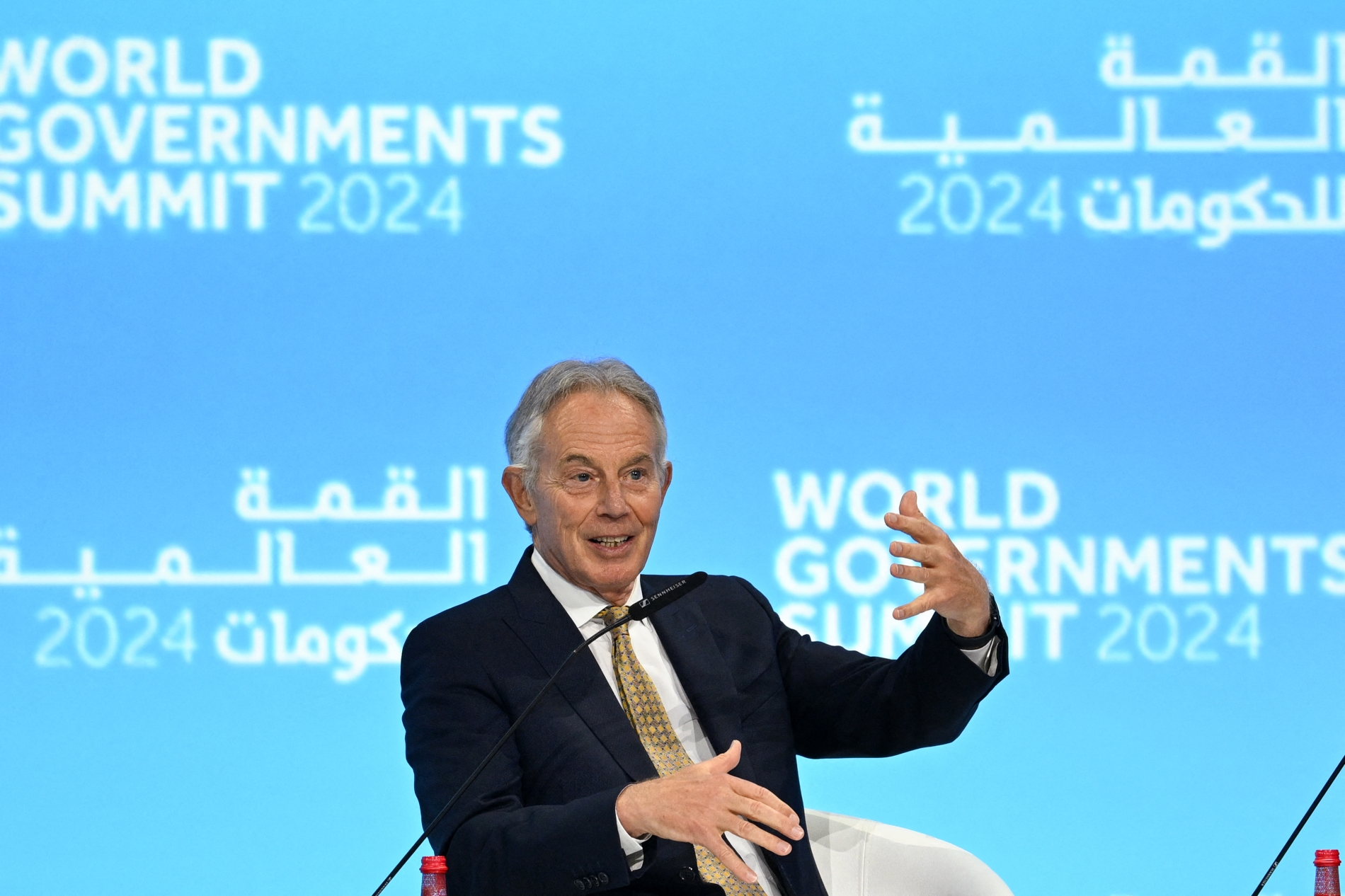
Britain's former prime minister Tony Blair speaks at a panel session during the World Government Summit in Dubai on 13 February 2024.
Energy sovereignty
Sir Tony Blair's intervention points to a broader political trend across Western democracies: energy policy is increasingly framed in terms of national resilience and economic sovereignty, rather than climate change alone. A similar framing is visible in the US, where President Donald Trump has argued that Britain should increase North Sea production and pursue greater energy self-reliance.
The argument resonates with those who view domestic energy production as a strategic asset amid geopolitical uncertainty. The logic is simple: countries that produce more of their own energy retain greater freedom of action than those dependent on imports. This view has gained relevance following Russia's use of energy exports as a political tool, tensions in the Middle East, and global competition over minerals needed for the energy transition.
For Britain, energy sovereignty no longer means a return to the conditions of the 1980s. Even with expanded drilling, full self-sufficiency is unlikely. The more practical question is whether domestic oil and gas should serve as a bridge to a lower-carbon system. The debate over North Sea drilling reflects a wider challenge facing advanced economies.
Starmer's task is not simply to decide on additional drilling licences; it is to define an energy approach that delivers affordability, security, and decarbonisation
The transition to net-zero has become a political and economic question. Governments must show that climate policy can improve living standards, rather than constrain them. Starmer's task is not simply to decide on additional drilling licences; it is to define an energy approach that delivers affordability, security, and decarbonisation. A rigid choice between fossil fuels and renewables is unlikely to meet these aims.
A more credible approach accepts that hydrocarbons will remain part of the energy mix for a period, alongside accelerated investment in replacement technologies. The risk for Labour is that voters see a widening gap between long-term goals and near-term pressures. The risk for Britain is that political division over energy policy weakens both.
What is needed is not a retreat from net-zero or a return to fossil fuel dependence, but a pragmatic approach that recognises energy security as part of the transition. In a more uncertain geopolitical environment, affordability and sustainability are closely linked. Whether Starmer can sustain that balance may become one of the defining tests of his premiership.